The Portfolio Economy Is Taking Shape
From venture portfolios to portfolio careers, the way we build businesses, organize talent, and create professional opportunity is changing.

For decades, the prevailing advice to ambitious founders and professionals has been remarkably consistent: pick a lane, commit to it, and become exceptionally good at one thing.
For entrepreneurs, that meant building one company. For executives, it meant advancing through a series of increasingly senior positions. For organizations, it meant assembling the right people into a relatively permanent structure and developing their capabilities over time.
That model still has considerable merit. But the economics of building businesses, the nature of professional opportunity, and the way organizations access expertise are all changing.
2 conversations capture what's happening.
One concerns the possibility of founders building portfolios of ventures, an idea gaining new relevance as AI reduces the cost of experimentation and company creation. The other concerns the rise of portfolio careers, as professionals assemble combinations of operating roles, advisory positions, board appointments, and entrepreneurial interests.
These developments point toward something larger than a change in employment preferences.
We may be moving toward an economy in which opportunity is increasingly organized around portfolios of ventures, capabilities, and relationships.
From one company to a portfolio of possibilities
Sam Altman has long been associated with the conventional Silicon Valley advice to founders: focus intensely, avoid distractions, and build something exceptional.
His published Startup Playbook makes that position clear. Concentration, prioritization, and the discipline to say no are central to building a successful company.
Now he says that advice no longer applies. “The canonical advice that was correct two years ago was, ‘Pick one, and put all your effort into it, because you can’t build all 30 things,’” he said recently. “You can now build all 30 things. And you can get people to use them all. And you can work more on the ones that work.”
“So I think this mindset of lots of ideas, quick feedback, and being open to a lot of things not working is great for this new era for how people build,” he added.
What happens when an individual can investigate a market, develop a prototype, test positioning, create a website, and begin customer discovery with a fraction of the resources previously required?
The economics of experimentation change.
Historically, pursuing several venture ideas simultaneously was often impractical. Each required substantial time, specialized resources, and financial investment before a founder could establish whether the underlying opportunity justified further commitment.
Today, some of that early work can happen considerably faster. A founder can explore several hypotheses, establish early evidence, and make a more informed decision about where to concentrate resources.
This creates the possibility of approaching venture creation more like portfolio management.
Different ideas can be explored, compared, advanced, or discontinued based on emerging evidence. Some may develop into independent businesses. Others may become products, intellectual property, licensing opportunities, or strategic partnerships.
The central capability becomes the ability to identify promising opportunities and allocate attention and resources intelligently.
Focus remains essential, particularly when a venture begins to demonstrate traction. What changes is how founders arrive at that decision and how much they can learn before making a substantial commitment.
The career ladder is giving way to something more flexible
A similar shift is taking place in professional careers.
LinkedIn's 2026 research provides several useful signals. Its Grad's Guide reported a 69% year-over-year increase in US members adding “founder” to their profiles. Meanwhile, its Future of Talent research describes organizations moving beyond traditional recruitment toward talent orchestration, coordinating people, skills, and AI around business outcomes.
The evidence points to a workforce reconsidering how opportunities are created and how expertise is deployed.
LinkedIn’s leadership is now describing the trend directly. In his Talent Connect 2026 keynote, CEO Dan Shapero discussed the rise of the “portfolio career”: building a career across several pursuits instead of holding one traditional job.
For experienced executives, this is increasingly visible in the growth of portfolio careers.
A senior leader might combine fractional executive work with board service, advisory engagements, investing, teaching, or an independent venture. Some deliberately build a portfolio over several years. Others begin by accepting an advisory appointment or developing a commercial interest alongside an existing position.
For people with substantial experience, the appeal extends beyond flexibility.
A portfolio creates opportunities to apply expertise across different operating environments, remain intellectually engaged with emerging markets, and develop multiple sources of professional and financial value.
It can also create a different relationship with risk. Rather than depending entirely on one employer, an individual can develop several opportunities and adjust their commitments as circumstances change.
Of course, the economics need to work. Portfolio careers require business development, relationship management, financial planning, and the discipline to manage competing obligations. Board positions introduce fiduciary duties, independence requirements, and potential conflicts of interest.
The ability to work across several organizations should never be confused with the capacity to do everything simultaneously.
The people who succeed in this model will need to become particularly good at selecting where their involvement creates meaningful value.
Organizations are rethinking the boundaries of talent
Perhaps the more consequential change is happening on the demand side.
Many organizations still approach workforce planning primarily through positions. A business identifies a need, defines a role, establishes a budget, and recruits someone to occupy it.
But an increasing number of strategic problems don't fit neatly into permanent job descriptions.
A company preparing to enter a new market may need category strategy, commercial validation, regulatory expertise, and specialist technical capabilities. A board confronting emerging technology risks may need governance experience and a deeper understanding of AI systems. A growing business may require CMO-level judgment before it has the scale to justify a full-time executive.
These are capability requirements, and they frequently change as the organization develops.
LinkedIn's Future of Talent Report describes this shift as talent orchestration: coordinating the right combination of people, skills, processes, and technology to achieve outcomes.
It's an important distinction because it changes the fundamental planning question.
Instead of asking which position needs to be filled, an organization can begin by identifying the capability required, the work to be accomplished, and the most effective way to assemble the necessary expertise.
That might involve employees, independent specialists, fractional leaders, advisors, board members, strategic partners, and AI-enabled capabilities.
The implications extend into organizational design, operating costs, knowledge transfer, and decision-making.
The constellation model
We think of this emerging approach as the constellation model.
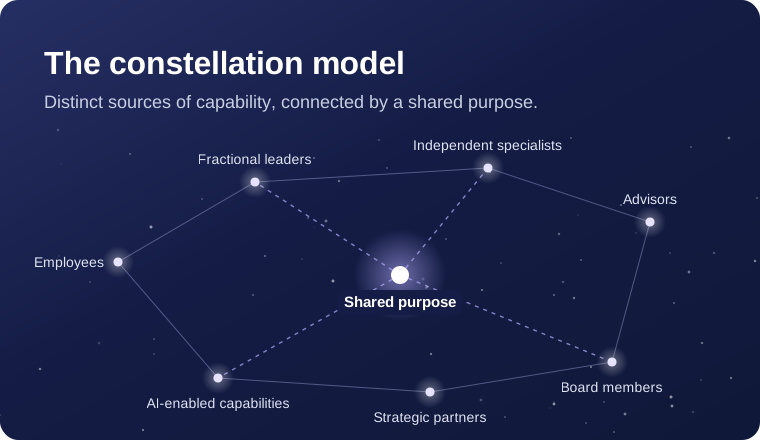
A constellation brings together distinct sources of capability around a shared purpose. Individual contributors retain their expertise, relationships, and professional identities while participating in combinations suited to particular opportunities.
For a founder, the constellation may include technical specialists, commercial advisors, operators, and potential partners who can help validate and advance an opportunity.
For an experienced executive, it may consist of several organizations that benefit from their expertise in different capacities, supported by a broader professional network.
For an organization, it may be a deliberately designed combination of internal talent and external capability, brought together around strategic objectives.
The advantage is adaptability.
A constellation can expand, contract, or change configuration as needs evolve. Specialized expertise can be applied where it matters most, and different combinations of people can address different problems.
But flexibility introduces new management responsibilities.
Organizations need clarity around accountability, decision rights, information access, intellectual property, incentives, and how knowledge is retained. Individuals need to manage availability, independence, confidentiality, and commitments.
The model works when the relationships are intentional and the operating structure is clear.
What this means for strategy
There is a common thread connecting venture portfolios, portfolio careers, and organizational constellations.
Each requires a more sophisticated approach to making choices under uncertainty.
Founders must decide which opportunities justify further investment. Professionals must determine which engagements advance their economic and strategic interests. Organizations must identify which capabilities matter, how to access them, and when to change the mix.
The underlying strategic questions are remarkably similar.
Where is the opportunity? What evidence supports it? Which capabilities are necessary? How should resources be allocated? What would cause us to change direction?
AI may lower the cost of exploring possible answers, but it also increases the number of possibilities competing for attention.
And that makes judgment, prioritization, and the ability to coordinate resources more valuable.
Where Eudai fits
Eudai was built around the idea that identifying an opportunity and developing the capability to pursue it are closely connected strategic disciplines.
Our OPSI approach, Opportunity, Proof, Strategy, Implement, provides a structure for moving from an emerging possibility to an executable business decision.
That applies across 3 increasingly connected audiences.
For founders and venture builders, we help evaluate opportunities, establish evidence of demand, develop positioning and commercial strategy, and determine what capabilities are needed to bring an idea to market. That work can support a new venture, an emerging product, or a portfolio of potential businesses competing for investment and attention.
For individuals building portfolio careers, we help translate experience into a coherent market proposition. That includes identifying where expertise has differentiated value, evaluating fractional and advisory opportunities, and developing the positioning, relationships, and commercial foundations to pursue them. For those considering board service, the same strategic discipline can help clarify the contributions they are equipped to make and the opportunities aligned with their experience.
For organizations, we help define the capabilities required to pursue strategic opportunities and explore more flexible ways of accessing them. The constellation model provides a framework for combining leadership, specialist expertise, partners, and emerging technologies around meaningful business outcomes.
Across all 3, the challenge is to turn a range of possible opportunities into a deliberate strategy.
The next advantage may be knowing what to assemble
The traditional structures of work and entrepreneurship developed around a particular set of constraints. Talent was expensive to find and difficult to coordinate. Building a business required considerable upfront resources. Careers were closely associated with employers, titles, and organizational hierarchies.
Some of those constraints are changing, and the structures built around them are beginning to evolve.
We should expect more experimentation with how companies are created, how expertise is deployed, and how professional value is built over time.
There will still be businesses that demand a founder's undivided attention, careers best served by deep commitment to one institution, and capabilities that organizations should develop and retain internally.
The important change is the widening range of viable choices.
For founders, executives, and organizations alike, advantage may increasingly depend on the ability to recognize opportunities, assemble the right constellation of capabilities, and know where to concentrate effort.
The portfolio economy rewards people who can make those choices well.