Whose Change Window Is It?
A routine router replacement grounded flights across the United States. Third-party extensions exposed remote-access customers. And Microsoft’s largest Patch Tuesday yet tested the limits of vulnerability management. 5 developments from a week when the systems we depend on showed how difficult change can be to control.

November 9–15, 2026 | Eudai Weekly Perspectives
There is a particular kind of risk that comes from improving something.
An infrastructure upgrade, a software integration, a security patch. Each is intended to make a system more capable, reliable, or secure. Yet the consequences can extend far beyond the people and processes responsible for making the change.
This week offered several reminders of how those dependencies play out in practice.
The FAA grounded flights nationwide after telecommunications work at a remote facility in Arkansas. ConnectWise investigated unauthorized access involving third-party ScreenConnect extensions. Microsoft released an extraordinary volume of security fixes, forcing organizations to make decisions about what to address first.
Elsewhere, law enforcement dismantled major malware infrastructure, while 2 large organizations confronted the difficult operational consequences of cyberattacks.
The common thread is the relationship between technical decisions and business outcomes, particularly when control is distributed across systems, suppliers, and organizations.
Here are 5 developments worth examining.
1. A router replacement brought U.S. aviation to a standstill
On November 13, the Federal Aviation Administration ordered a nationwide ground stop after telecommunications problems disrupted air traffic control systems.
The disruption lasted more than 4 hours, affecting flights across the country.
Officials linked the incident to work involving a router at an FAA facility in El Dorado, Arkansas, as part of a broader effort to modernize telecommunications infrastructure.
The incident was not attributed to a cyberattack.
Why it matters
A localized infrastructure change had national consequences.
Large modernization programs are often managed through individual projects, contractors, maintenance schedules, and technical approvals. The business consequences of those changes can extend far beyond their immediate scope.
This raises important questions about how organizations evaluate change.
Who understands the dependencies between the component being modified and the services it supports? Who can authorize work with system-wide implications? What evidence establishes that an upgrade can be reversed if it behaves unexpectedly?
The ability to approve a technical change is only one part of managing it. Organizations also need to understand its consequences across the operating environment.
For technology providers, that makes deployment practices, rollback capabilities, and evidence of testing increasingly important parts of the commercial proposition.
2. The vulnerability was in the extension
On November 11, ConnectWise disclosed an investigation into unauthorized access to ScreenConnect partner accounts.
Its initial assessment pointed toward possible abuse of independently developed third-party extensions. The company subsequently identified approximately 400 partner environments containing affected extension families and took precautionary action to disable them where possible.
Why it matters
The security of a platform increasingly depends on the ecosystem surrounding it.
Extensions and integrations are valuable precisely because they allow customers to adapt technology to their needs. They extend functionality, connect workflows, and reduce the need for custom development.
They also expand the number of parties capable of influencing what happens inside a customer’s environment.
For organizations using integrated platforms, the relevant questions extend beyond the security of the core product.
Which extensions are installed? Who maintains them? What permissions do they hold? How quickly can their access be withdrawn?
For platform companies, ecosystem governance is becoming part of product quality.
The commercial benefits of extensibility depend on customers being able to trust the capabilities and permissions that come with it.
3. More than 1,000 vulnerabilities, one decision about what comes first
Microsoft’s November Patch Tuesday addressed more than 1,000 vulnerabilities, including critical flaws and an actively exploited Outlook zero-day.
The release was unusually large, creating a substantial assessment and remediation burden for security and technology teams.
Why it matters
At this scale, vulnerability management becomes an exercise in resource allocation.
Not every affected system has the same importance. Not every vulnerability presents the same exposure. And deploying a fix may require downtime, testing, or changes to critical applications.
The challenge is determining where remediation will reduce the most consequential exposure without creating unacceptable disruption elsewhere.
That requires an understanding of the business processes supported by each system.
It also requires clear decisions about what can be delayed, what must be addressed immediately, and who is accountable for the trade-offs.
For security technology providers, this creates an opportunity to connect technical findings with operational dependencies and commercial consequences.
The value is increasingly in helping organizations decide what matters, rather than simply generating more findings.
4. Europol dismantled infrastructure supporting 3 malware families
On November 12, Europol announced another phase of Operation Endgame, targeting the infrastructure behind Gootloader, CastleRAT, and StealC.
The coordinated operation seized 235 servers and 257 domains, disrupting infrastructure used in malware distribution and cybercrime.
Authorities also secured approximately 6.4 million victim datasets.
Why it matters
The scale of the operation demonstrates what coordinated action across governments, law enforcement, and private industry can accomplish.
Cybercrime increasingly relies on interconnected services, infrastructure, and commercial arrangements. Disrupting those networks requires cooperation beyond individual organizations.
But infrastructure takedowns do not automatically eliminate the consequences of earlier compromises.
Credentials may already have been stolen. Systems may remain infected. Criminal groups can attempt to rebuild their operations.
There is a broader lesson here about the difference between disrupting an activity and resolving the conditions that allowed it to succeed.
For businesses, the value of threat intelligence comes from turning information about adversary infrastructure and compromised assets into timely action.
For the security industry, effective collaboration can create value that extends well beyond individual products.
5. 2 organizations confronted the operational cost of a cyberattack
On November 9, Vanderbilt University restricted access to systems as it responded to a cyberattack, affecting normal university operations.
The same day, Japanese retailer Nitori Holdings disclosed unauthorized access to its systems and warned that up to 37.62 million personal-information records may have been exposed.
Why it matters
These incidents demonstrate 2 different dimensions of cyber risk.
One concerns the continuity of operations. The other concerns the potential exposure of information held by an organization.
Both create business decisions that extend beyond the security function.
Restricting access to systems may help contain an attack while interrupting services that people depend on. Investigating a suspected data breach requires decisions about evidence, communications, legal obligations, and customer trust.
The difficult decisions frequently arise while important facts remain uncertain.
Leaders need to understand which services can be suspended, which must continue, and what alternatives are available.
The quality of those decisions depends partly on the organization’s preparation, particularly whether the relevant trade-offs have been considered before a live incident.
The bigger picture: Change has an owner. Its consequences often don’t.
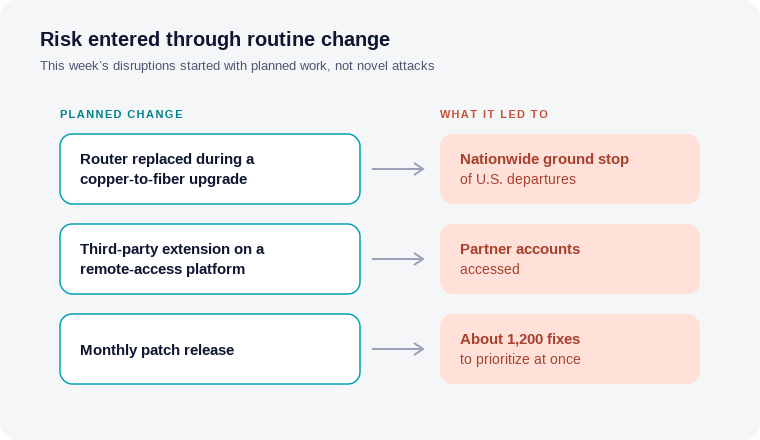
The FAA incident began with planned infrastructure work. The ConnectWise investigation involved components operating within a wider platform ecosystem. Microsoft’s enormous patch release required thousands of individual technical exposures to be considered against operational priorities.
These are different situations, but they reveal a recurring management problem.
Organizations increasingly depend on interconnected systems whose behavior is influenced by decisions made across multiple teams, companies, and suppliers.
A change may be authorized within one part of that environment while its consequences emerge somewhere else.
The challenge grows as technology becomes more integrated and automated.
Modernization introduces new dependencies. Extensibility brings additional participants into the operating model. Automation accelerates the pace at which changes can be made.
The question is whether management arrangements are evolving at the same pace.
Businesses need clear accountability for critical dependencies, an understanding of the effects of proposed changes, and credible ways to reverse or contain unintended consequences.
For technology providers, these capabilities are becoming part of what customers are buying: confidence that new functionality can be introduced without creating disproportionate exposure elsewhere.
The ability to innovate safely is increasingly an operating capability and a source of commercial differentiation.
On Uncharted this week
We launched Uncharted, a podcast exploring what happens when innovation and security occupy the same room.
Hosted by Paula Fontana and Deniz Tudor, the conversations examine the decisions, assumptions, and trade-offs shaping how organizations navigate change.
Doomscrolling Is Not a Strategy
How do leaders distinguish the risks they can influence from those they can only observe? Our first episode explores why preparation, judgment, and practical action matter more than following every alarming headline.
We Spent It All on the Conference
From the Grace Hopper conference cancellation to the economics of new businesses and portfolio careers, our second episode explores what organizations choose to invest in and how those choices shape their capacity for change.
One question for the week
Who understands the full business impact of changes made by the third parties your organization depends on?
Eudai works with founders, executives, and organizations to turn emerging opportunities into capability and commercial value through strategy, innovation, and execution.