Before there is a choice, there is a story
Choices happen inside a working narrative, setting the terms of attention long before a decision begins.

In 2023, an odd little image began circulating through the AI world: a many-eyed, octopus-like creature with a yellow smiley face attached to one tentacle.
It was called the Shoggoth. The creature represents large language models.
The shoggoth comes from H.P. Lovecraft. In his 1931 novella At the Mountains of Madness, it is a shapeless mass of living protoplasm, bio-engineered by an ancient alien race as mindless labor. Over millions of years the servants acquired intelligence and rose against the people who made them.
In the meme, the creature is the base model: vast, capable of generating anything, and hard to predict. The smiley face is the safety training layered on top, reinforcement learning from human feedback, which makes the system polite and useful to talk to.
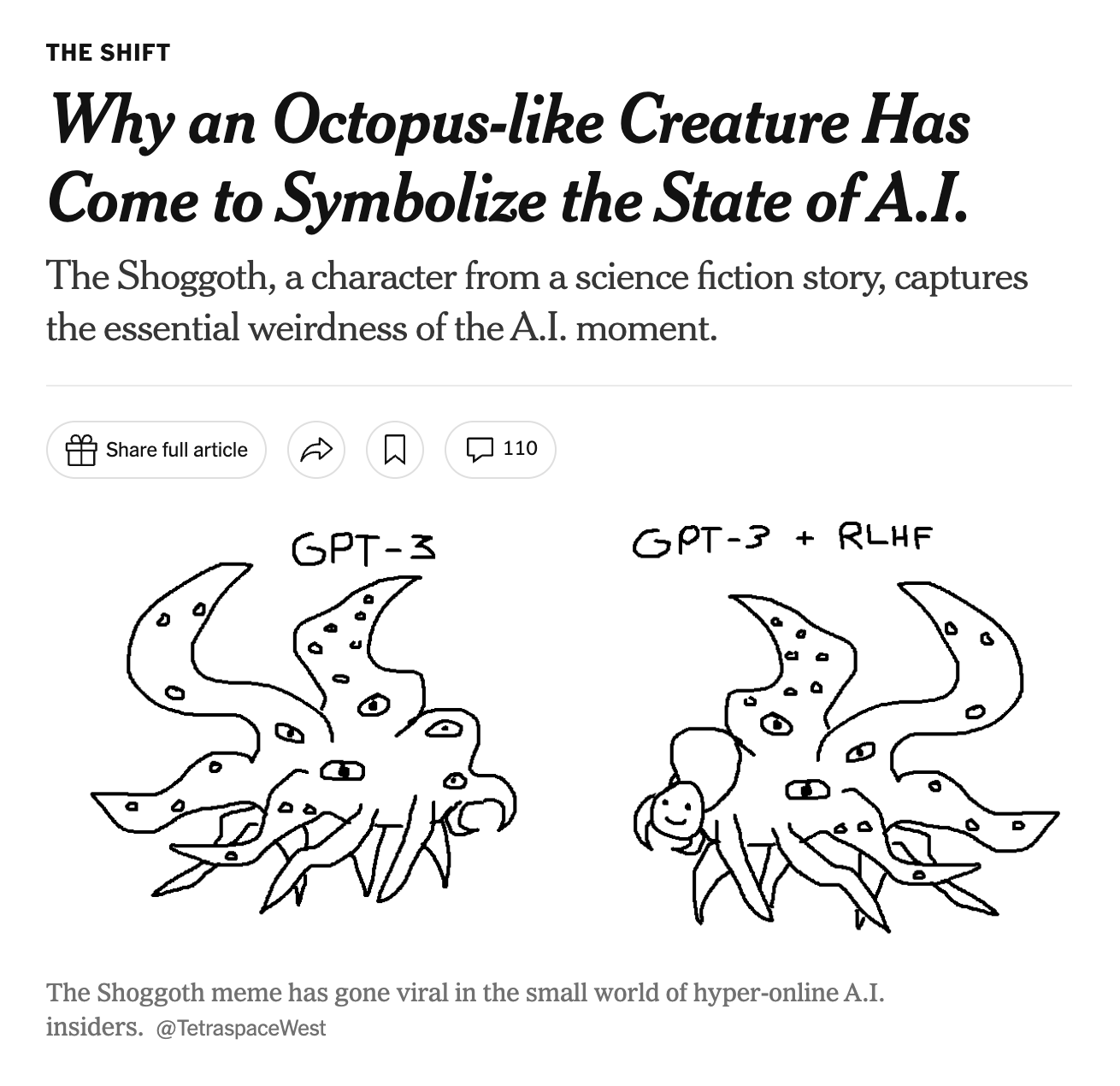
Credit: The New York Times.
The meme depicts a broader pattern around technology. A powerful system takes on a friendly face so people can accept it, invite it into their work and use it with less hesitation. The smiley face stands in for the language of helpfulness and reassurance that accompanies adoption.
That framing changes what people notice. The assistant is easy to understand. The system underneath carries training data, incentives, failure conditions and power dynamics, and that is where risk concentrates.
Kevin Roose’s account of the meme put it plainly: a powerful system with a smiley face attached.
The meme offers a useful lesson in how people make sense of complex choices. Evidence helps us establish what is true, likely and possible. A story gives those facts a setting, a sequence and a consequence. It tells us where to look, what might happen next, and what role we have in it.
Yuval Noah Harari’s Sapiens places this in a longer historical frame. Humans coordinate at scale through shared stories: ideas, institutions and futures that allow strangers to act in concert. A narrative directs attention, permission, investment and action.
The stories that set direction
The pattern extends far beyond AI.
The 1.5°C goal gave the climate crisis a shared horizon. It has shaped national targets, investment decisions and the language companies use to explain transition plans. The number gives a vast and complex system a point of reference. The UNFCCC continues to use it to explain the losses and damages that near-term action can reduce.
Supply-chain resilience has become a similar organizing idea for governments and businesses navigating geopolitical disruption, concentration risk and operational dependence. The OECD’s 2025 review brings evidence to that story: resilience comes from agile, adaptable and aligned systems. Its modeling shows that broad relocalization can reduce global trade and GDP.
But AI offers the current and especially vivid example. “The AI race” has become a governing frame in the United States. In July 2025, the U.S. administration released America’s AI Action Plan under the title “Winning the Race,” organizing its program around accelerating innovation, building infrastructure and leading internationally. The frame makes speed, scale and national advantage feel like the immediate work of leadership.
In the U.K., the AI Opportunities Action Plan organizes its agenda around laying foundations for AI, changing lives through adoption and securing the future with homegrown capability. The words carry their own invitation: find the practical opportunities, build the conditions for uptake, and make the gains visible.
Europe has built its narrative around trustworthy AI. Its AI Act uses a risk-based framework and connects technological development with safety, fundamental rights, traceability and human oversight. This leads to a different set of operating questions for companies and public institutions.
These are stories of competition, opportunity and trust. Each brings different evidence to the foreground. Each makes certain investments, risks and responsibilities feel more urgent.
When activity becomes the story
Craig Bright, Barclays’ Group Co-Chief Operating Officer and Co-CEO of Barclays Execution Services makes this connection through Frederick P. Brooks Jr.’s The Mythical Man-Month. Brooks showed why a simple unit of labor cannot explain software output. Coordination, dependencies, onboarding and conceptual integrity shape the work across the entire delivery system.
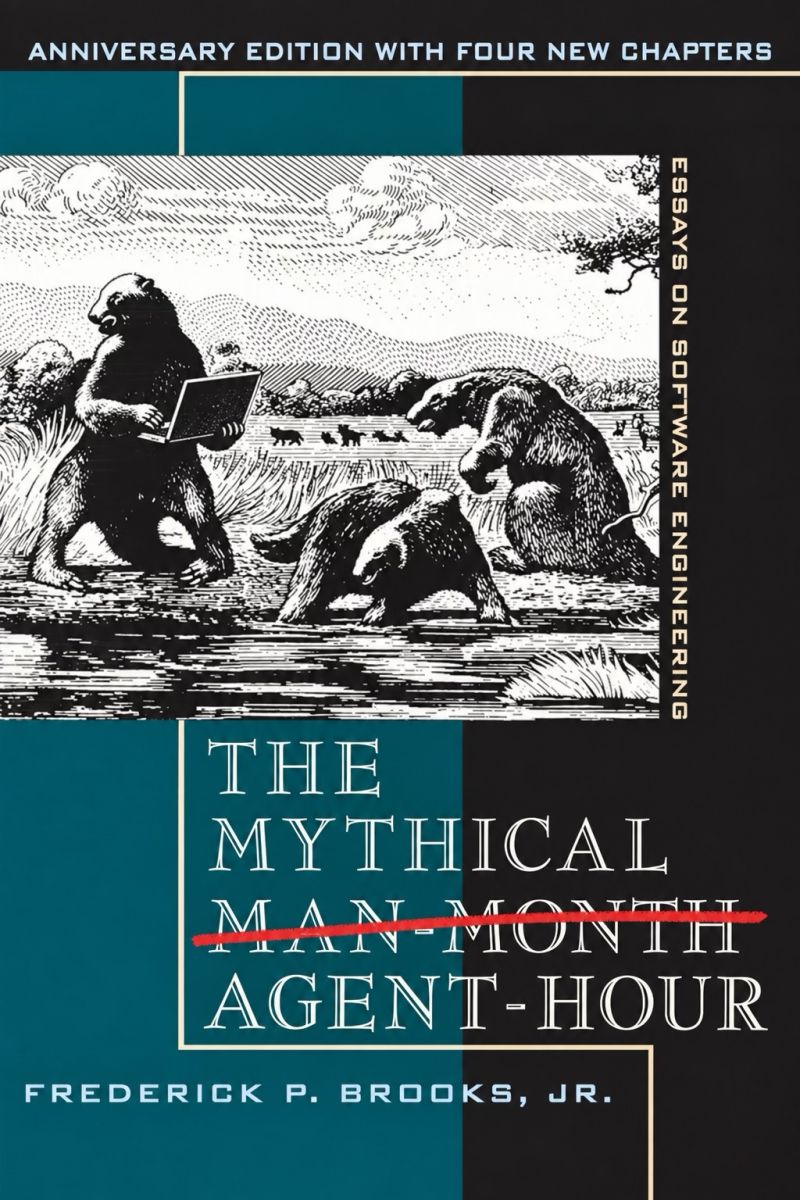
Bright’s “mythical agent-hour” carries that question into AI. The label offers a clean way to talk about AI productivity: an agent produces a feature in hours. The operational reality includes product definition, architecture, testing, control assurance, release management, cost to run, security and maintenance over years.
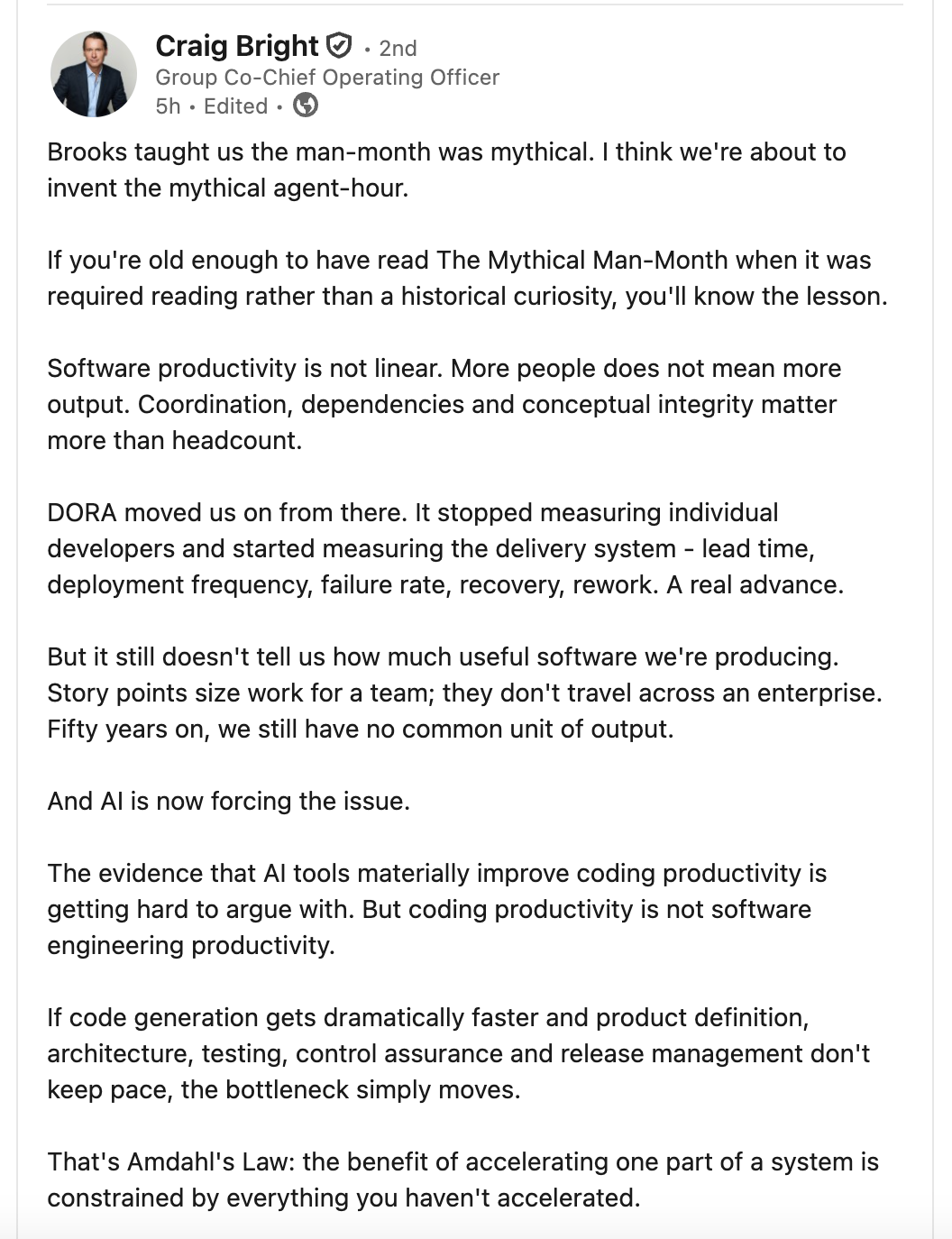
His deeper question sits upstream of productivity: what are we building toward? An agent-hour measures an input. The organization still needs a defined outcome grounded in customer value, long-term economics, maintainability, security and progress toward a shared goal. In the absence of that north star, output multiplies across competing motives. Architecture sprawls. Risks accumulate. Impact becomes harder to interpret.
AI increases the speed and volume of building. Purpose determines whether that activity becomes progress.
Here is that question in play, with real agents in the real world.
Last week, my daughter went to the Apple Store for help with her phone battery. The specialist suggested she call Verizon while she was there.
So she stood in the Apple Store, with an Apple specialist beside her, talking to Verizon’s customer support bot.
Then that bot transferred her to another bot.
She left without a fix.
The customer outcome was simple: a working phone. The system produced a store visit, a human handoff, a bot interaction and a bot-to-bot transfer. The journey accumulated activity and did nothing to address the need.
This happens inside companies too.
“We need an AI strategy” can create a story of being late, where movement itself becomes the proof of progress. A customer-centered north star creates clearer questions: whose problem are we solving, what outcome should change, what will this cost over its life, and what new risk will the organization carry?
The work of leadership is to make the underlying assumptions explicit, test them against evidence, and decide what the organization is trying to make possible.
Narrative is early infrastructure. It shapes the questions a board asks, the talent a company hires, the signals a sales team looks for and the choices a product team treats as inevitable.
Knowing when you are in a story
The first discipline is recognition. A story can cause us to skip the steps of examining the evidence: when the race is assumed, when the roadmap is defended on momentum, when a number is quoted without anyone asking what it measures.
Evidence needs context that connects it to the decision. It can be accurate and well-presented, yet remain distant from what people do on Monday morning.
Strategy needs stories that can be examined: stories with assumptions, consequences, alternative paths and evidence that can challenge them.
This is part of why well-designed scenarios help. A scenario places people inside a plausible future and asks them to act, surfacing the stories they already had in hand: who they assume owns the problem, what they believe customers will want or tolerate, and where their confidence is not supported by evidence.
A north star, not an activity count
The second discipline is the target. Activity measures are easy to produce and easy to report. They tell you the organization is busy. They do not tell you whether anything got better for the customer or the downstream cost.
A north star is stated in terms of customer value and durable progress, and it is specific enough to rule things out. It gives activity measures meaning: they become evidence of movement toward an outcome rather than evidence of effort. Scenarios test whether it works under operational pressure.
For leaders working in cyber, AI, infrastructure and resilience, the practice is short:
- Be aware of the narrative shaping the choice.
- Separate its assumptions from the evidence.
- State the north star in terms of customer value and durable progress.
- Choose metrics that show movement toward that outcome, not volume of work.
- Test the story against two or three plausible paths before committing.
Stories will shape the path. The work of leadership is to notice when a story has become the decision framework, test it against evidence, and build a shared narrative worthy of guiding action.