Every Metric Is Green. Revenue Isn’t.
The growing distance between operational performance and commercial success.

Imagine a company where nearly every performance indicator is improving. Customer inquiries are being resolved faster. Software releases are more frequent. Marketing campaigns are reaching larger audiences. AI has reduced the time required to complete administrative work, and automation has helped the organization operate with fewer resources. By conventional measures, the business is performing well.
Yet customer retention is declining. Revenue growth has stalled. Margins are under pressure. Competitors are acquiring customers with propositions the company hadn’t anticipated. Everything appears to be working, except the business itself.
This is an increasingly important management problem. As organizations become more sophisticated at measuring and improving individual activities, they risk losing sight of whether those activities are producing the outcomes that matter. AI may make that problem considerably more pronounced.
The difference between activity and value
For decades, organizational improvement has followed a relatively consistent logic: identify an activity, measure its performance, remove inefficiency, and repeat.
Manufacturing adopted lean production. Customer service introduced increasingly sophisticated performance indicators. Marketing developed attribution systems. Software teams adopted agile methods and automated delivery pipelines. Each improvement made an individual function easier to understand and manage. The challenge is that business value rarely resides entirely within one function.
Consider a company using AI to accelerate customer support. Its cost per interaction falls, and average handling time improves. From an operational perspective, the investment has worked.
But suppose customers are contacting support because the product has become more difficult to use. Faster resolution may improve the experience without addressing the underlying problem. The company has optimized the cost of responding to dissatisfaction while the conditions producing that dissatisfaction remain unchanged.
Or consider a sales organization that automates prospecting and dramatically increases outbound activity. Meetings increase. Pipeline grows. Sales productivity appears to improve. If the additional prospects have little intention of buying, the organization has simply become more efficient at generating work for itself.
The problem lies in the relationship between the metric and the economic outcome. An improvement in activity is valuable only to the extent that it contributes to something the business needs to achieve.
AI is exposing the gap
The 2026 McKinsey Global Survey on AI illustrates the distinction. Despite increasingly widespread deployment, only 37% of respondents reported a positive impact from AI on their organizations’ earnings before interest and taxes. Just 6% met McKinsey’s definition of AI high performers, reporting both significant value and an EBIT contribution of at least 5%.
The research also found that high performers were more likely to redesign workflows fundamentally, rather than introduce AI into existing processes. This is an important distinction.
Most organizations begin with the work they already perform. They identify where AI might make that work faster, cheaper, or more consistent. The more consequential question is whether the organization should continue performing that work in the same way.
A business can automate an inefficient process and generate savings. It can also reconsider why the process exists, how it contributes to customer value, and whether a different operating model would produce a substantially better result. Those opportunities have very different economic implications. The first improves the cost structure of the existing business. The second may change the economics of the business itself.
The problem with local optimization
Organizations are collections of interdependent systems, but their management structures often encourage independent optimization. Sales is rewarded for revenue. Marketing for pipeline. Operations for efficiency. Technology for delivery. Finance for cost discipline. Each function can succeed against its objectives while the overall business underperforms.
There are familiar examples. Inventory reductions improve working capital but increase the probability of lost sales. Aggressive customer acquisition generates growth but produces a customer base that is expensive to retain. Automation reduces labor costs but weakens the organization’s ability to handle exceptions.
None of these decisions is inherently wrong. The problem arises when the consequences are assessed within the function making the decision, rather than across the economic system affected by it.
AI introduces another dimension. An organization may deploy dozens of highly capable systems, each designed to improve a particular activity. If those systems optimize different objectives, their collective behavior may produce outcomes no individual team intended.
The question becomes one of coordination. Who is responsible for understanding how improvements in one part of the business affect the performance of the whole?
From operational metrics to economic mechanisms
A better approach begins with the economic mechanism a proposed improvement is intended to change.
- If AI reduces the cost of delivering a service, what happens to gross margin? Is the saving retained, reinvested, or passed through to customers?
- If it increases output, does demand exist to absorb that additional capacity?
- If it accelerates product development, does the organization have the distribution, customer insight, and commercial capability to turn more releases into more revenue?
- If it reduces the need for people in a function, what knowledge or adaptability might disappear with them?
These questions help distinguish three kinds of value.
- Activity value: A task is completed faster, more cheaply, or with greater consistency.
- Operating value: A process or business function produces a measurable improvement in cost, quality, capacity, or responsiveness.
- Enterprise value: The improvement changes financial performance, competitive position, customer economics, or the organization’s future options.
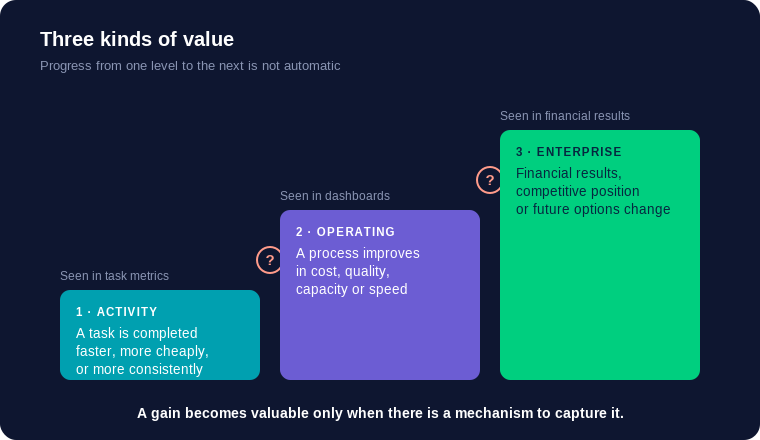
These categories are connected, but progress through them is not automatic. A productivity gain becomes commercially valuable when the organization has a mechanism for capturing it.
Saving three hours per employee each week does not necessarily reduce costs or generate additional revenue. The benefit depends on what happens to those hours. The same is true of increased capacity, faster decision-making, and improved analytical capability.
Without deliberate choices about redeployment, pricing, demand, and business design, efficiency gains may remain visible in operational dashboards without ever appearing in financial results.
Consider a hypothetical lender evaluating changes to an AI-enabled credit model.
A proposed adjustment could improve approval rates and increase returns while remaining within established credit policy.
The operational indicators might support the change. Yet the commercial decision requires a broader assessment.
Which customers would now be approved? How might the risk profile of the portfolio change? What assumptions underpin the projected returns? And how would management know whether the benefits materialize over time?
These were among the questions explored in a recent boardroom simulation at NYU Law.
The exercise demonstrated why technical performance, policy compliance, and commercial value need to be evaluated together.
What leaders should measure differently
The answer is not to abandon operational metrics. It is to establish clearer connections between them and commercial outcomes. Every major improvement initiative should carry an economic hypothesis. What business outcome should change? Through what mechanism? Over what period? What other conditions must hold true for the expected value to materialize?
Measurement should also extend beyond the immediate process. A customer-service automation project should consider retention, repeat contact, satisfaction, and the underlying causes of demand. A product-development initiative should consider adoption, revenue contribution, and the cost of supporting the resulting product.
Leaders should be particularly attentive to situations in which operational indicators improve while commercial indicators deteriorate. That divergence is information. It may signal that the organization is measuring the wrong things, that improvements are not being converted into value, or that the conditions underpinning its business model have changed.
The next management challenge
For much of the modern management era, organizations have been rewarded for developing greater control over how work gets done. The next era will demand considerably more attention to why that work creates value.
AI is making operational capability cheaper and more accessible. Activities that once required specialized teams, expensive infrastructure, or months of development can increasingly be performed with far fewer resources. As those capabilities become widespread, the ability to execute an activity efficiently may provide less differentiation than it once did.
Competitive advantage will depend increasingly on selecting the right activities, connecting them into coherent business models, and adapting those models as the economics change.
The critical question for leaders is becoming less about whether individual systems and functions are performing as intended. It is whether the organization they collectively create is still capable of winning.
Research reference: McKinsey, The State of AI in 2026: On the Road to ROI