When Efficiency Becomes a Strategic Liability
What happens to an organization’s capabilities when the work that developed them disappears?

There’s a question missing from most AI productivity conversations: What happens to an organization’s capabilities when the work that developed them disappears?
Companies are understandably enthusiastic about the efficiency gains AI is creating. Tasks that previously took hours can now be completed in minutes. Workflows are being automated, operating costs are being challenged, and productivity metrics are becoming central to AI investment decisions.
The numbers suggest these improvements are real. According to McKinsey’s 2026 State of AI research, 80% of respondents say AI has improved their individual productivity. Yet only 37% report any positive impact on organizational EBIT.
That is a considerable gap between individual performance and enterprise value. And it raises a larger strategic question about what organizations are actually optimizing for.
The hidden value of doing the work
We tend to think about organizational capability in terms of skills, systems, processes, and institutional knowledge. But much of that capability is developed through the experience of doing work.
A junior analyst learns judgment by investigating ambiguous information. A marketer develops strategic intuition by testing ideas and observing market responses. An engineer learns how systems behave by diagnosing failures. A manager develops decision-making ability through repeated exposure to complex trade-offs.
These experiences build capabilities that are difficult to capture in a process document or transfer through a training program. When organizations automate significant portions of that work, they change how people develop expertise.
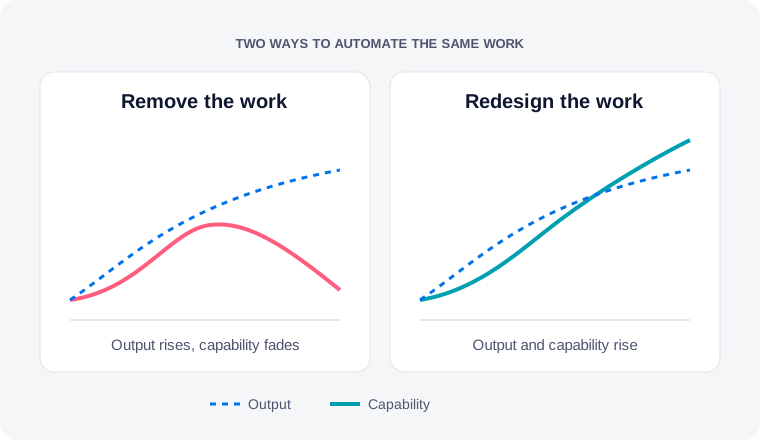
This doesn’t necessarily mean capability declines. AI can accelerate learning, expose people to new problems, and help them work at levels previously beyond their experience. But those benefits depend on how the work is redesigned.
An organization that removes repetitive activities while increasing opportunities for analysis, experimentation, and judgment may become substantially more capable. An organization that simply removes the activities through which expertise develops may discover a very different outcome. The distinction deserves more attention.
The economics of capability erosion
The financial case for automation usually emphasizes immediate, measurable benefits: hours saved, lower delivery costs, increased throughput, reduced headcount requirements. The longer-term implications are harder to quantify.
Consider an organization that automates most of its routine analytical work. Its experienced professionals may become more productive almost immediately. But where will the next generation of experienced professionals come from?
Or consider a customer-facing function where employees increasingly rely on AI-generated recommendations. As automation expands, employees may have fewer opportunities to develop the contextual knowledge needed to identify when those recommendations are inappropriate.
Over time, the organization can become increasingly dependent on capabilities it is no longer actively developing. This is especially important when technology fails, operating conditions change, or circumstances require human intervention.
The assumption that people can simply resume work previously performed by technology deserves scrutiny. Expertise requires continued practice, and some capabilities deteriorate when they are rarely exercised. What looks like an efficient operating model under normal conditions may become remarkably difficult to adapt when its underlying assumptions change.
Productivity is a means to an economic outcome
There’s another dimension to this challenge. Many organizations are measuring AI performance at the level of individual tasks rather than across the value they deliver to customers and the business.
A team that produces twice as many reports has increased output. Whether those reports improve decisions, customer outcomes, revenue, or profitability is a different question. The same applies to software development, marketing content, financial analysis, and customer support.
AI makes producing work considerably easier. That increases the importance of understanding which work creates meaningful value. It also creates a management challenge.
If a company reduces the time required to perform a task by 70%, what happens to the capacity it releases? Does that capacity translate into lower costs? Faster product development? Better customer experience? New services? More experimentation? Or does the organization simply generate more work?
Without a deliberate approach to reallocating capacity, productivity improvements can remain local efficiencies that produce limited enterprise-level benefit.
What should remain distinctive?
As AI capabilities become more widely available, organizations should also reconsider where their competitive advantage resides. A capability that once required a large team, years of experience, or specialized infrastructure may become accessible to nearly everyone.
That changes the economics of differentiation. If competitors can access similar technology, similar information, and increasingly similar execution capabilities, what makes one organization meaningfully better than another?
The answer may lie in proprietary relationships, accumulated expertise, unique data, distribution, customer understanding, or the ability to combine capabilities in ways others cannot easily replicate.
These are strategic questions that should influence how organizations approach AI investment. They should also influence which human capabilities organizations deliberately preserve and develop.
Designing for capability, not just efficiency
Before automating a significant workflow, leadership teams should be able to answer several questions:
- What economic value does this workflow create, beyond the effort required to execute it?
- Which skills and forms of organizational knowledge are developed through performing the work?
- How will those capabilities be maintained or strengthened after automation?
- Where will the capacity released by AI be reinvested?
- What happens if the technology becomes unavailable, unreliable, or accessible to every competitor?
These questions help connect technology investment to business strategy, workforce development, and organizational resilience. They also create a more meaningful basis for measuring AI success.
The most valuable outcome of AI adoption may be the new capabilities an organization becomes able to develop.
A broader definition of return
AI offers extraordinary opportunities to improve how organizations operate. Many productivity improvements are already material, and the potential to create new products, services, and business models is substantial. Realizing that potential requires attention to the capabilities that support it.
The objective should be an organization that is more valuable, more adaptable, and better equipped to compete.
As the economics of execution continue to change, leaders need to understand which capabilities they can automate, which they need to strengthen, and which will define their future competitive position. That is where productivity becomes strategy.