Begin Before You’re Ready
The ability to act without certainty may be one of the most valuable capabilities we can develop. A lesson in initiative, learning, and creating opportunities before we know exactly how they’ll unfold.

My daughter Gabby made her high school dance team this fall. That might not sound particularly remarkable until you understand that Gabby isn’t really a dancer. She’s my academic and theater kid. Her older sister, Adrianna, danced her whole life, and Gabby wanted to be part of that world.
So she spent 18 months taking advanced leaps and turns classes, hoping to accelerate her progress. She hated them. For a long time, she wasn’t particularly good at them, either. She kept going.
She joined sideline cheer to improve her skills, fully expecting to hate that too. Instead, she discovered she loved it. Her theater background turned out to be an advantage. She knew how to perform, connect with an audience, and improvise when she didn’t know the right moves. She had entered one unfamiliar world to pursue a goal and discovered capabilities she hadn’t known she possessed.
Then came dance team tryouts, preceded by weeks of anxiety and genuine uncertainty about whether she’d make it. She tried out anyway. And she made the team.

My favorite part of the story, though, was something Adrianna told her after cheer season:
“Do things that make you uncomfortable as often as you can. That’s where the most growth happens. The faster you learn how to do that, the better off you will be in life.”
I’ve thought about that advice quite a bit since. Because while it was intended for her younger sister, it captures something important about how people and organizations develop the capacity to do things they haven’t done before.
The limits of the established path
For a long time, we’ve organized education, careers, and businesses around the idea that competence comes before responsibility. Learn the rules. Develop the skills. Master the process. Demonstrate proficiency. Then move to the next level.
There’s good reason for that structure. Experience matters. Preparation matters. Some activities demand considerable expertise before anyone should attempt them.
But the model becomes less useful when the thing you’re trying to accomplish doesn’t have an established path. When you’re creating a new market, introducing an unfamiliar product, or pursuing an opportunity that doesn’t fit an existing category, there may be no playbook to master.
You can’t learn everything required in advance because some of the knowledge doesn’t exist yet. It has to be created through the work. That introduces a different relationship between capability and action.
Sometimes you develop the ability to do something by beginning to do it.
Initiative creates information
Organizations often treat uncertainty as a reason to delay. They want stronger evidence of demand before entering a market, a more complete product before approaching customers, or a clearer competitive landscape before committing resources.
These are reasonable concerns. But beyond a certain point, additional analysis produces diminishing returns. Some questions can only be answered through engagement with the market:
- Will customers recognize the problem you’re solving?
- Will they pay to address it?
- Can your capabilities deliver the outcome they need?
- Which assumptions about the opportunity are wrong?
You can research these questions extensively. Eventually, you have to try something: a limited launch, a customer experiment, a new partnership, a prototype introduced before every feature is complete.
Each creates information that wasn’t available beforehand. The organization learns something about the market, its own capabilities, and the relationship between the two. And that learning changes what it can do next.
The opportunity you discover may not be the one you started pursuing
Gabby joined cheer because she thought it would make her a better dancer. She discovered something she loved and was surprisingly good at. That wasn’t the original plan. It became one of the most valuable outcomes.
We see versions of this in business all the time:
- A company develops technology for one application and discovers a larger opportunity in an adjacent industry.
- A service created for existing customers reveals an entirely new market.
- A partnership intended to solve a distribution problem becomes the foundation of a new business model.
These opportunities emerge because organizations expose themselves to new information, new relationships, and new combinations of capabilities.
The difficulty is that many companies are structured to reward adherence to the original plan. Budgets are assigned to predefined outcomes. Teams are evaluated against established objectives. Unexpected discoveries can look like distractions when measured against the commitments that justified the work.
A strategy should provide direction without making the organization blind to what it learns along the way.
The age of initiative
Seth Godin has described the period we’re entering as the age of initiative. It’s a useful way to think about what happens when access to information, tools, and technical capabilities becomes less of a constraint on what people can accomplish.
AI is making it possible to perform work that previously required substantial resources or specialized expertise. Product development cycles are compressing. Small teams can undertake projects that once demanded much larger organizations. These changes don’t eliminate the importance of experience or judgment. They make the willingness to apply them more consequential.
When more people have access to the tools, the difference increasingly comes from recognizing an opportunity, assembling the necessary capabilities, and taking responsibility for making something happen.
That presents an interesting challenge for established organizations. Many have extraordinary resources, customer relationships, expertise, and infrastructure. They possess assets that younger companies would struggle to reproduce. Yet those advantages don’t automatically translate into new sources of growth.
An organization can have everything required to pursue an opportunity except the willingness to begin. Initiative can also mean creating smaller, more deliberate ways to explore uncertainty before making larger commitments.
Capability is built in the unfamiliar
We tend to think of capabilities as things organizations possess: technology, expertise, processes, infrastructure, distribution, capital. But there’s another dimension that is harder to capture in a capabilities inventory: the organization’s demonstrated ability to develop new capabilities when circumstances require them.
- Can it learn quickly?
- Can it apply existing expertise in an unfamiliar context?
- Can it recognize when an unexpected result reveals a better opportunity?
- Can it mobilize people around something that doesn’t yet have a proven business case?
- Can it sustain effort through the period when progress is uncertain and outcomes remain difficult to measure?
These qualities influence the speed, cost, and likelihood of successfully commercializing new opportunities. And like other capabilities, they improve through practice.
The accomplishment came before the result
Gabby could have tried out and not made the team. Of course, I’m thrilled that she did. She worked hard for it. But I don’t think the most important outcome was making the team. It was everything she developed while pursuing something she wasn’t sure she could accomplish.
She learned to be uncomfortable without quitting. She discovered an unexpected strength. She found another way to make progress when the original approach wasn’t particularly rewarding. And she gained evidence that she could enter unfamiliar territory and figure things out as she went. Those capabilities will be useful long after she’s finished dancing.
The same principle applies to organizations pursuing their next stage of growth. Markets won’t always provide certainty before an investment needs to be made. Opportunities won’t arrive with complete instructions. And the capabilities required to succeed may only become apparent once the work begins.
The answer is developing the judgment to know when you’ve learned enough to begin, the discipline to learn from what happens next, and the willingness to adjust as new possibilities emerge.
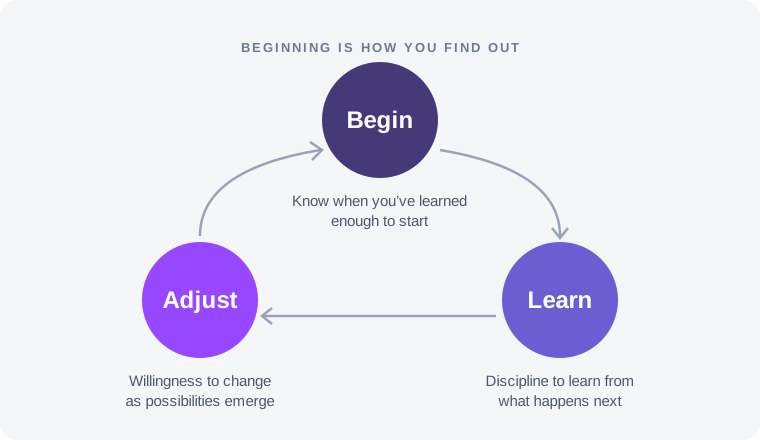
You don’t have to know exactly how something will work to make a worthwhile beginning. Sometimes beginning is how you find out.
Eudai works with organizations creating and commercializing new opportunities. We help identify emerging markets, develop the capabilities required to compete, and turn strategic potential into commercial value.