Market Creation Starts Before Demand Generation
When customers haven’t yet learned how to buy what you’re selling, generating interest is only part of the commercial challenge.

There’s a familiar response when growth slows. Increase campaign activity. Expand the content program. Test new channels. Improve conversion rates. Generate more leads.
Sometimes that’s precisely what’s needed. But these activities assume something important: that a recognizable market already exists for the offering. They assume customers understand the problem, recognize the category, know how to evaluate solutions, and have some means of funding a purchase.
For companies introducing genuinely new capabilities, these assumptions can be premature.
Demand generation becomes much harder when the market itself is still being created.
A market is more than a collection of potential customers
Market sizing often begins by identifying organizations that could benefit from a product. That produces a population of potential users, although it tells us relatively little about their readiness to buy.
For an opportunity to become an addressable market, several conditions must come together. Customers need to recognize a problem or aspiration worth acting on. Someone within the organization needs to own the decision. There must be a way to allocate resources, assess competing solutions, and justify a commitment. The offering also needs to fit into existing workflows or provide enough value to motivate changes to those workflows.
These conditions are easy to overlook in established categories because much of the work has already been done. In emerging categories, companies may need to help create them.
Education alone rarely creates a market
Market creation is frequently reduced to educating prospective buyers. Publish thought leadership. Explain the emerging problem. Introduce new terminology. Help customers understand the technology.
Education matters, but understanding an opportunity and acting on it are different things. A senior executive might agree that AI agents introduce new operational risks, for example, while remaining uncertain about which team should manage those risks, which existing controls apply, and whether the organization needs another technology platform.
More information may improve awareness without resolving the organizational obstacles to action. Effective market creation addresses those obstacles directly. It helps establish ownership, decision criteria, economic justification, operating practices, and confidence in the proposed approach.
The goal is to make adoption increasingly understandable and executable.
Demand exists at different levels of maturity
An emerging market rarely moves uniformly. Some potential customers are simply becoming aware of the issue. Others are experimenting. A smaller group has already committed people and money to solving it.
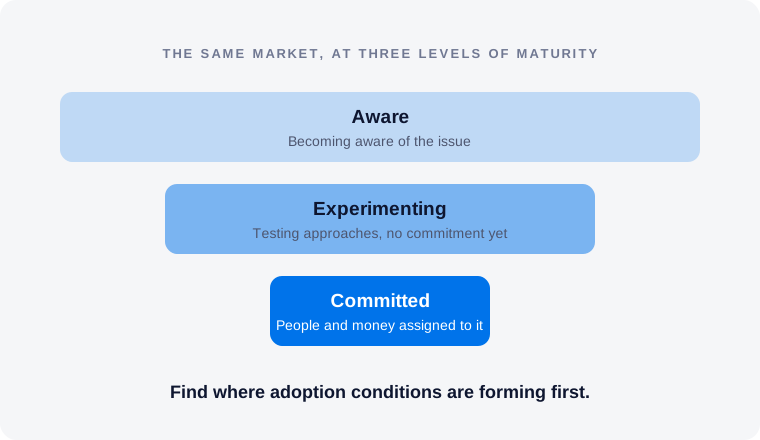
These differences matter enormously. A company focused on customers who are merely curious may attract considerable engagement while producing relatively little revenue. A company serving customers with urgent problems and a clear capacity to act may find a much smaller but more commercially productive market.
The strategic question is where adoption conditions are forming first. That might be a particular industry, regulatory environment, customer segment, operational workflow, or type of organization.
Identifying these environments requires research into customer behavior and commercial constraints, as well as a willingness to challenge assumptions about the total addressable market.
The early market needs infrastructure
Every established product category benefits from supporting infrastructure:
- Shared terminology
- Standards
- Analyst coverage
- Buyer communities
- Procurement criteria
- Implementation partners
- Reference customers
- Professional practices
These elements make a market easier to understand, enter, and navigate. They also reduce the perceived risk of adopting unfamiliar solutions. For companies creating new categories, investing in this infrastructure can be as important as investing in traditional marketing.
Consider what happens when a company convenes practitioners around an emerging challenge. The participants develop a more precise understanding of the problem, exchange approaches, identify gaps in existing practices, and begin developing a shared vocabulary. Over time, that activity can contribute to new expectations and purchasing criteria.
Research, community development, partnerships, working groups, practical frameworks, and customer experimentation can all contribute to market development when connected to a clear commercial objective. They create the conditions that make future demand easier to capture.
The commercialization model should evolve with the market
Early customers in emerging markets often buy differently from later customers. They may need more consultation, customization, proof, and executive sponsorship. The commercial relationship can resemble a strategic partnership as much as a conventional software purchase.
That doesn’t necessarily mean the business is destined to remain services-led. It means the company is learning what will eventually become repeatable.
The challenge is to turn those early engagements into knowledge and assets that reduce the effort required to acquire and serve subsequent customers.
- Which use cases recur?
- Which objections appear consistently?
- Which implementation steps can be standardized?
- What proof consistently influences buying decisions?
As the answers become clearer, the company can refine its product, packaging, pricing, partnerships, and sales motion. Market creation and product development inform each other.
Marketing has a role in shaping the market
This requires a broader view of marketing’s contribution to commercial strategy. In an established market, marketing can concentrate on differentiation, distribution, and demand capture. In a developing market, it also needs to understand how demand forms.
That means bringing customer research into strategic decisions, identifying early adoption environments, building relationships across emerging ecosystems, and helping establish how the category is understood. It also means working closely with product, sales, operations, and leadership to ensure that emerging demand can be converted into successful adoption.
This is particularly important as AI accelerates the creation of new products and compresses traditional development cycles. More capabilities are reaching the market before the market has developed a clear understanding of what to do with them. The resulting challenge is commercial as much as technological.
Know which market you’re operating in
Before investing heavily in demand generation, it is worth asking a few questions.
- Are customers actively looking for a solution to this problem?
- Do they have established budgets and evaluation criteria?
- Can they purchase and implement a solution using existing organizational processes?
Or is the company still helping customers understand why the problem matters, how to approach it, and what successful adoption would require?
The answers should influence how commercial resources are allocated. When a market is forming, activities that appear inefficient by conventional demand generation standards may be essential to creating future revenue. They should still be measured, with attention to whether they improve customer readiness, accelerate decisions, and establish a more repeatable commercial model.
Market creation is the deliberate work of making an opportunity commercially actionable.
The organizations that understand this can build more effective paths from innovation to adoption, and from adoption to sustainable growth.