Expand Your Creative Surface
The quality of your ideas depends, in part, on how much of the world you give them to work with.

There is a tendency, particularly in business, to approach creativity as a function of expertise. Read more about your industry. Study your competitors. Follow the analysts. Attend the same conferences as your peers. Stay close to the conversation.
All reasonable advice. And a remarkably effective way to end up thinking like everyone else. The problem is that we’re often looking for new ideas in places where the thinking has already been done.
The limits of looking closer
Every industry develops its own vocabulary, assumptions, frameworks, and conventions. Over time, these become so familiar that we stop noticing them.
Marketing teams study other marketing teams. Technology founders study other technology companies. Consultants borrow frameworks from other consultants. Eventually, entire industries start producing variations of the same ideas.
You can see it in the language. The websites that sound interchangeable. The conference presentations built around the same handful of observations. The strategies that describe a market’s direction but offer little insight into where it might go next.
We mistake proximity to a subject for originality of thought. And the more specialized we become, the easier it is to narrow our field of vision without realizing it.
Creativity needs a larger surface area
Think of your creative surface as the range of experiences, disciplines, people, environments, and ideas available for your mind to make connections between. A narrow creative surface gives you fewer combinations to work with. A broader one increases the possibility of encountering something that changes how you understand a problem.
It’s a companion to the learning surface we wrote about earlier: how many places the market can correct you in a given week. A learning surface tells you what is true about a market. A creative surface widens what you can imagine doing in it.
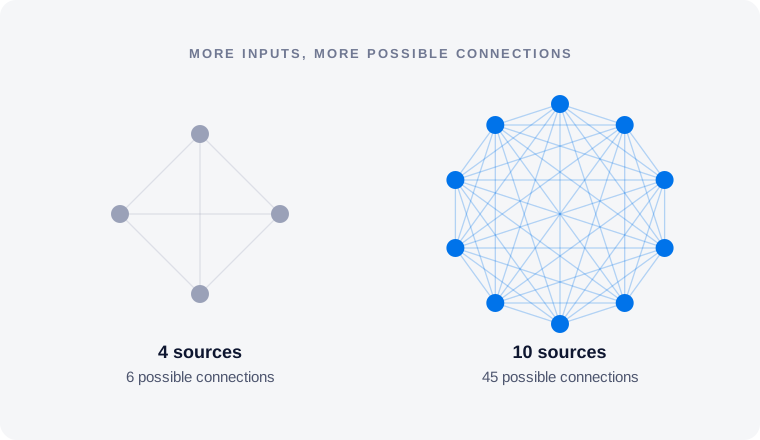
Some of the most interesting ideas emerge when something familiar appears in an unfamiliar context.
- A museum exhibit might offer a better model for explaining complex information than another executive dashboard.
- A children’s game might reveal a more effective approach to organizational learning than a conventional training program.
- A restaurant’s approach to managing anticipation might teach a technology company something about customer experience.
- An urban planner’s understanding of how people move through physical spaces might reshape how we design digital services.
None of these connections is inevitable. That’s what makes them interesting. They require enough exposure to recognize a useful pattern and enough curiosity to imagine where else it might apply.
The value is in the transfer
Exposure alone isn’t particularly valuable. We can consume extraordinary amounts of information without producing an original thought. The creative work happens when we transfer an idea between contexts.
Consider three questions:
- What is interesting about this? Look beyond the obvious function. What principle, behavior, or mechanism makes it work?
- Where else might that principle apply? Think across industries, disciplines, and settings that don’t ordinarily intersect.
- What would need to change for it to work there? Translation matters. An idea borrowed without adaptation is usually just imitation.
That third question is particularly important. An insight from hospitality won’t automatically improve enterprise software. But understanding how hospitality businesses anticipate needs, reduce uncertainty, or create memorable moments might reveal something useful about the software experience.
The opportunity is in understanding the underlying mechanism and reconstructing it for a different purpose.
AI makes this more important
Generative AI has made it extraordinarily easy to produce plausible ideas. Ask for ten marketing concepts, five strategic options, or a new product category, and you’ll have something to work with in seconds.
But the systems are drawing heavily from the patterns represented in their training and the context we give them. When everyone asks similar questions, using similar assumptions and similar references, the outputs can converge.
Expanding your creative surface becomes a way to expand the possibilities available to you and to the systems you use. Bring in unexpected reference points. Introduce concepts from other disciplines. Challenge the framing of the problem. Ask how an artist, architect, behavioral scientist, or game designer might approach it.
The quality of the exploration changes when the starting material changes.
This is also where human experience becomes increasingly valuable. The places you’ve been, the work you’ve done, the people you’ve encountered, and the seemingly unrelated things you’ve noticed give you a distinct set of associations to draw from. AI can help explore those associations at scale. You still have to recognize which connections are meaningful.
Build a practice of productive curiosity
Expanding your creative surface doesn’t require a sabbatical or an elaborate innovation process. It requires being more intentional about what enters your field of attention.
Read outside your professional discipline. Attend an event where you know little about the subject. Study how a different industry solves a problem you recognize. Pay attention to physical environments, particularly when your work happens mostly on screens. Spend time with people whose expertise has little overlap with yours.
And when something catches your attention, resist the temptation to dismiss it because it isn’t immediately relevant. Ask why it works. What assumptions it challenges. What other problems might benefit from the same approach.
Over time, these observations become a collection of raw materials available for future use. The objective is to develop a wider range of possibilities to draw from when a meaningful problem presents itself.
The commercial advantage of seeing differently
There’s a practical business implication to all of this. Most organizations have no shortage of information about their existing markets. They know their competitors, understand their customers, and monitor the trends affecting their industries.
What’s harder is recognizing opportunity outside the boundaries of what they’ve already decided the business is.
New markets are often created by transferring capabilities, behaviors, or business models between contexts. A technology developed for one application finds a more valuable use elsewhere. An unmet need becomes visible through the lens of another discipline. An established industry convention turns out to be optional.
These opportunities require more than creativity. They demand evidence, strategic judgment, and the ability to turn an interesting possibility into something commercially viable.
But the process begins with seeing something others have overlooked. And that is much harder when everyone is looking in the same places.
Expand your creative surface. Give yourself more of the world to think with.
The next commercially valuable idea may come from something entirely unrelated to the problem you’re trying to solve.