Gut feel at scale
AI can make the Highest Paid Person’s Opinion harder to spot. The fix is to use it to test decisions, keeping clear lines between what we know, what we infer and what we believe.

Tom Fishburne recently shared a cartoon that gets at a familiar organizational dynamic: a room full of people standing beside the data, while the senior person in the room studies a picture of a stomach and concludes, “Hmm… persuasive.”
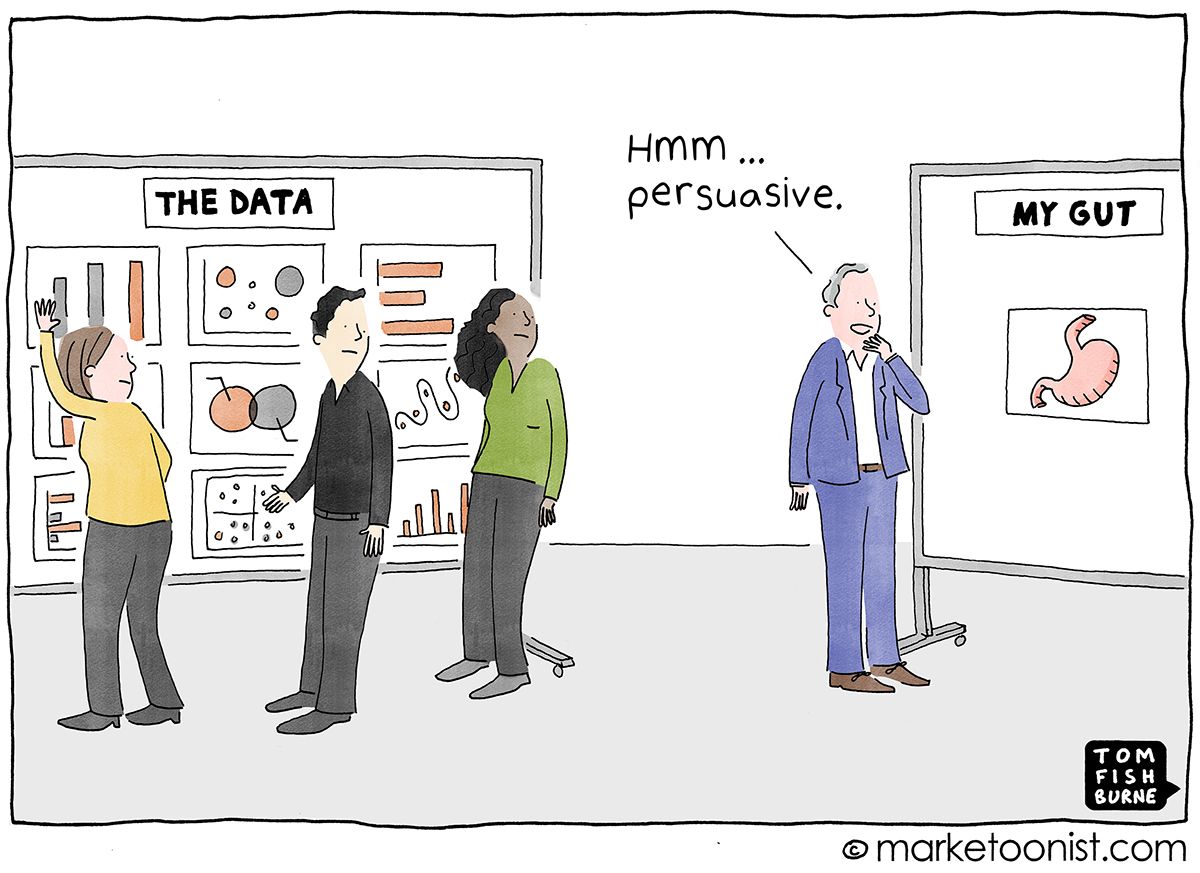
He paired it with a Jim Barksdale line I have always liked: “If we have data, let’s look at data. If all we have are opinions, let’s go with mine.”
Most leaders recognize the joke. Organizations can have dashboards, research, customer interviews, forecasts and increasingly sophisticated analytics and still end up making decisions based on the conviction of the most senior person in the room. There is a name for that: the HiPPO, the Highest Paid Person’s Opinion.
AI introduces an interesting complication. It can make the HiPPO harder to see.
Evidence, eminence and AI
Fishburne references Professor Byron Sharp’s distinction between evidence-based marketing and eminence-based marketing. The distinction is useful well beyond marketing.
Evidence-based decisions start with what we can observe: data, experiments, customer behavior, operational results and external research. Eminence-based decisions rely more heavily on who is making the argument: experience, authority, reputation and seniority.
Experience matters. Pattern recognition matters. Judgment matters. The question is what happens when AI enters the decision process and those things become difficult to distinguish.
Ask an AI system why your enterprise positioning is not resonating and it may give you a polished, plausible explanation. Maybe your messaging is too generic. Perhaps buyers need stronger ROI. Maybe competitors have captured the category narrative.
All reasonable. But what exactly produced that answer?
Was it your customer data? Industry research? Patterns learned from thousands of marketing articles? Assumptions embedded in your question? Or simply the statistically most likely explanation for this kind of problem?
The output often arrives in the same confident prose regardless. That creates a new decision-making risk: gut feel with citations, structure and perfect grammar.
AI is very good at making an argument
One of the most useful properties of generative AI is also one of the reasons it needs to be used carefully in strategy. It can build an argument remarkably quickly.
Give it a thesis and it can find reasons the thesis makes sense. Give it a concern and it can explain why the concern is justified. Give it your preferred strategy and it can help articulate why the strategy is smart.
This is valuable when you are exploring an idea. It becomes more problematic when exploration quietly turns into validation.
Ask, “Why should we reposition around AI governance?” and you have already shaped the answer.
Ask instead, “What evidence would suggest AI governance is becoming an important buying priority, what evidence would contradict that, and what would we need to know before changing our positioning?” and you are doing something very different.
The quality of AI-assisted decision-making depends heavily on the quality of the questions around it.
The danger is false confidence
Gut decisions have always existed. AI changes their presentation.
A human intuition might arrive as: “I think this is where the market is going.”
An AI-assisted version might arrive as a five-part strategic framework, complete with market dynamics, buyer motivations and recommended actions.
The underlying evidence may not have changed very much. The presentation has.
That matters because confidence is often interpreted as evidence. We are especially susceptible when the output confirms something we already believe.
A CEO convinced the company needs to move upmarket can ask AI to construct the business case. A marketing leader convinced the category is changing can generate an analysis explaining why. A product team excited about a feature can create a convincing narrative about customer demand before talking to many customers.
The output feels analytical. The original intuition can remain largely untested.
Fishburne calls this the possibility of “gut feel at scale.”
Use AI to challenge the decision
There is another way to use these systems.
Instead of asking AI to strengthen the argument, ask it to test the assumptions behind it.
If you are considering entering a new market, ask what would have to be true for the strategy to work. If customer interviews support your thesis, ask what alternative explanations could produce the same signals. If your data appears conclusive, ask what important variables might be missing. If everyone in the room agrees, ask what a credible skeptic would argue.
And when AI recommends a strategy, ask which parts of the answer are based on evidence and which are inference.
Those questions shift AI from being a very articulate supporter of a decision to being part of the mechanism for testing it.
That distinction will become increasingly important as AI becomes embedded in research, planning, forecasting and executive decision-making.
The new HiPPO may be harder to spot
The old HiPPO was visible. Everyone knew whose opinion had won.
The new version can look objective.
A strategy deck can contain market research, AI synthesis, customer insights, competitive analysis and a recommendation. Somewhere inside that process may still be the original instinct of the person who framed the problem.
That does not make the instinct wrong. It means we need to preserve the distinction between what we know, what we infer and what we believe.
AI makes it easier to blur those categories. Good decision-making requires making them more explicit.
The goal is not to eliminate judgment from strategy. The goal is to know when judgment is carrying the decision, and whether AI has helped us test that judgment or simply made it sound more persuasive.
Part of our work on security, risk, and innovation marketing.