Why Is Everything an Index Now?
AI can increase the volume of language while decreasing its variety, and markets that depend on new vocabulary start to sound alike.

Has anyone else noticed that everything is suddenly an index?
The AI Readiness Index. The AI Visibility Index. The Pacesetter Index. The Machine Relations Index. The Enterprise AI Buying & Budget Index. The HR AI Recommendation Index. The IT AI Recommendation Index.
There are, apparently, a great many things urgently requiring indexing.
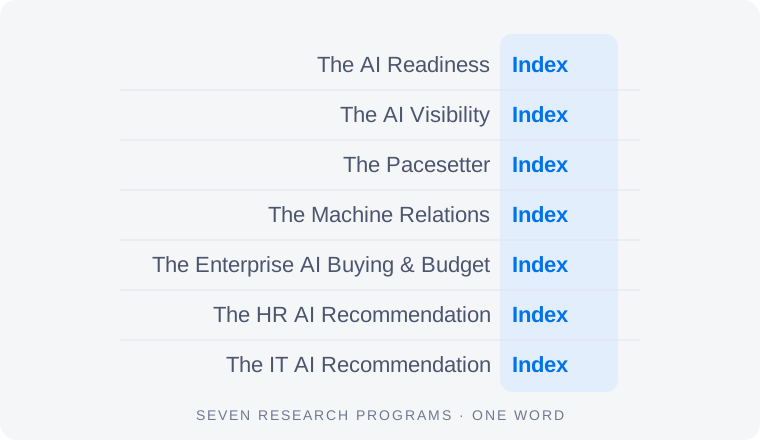
I have a theory.
AI really likes the word index.
Ask an AI model to name a recurring research program, a proprietary dataset or a piece of thought leadership that tracks something over time, and “Index” has an uncanny tendency to appear.
It makes sense. Index sounds authoritative. It implies measurement, methodology and repeatability. It turns a report into intellectual property in a single word.
It is exactly the sort of pattern a language model would learn.
The interesting part is what happens when millions of people start using the same models to help name things.
We tend to talk about generative AI as a content-production technology: more articles, more posts, more emails, more images.
But there may be another effect.
AI can increase the volume of language while decreasing its variety.
Not because everyone is deliberately copying everyone else. Because we are increasingly drawing from the same probabilistic well.
It may reach past language into thinking itself. More often than before, I’ll think I’ve come up with an original idea, then see the same idea out in the wild.
Is AI influencing how we think, or are we all supplying it the same raw ingredients and arriving at the same conclusions? Probably both. Shared inputs have always produced similar ideas. What has changed is how quickly a model can turn those inputs into a finished argument, for everyone at once.
In any case, it does feel like an epidemic of indexes.
You can see it in writing already. Certain constructions suddenly appear everywhere. Words such as delve became running jokes. LinkedIn acquired an epidemic of “It’s not X. It’s Y.” Every strategic challenge started occurring “in an increasingly complex landscape.”
And now, apparently, we are indexing everything.
That matters beyond mildly amusing naming trends.
Language is one of the ways markets differentiate ideas. New categories need new vocabulary. Companies need language that helps customers recognize a problem differently. Research needs framing that tells us why a particular body of evidence matters.
If AI continually pulls us toward the most statistically plausible way of describing something, the risk isn't simply that the writing becomes boring.
Markets start sounding more alike.
Which creates a strange new challenge for marketers.
For years, the job was partly to discover the language the market already used and make sure you appeared within it.
In an AI-mediated market, we may increasingly need to recognize when the machine is giving everyone the same language — and deliberately move beyond it.
So perhaps the next time AI suggests calling your research program an index, ask it for another 20 ideas.
Then delete anything you've heard before.
Part of our work on category creation and messaging.