You Can’t SEO Out of an Unsettled Market
The way we find things is being disrupted from several directions at once.

For a while, search felt knowable. Not easy. Not static. But knowable.
You could identify the language your market used, understand what people were searching for, build authority around those topics, improve the technical foundations of your site, and watch the signals accumulate.
That system is being disrupted from several directions at once.
Google is changing what a search result is. AI-generated answers increasingly synthesize information rather than simply return a ranked list of pages. ChatGPT, Copilot and other AI products have created another discovery layer entirely. Buyers are asking longer, more contextual questions. Answers are being assembled from multiple sources. And increasingly, the person looking for information may never arrive at the website that helped produce the answer.
The industry’s response has been predictable. Now we have SEO, AEO and GEO living side by side: SEO for traditional search, AEO for answer engines, GEO for generative engines.
Except even those definitions aren’t settled. Some practitioners draw clear boundaries between AEO and GEO. Others use the terms almost interchangeably. The tactics overlap. The platforms overlap. And increasingly, the search experiences themselves overlap.
We wrote about this acronym proliferation, and what ranking for your own name actually reveals, in Ranking For Your Own Name.
Around them, a new category of tools, scores, agencies and advice has appeared, all promising to help companies understand where they show up and how to improve it.
With that, new capabilities. But the proliferation of acronyms is also a pretty good description of the moment we’re in.
The discovery environment is changing faster than the playbook for optimizing it.
And there is a bigger problem underneath it:
You cannot optimize your way out of an unsettled market.
The map is moving
SEO was built around a relatively stable bargain. People expressed demand through queries. Search engines organized the available supply of information. Brands competed to appear when those two things met.
AI changes several parts of that bargain simultaneously. A single question can now generate multiple underlying searches. AI search experiences can break a question into related subtopics, retrieve information across them, and synthesize the result.
The unit we spent years optimizing around — the keyword — becomes less representative of the actual discovery process.
The question is no longer simply:
Do we rank for this term?
It may be:
When someone asks a much larger question about this problem, does anything we know become part of the answer?
That is a meaningful change in what visibility means. And we are trying to measure it while it is still changing.
We have a measurement problem
Traditional search gave marketing teams an imperfect but useful chain:
query → ranking → impression → click → session → conversion
Generative discovery makes that chain much harder to observe.
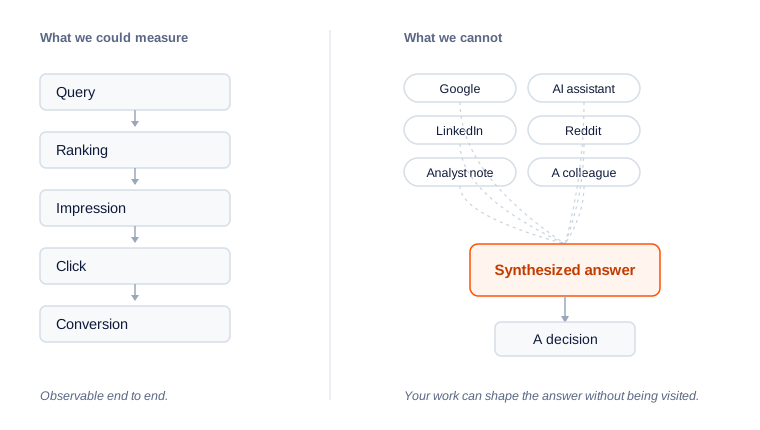
Someone can encounter your research inside an AI-generated answer without visiting your site. They can discover your company through a synthesized comparison and search your brand later. They can move between Google, an AI assistant, LinkedIn, Reddit, analyst research and a colleague’s recommendation before becoming visible in your analytics.
The platforms themselves are still building the instrumentation to help companies understand what is happening. So when a dashboard confidently tells you that your “GEO score” is 72, it is worth asking what exactly is being measured.
The market does not yet have a universally accepted equivalent of rank, share of search or organic traffic for AI discovery. That does not make measurement useless. It makes false precision dangerous.
We also have a language problem
This is particularly important in markets being disrupted by AI. The language people use when a category is established is very different from the language they use while trying to understand something new.
Early markets are messy. People search for symptoms before categories. They describe what happened rather than the product they need. They borrow terminology from adjacent disciplines. New phrases appear quickly. Several labels compete for the same emerging problem. The language used by practitioners can be different from the language used by executives, regulators, analysts or vendors.
Eventually some terminology consolidates. But there is a period before that happens when conventional keyword strategy can become oddly backward-looking.
Search volume tells you what people already know how to ask for.
It is much less good at telling you what they are beginning to need. That distinction matters enormously in markets such as AI governance, AI security and operational resilience. If the market itself is searching for language, optimizing exclusively around established terminology can make you exceptionally visible for yesterday’s framing.
Generic terms are also the most contested. In an established domain the head terms belong to incumbents who have been accumulating links, citations and crawl history for years, and no amount of on-page work dislodges them quickly. Volume and difficulty travel together.
Which makes search a long-tail channel for most companies. The winnable queries are the specific ones: a named problem, a qualified audience, a situation described in enough detail that only a few pages can honestly answer it. That is a positioning decision before it is a keyword decision. If you cannot say what makes you the better answer to a narrow question, the broad one is not available to you either.
We have an optimization industry optimizing for a system that is still changing
AEO and GEO are attempts to solve a real problem: how do organizations remain discoverable when machines increasingly mediate discovery?
But some of the emerging advice already looks suspiciously like previous generations of SEO folklore.
- Add a particular file.
- Write in a particular format.
- Break everything into AI-friendly chunks.
- Create pages for every possible question.
- Add special markup.
There will be useful techniques. There will also be plenty that get repeated long before we know how much they matter. And the underlying platforms are changing at the same time.
Today’s optimization tactic may matter. It may become table stakes. It may disappear into the infrastructure. Or it may turn out to have had very little effect at all.
The more durable advice is considerably less exciting: create valuable, original, credible information.
The scarce resource is becoming original information
Generative AI made producing content extraordinarily cheap. It did not make producing knowledge cheap.
Anyone can generate another article explaining the EU AI Act. Far fewer organizations can tell you what several years of market data reveal about how demand for AI governance is changing.
That difference matters in both traditional and generative search. When synthesis becomes abundant, source material becomes more valuable.
Depending on Google is a growth risk
There is a second reason to care about this, and it has little to do with algorithms.
A business that depends on Google for traffic does not control its own growth. Google does. Every ranking change, every layout change, every AI summary that answers the question before the click is a decision made by someone else about your pipeline. You feel the effect. You had no part in the cause. Companies built on that dependency have been absorbing those decisions for years, and the decisions are getting larger.
The response is not a better hedge inside the same channel. It is to build the things that belong to you: direct relationships with customers, a brand people can recall without a search box, original insight nobody else is able to publish, and demand created across several channels at once — events, communities, partners, a podcast, a list you own.
None of that removes search from the mix. It removes search as the single point of failure.
So what should teams do?
| Do this | Because |
|---|---|
| 1Fix the boring SEO problems first | A page that cannot be crawled, indexed or understood is not rescued by GEO. |
| 2Stop treating keyword volume as the market | Keyword data is evidence, not reality. |
| 3Build around questions and problems | A buyer does not experience your market as a keyword taxonomy. |
| 4Produce what cannot be synthesized without you | Move some of the budget from publishing more to knowing more. |
| 5Make your knowledge easy to verify | Originality alone is not enough. Claims need sources and dates. |
| 6Give the market evidence | A page claiming leadership is a claim. A customer is evidence. |
| 7Get other people talking about you | You cannot manufacture consensus on your own website. |
| 8Measure a portfolio of signals | Watch earned presence, not simply owned visibility. |
| 9Keep some capacity deliberately unoptimized | Someone has to name it before someone searches for it. |
1. Fix the boring SEO problems first
AI discovery has not made technical SEO irrelevant. A page that cannot be crawled, indexed or understood is not suddenly rescued by GEO.
Make sure the site itself works.
- Clean up duplicate pages and fix canonicals.
- Maintain the sitemap, and check what is actually indexed.
- Make important information available as text rather than burying it in graphics or PDFs.
- Build sensible internal links.
- Keep the site fast and usable.
There is little value in optimizing content for an answer engine that cannot reliably access it.
2. Stop treating keyword volume as the market
Keyword data remains useful. But it is evidence, not reality.
Look at what is appearing around the search data: customer questions, sales calls, RFP language, regulatory documents, analyst taxonomies, job descriptions, conference agendas, community conversations and the terminology showing up in AI prompts.
Pay particular attention to language that is growing from a small base. An emerging problem will often exist before it has a large search category.
The strategic question is not only:
Where is demand?
It is also:
Where is language forming around new demand?
3. Build around questions and problems, not keyword permutations
A buyer does not experience your market as a keyword taxonomy. They experience a problem.
Build deep, useful bodies of knowledge around those problems.
- Explain the issue and define the competing terminology.
- Show the evidence.
- Answer the obvious questions and the difficult ones.
- Connect adjacent concepts.
- Update the material as the market changes.
This serves traditional search, generative search and, more importantly, the person trying to understand the problem.
You do not need 37 slightly different pages targeting 37 variations of the same phrase. You need something worth retrieving.
4. Produce things the internet cannot easily synthesize without you
This may be the most important shift. Move some of the content budget from publishing more to knowing more.
- Run the survey.
- Analyze the dataset.
- Interview the practitioners.
- Document the implementation.
- Test the hypothesis.
- Create the benchmark.
- Publish the framework.
- Take a position you can support.
If an AI system can produce essentially the same article without encountering your organization, you have created a commodity. That was already a weak content strategy. Generative AI is simply making the weakness more obvious.
5. Make your knowledge easy to verify
Originality alone is not enough.
- Make claims clear, and name things consistently.
- Cite primary sources.
- Put dates on changing information.
- Identify authors and their expertise.
- Connect research to methodology.
- Keep important pages current.
If you publish a statistic, make it easy to understand where it came from. If you introduce a framework, explain the thinking behind it. If you make a claim about your product or market, provide the evidence.
Think less about writing for a robot and more about making your organization’s knowledge legible and verifiable wherever it travels.
6. Give the market evidence
There is another consequence of search becoming more fragmented and synthesized:
What you say about yourself is only one part of what can be found about you.
That makes social proof increasingly important. Case studies. Named customers. Customer quotes. Independent reviews. Analyst recognition. Awards. Research results. Measurable outcomes. Specific examples of the work actually being done.
These have always mattered for credibility. Now they also contribute to the body of evidence available to someone — or something — trying to understand who you are and whether your claims are credible.
A page saying you are a leader in a category is a claim. A customer describing what changed after working with you is evidence. The more consequential the buying decision, the more that distinction matters.
This is also why generic case studies are a missed opportunity. “A global financial institution improved resilience” provides very little information. Who was the organization? What problem were they solving? What did they do? What changed? What can be demonstrated?
Make the proof as concrete as you are permitted to make it.
7. Get other people talking about you
For years, content strategy encouraged companies to behave as if they could build authority almost entirely on their own domains. Publish enough. Rank enough. Own enough keywords.
Discovery now happens across a much wider information environment. Analyst reports. Trade publications. Podcasts. Conference agendas. Customer websites. LinkedIn conversations. Industry communities. Review platforms. Research citations. Partner ecosystems. Reddit threads. And increasingly, AI systems synthesizing information from many of those places.
Your own content still matters. But you cannot manufacture consensus on your own website.
If you want to be known for something, other credible people and organizations eventually need to associate you with it too. That changes the job.
PR matters. Analyst relations matter. Customer advocacy matters. Partnerships matter. Speaking matters. Original research that other people reference matters. Being useful enough that experts voluntarily share your work matters.
Instead of asking only:
What should we publish?
Ask:
What would make someone else cite us, mention us, recommend us or use our work to make their own argument?
That is a much higher bar for content. It is also a much more durable form of visibility.
8. Measure a portfolio of signals
There probably isn’t one metric that tells you whether you are winning this transition. Use several.
Track traditional organic visibility and conversions. Watch branded search. Monitor which questions bring qualified visitors. Look at referral traffic from AI platforms. Track mentions and citations. Watch where your research travels. Ask prospects how they found you.
Start paying attention to earned presence, not simply owned visibility.
- Are customers talking about you?
- Are experts referencing your work?
- Are journalists and analysts finding you?
- Are other sites describing you accurately?
- Does your company appear in the places your buyers already trust?
Most importantly, connect discovery to business outcomes. Ten thousand informational visits may matter less than becoming part of the information environment the right 200 people use to make a consequential decision.
9. Keep some capacity deliberately unoptimized
This is uncomfortable for performance-oriented marketing teams. Not everything worth publishing will have existing search volume.
If your company has something genuinely new to say about a market, sometimes the search demand will arrive later. Someone has to name the problem first. Someone has to produce the research before people know to search for it. Someone has to introduce the language that eventually becomes a category.
If every content decision requires evidence of existing demand, you have built a system exceptionally good at following markets and structurally bad at seeing them move.
The opportunity inside the disruption
There is a temptation during periods like this to wait for the new playbook. Eventually the analytics will improve. Standards will emerge. Tools will mature. We will understand more about how different AI systems retrieve, weight and cite information.
By then, some organizations will already have spent years building the bodies of knowledge those systems draw from. That is the opportunity.
- Keep the technical foundations sound.
- Learn how the new discovery systems work.
- Experiment with AEO and GEO where there is evidence behind the tactic.
- Measure what can actually be measured.
- Build proof around what you say.
- Give customers, experts and other credible voices reasons to talk about you.
- And keep producing things that add something genuinely new to the market.
Discovery is becoming distributed across search engines, AI systems, communities, experts, customers, media and the accumulated evidence the internet has about your company. You cannot control all of that. But you can give it better material to work with.
You can’t SEO your way out of an unsettled market. You have to become worth finding.