The language of risk is changing
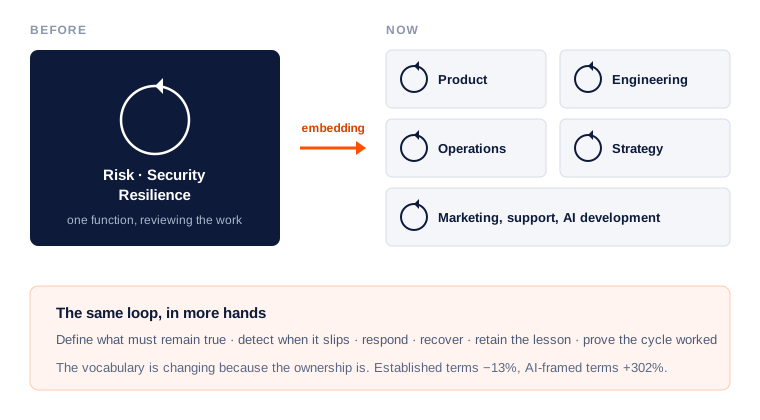
A familiar pattern is playing out across risk, security, and resilience: the work remains essential, but fewer people are discovering it through the language that has traditionally described it.

A familiar pattern is playing out across risk, security, and resilience.
The work remains essential. Organizations still need to make decisions under pressure, protect critical operations, manage dependencies, recover from disruption, and demonstrate that their controls work.
But fewer people are discovering that work through the language that has traditionally described it.
That is the central finding of Resilience 2030, new research from Eudai examining search behavior, regulation, certification, analyst coverage, public-company disclosure, job postings, private transactions, and government awards from 2022 to 2026.
Across 1,621 search terms, AI-framed language grew 302%. Established vocabulary declined 13%.
But the work is increasingly being found, framed, and carried through different positioning altogether.
A discovery problem before it is a demand problem
Someone searching for “AI incident response plan,” “AI audit,” or “agentic AI resilience” may be looking for capabilities that already exist within incident response, audit, operational resilience, governance, or security teams.
That matters for two groups.
For risk and security teams, it affects whether work is legible to leaders, peers, and functions that now share responsibility for it. For providers, it affects whether the market can find an offering before it has learned the old category language — a demand capture problem as much as a messaging one.
A company can retain the established terms that still carry reach while building authority in the arriving terms. A team can preserve the depth of its discipline while adopting language that travels beyond the function.
Neither requires abandoning the work underneath.
The first signals arrive before the market settles
The report tracks eight instruments because no single one is sufficient.
Search shows the questions people are beginning to ask. Regulation sets the dates around which those questions become urgent — the EU AI Act and DORA are the clearest current examples. Disclosure records what executives are prepared to put their names to, which is why SEC EDGAR full-text search is a useful instrument. Certification confirms adoption later: ISO/IEC 42001 is the AI management system standard now being adopted. Analyst coverage formalizes a category—or lets it recede. Job postings show where responsibilities are moving. Private capital and public awards reveal when the shift begins to register in transactions.
They move at different speeds.
Search language moved first. Private capital followed. Public procurement arrived later, but is now showing the sharpest directional change: AI-framed concepts rose from 1% of tracked awards in 2022 to 17% in 2026, albeit from a small base.
This is why positioning decisions are difficult. By the time a term becomes a familiar category, the language that created the opening may already be crowded. Move too early, however, and you risk positioning ahead of a market that has not yet formed — the Overton window problem, in a different guise.
The practical task is to recognize the difference between an emerging discovery route and a completed purchasing shift.
Evidence travels further than tooling language
One pattern held across both established and AI-framed subjects.
Assessment, audit, certification, and readiness language grew regardless of whether the subject was traditional risk work or AI. Tooling language did not travel as consistently. “Platform” and “software” performed differently depending on the subject and the buyer’s level of maturity.
That is useful for anyone communicating with a mixed audience.
Evidence helps a risk leader explain what has been tested, an executive understand what has changed, and a provider establish that an offer can produce a credible result. Tooling is often important, but it does not carry the same meaning across every emerging problem.
The question for 2030
The report does not forecast the future. It cannot tell us where budgets will land or which new term will become permanent.
It can show what is already becoming visible.
The work of risk, security, and resilience is appearing in more places, under more names, and alongside functions that have not historically used this vocabulary. That creates a choice: wait for the language to settle, or help make the work clearer while it is still taking shape.
Resilience 2030 is a research guide to that choice. It is for the companies building in this market and the teams responsible for the work inside it.