Why Good Technology Struggles to Become a Market
The distance between technical possibility and commercial value is often much greater than innovators expect.

We’ve become remarkably good at building things. AI has accelerated the process even further. Capabilities that once required years of engineering and substantial investment can now be demonstrated in weeks. New products emerge almost daily, and the technical barriers to entry continue to fall.
Yet commercial success remains stubbornly difficult. The market is full of impressive technology searching for a reason to exist in someone’s budget.
This is one of the more interesting consequences of accelerating innovation: our ability to create new capabilities is increasingly outpacing our ability to turn them into sustainable businesses.
The market doesn’t experience innovation the way its creators do
Inside a company, the significance of a technological breakthrough can feel self-evident. A new capability is faster, more accurate, more scalable, or capable of solving a problem that previously seemed impossible. Those distinctions matter enormously to the people building it.
Customers evaluate the opportunity through a different set of considerations.
- Where does this fit into the work we’re already doing?
- Who would own it?
- What changes if we adopt it?
- How would we justify the expenditure?
- What would we have to stop doing?
A technology can offer a substantial improvement in performance while introducing enough organizational friction to make adoption unattractive. Commercialization requires understanding the conditions under which that improvement becomes valuable enough to justify change.
Product-market fit is partly an organizational question
We tend to discuss product-market fit as a relationship between a solution and a customer problem. In practice, the relationship is more complicated. A product needs to fit an organization’s operating model, decision processes, purchasing behavior, incentives, capabilities, and tolerance for uncertainty.
Consider a new AI platform capable of automating an important business workflow. Its technical performance may be excellent. The business case may be compelling. Customers may even agree that the opportunity is significant.
But adoption might require legal approval, new governance practices, integration with legacy systems, changes to job responsibilities, and agreement between several departments over who controls the technology. Every additional dependency expands the distance between interest and revenue.
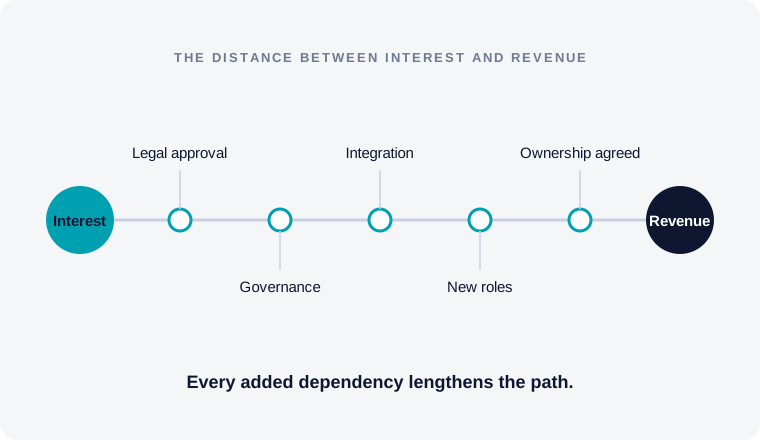
This is why enthusiastic customer feedback can coexist with disappointing sales. The value proposition has been validated at one level, while the conditions required to capture that value remain unresolved.
New categories create additional work for customers
Established markets offer companies something valuable: a shared understanding of how buying works. Customers recognize the problem. They know which department owns it, which vendors to compare, and approximately how much the solution should cost.
Emerging markets often lack that infrastructure. A buyer may recognize an opportunity without having a category in which to place it. There may be no established budget, procurement criteria, internal champion, or reliable benchmark for calculating returns.
For the innovator, this creates a second commercialization challenge. The company must help customers develop the language, evaluation criteria, business case, and organizational confidence necessary to make a decision. In some cases, it must also help establish the practices and standards that will eventually define the market.
These activities require deliberate investment and sustained engagement.
Commercialization is a capability in its own right
Many organizations approach commercialization as a sequence: develop the technology, establish the product, create messaging, generate leads, and sell. That sequence works when customer demand is reasonably well understood. It becomes less reliable when the underlying market is still emerging.
Commercial strategy needs to influence decisions much earlier.
- Which applications offer a sufficiently urgent problem?
- Which customers can act without significant organizational redesign?
- Which adjacent markets already have relevant budgets?
- What evidence would reduce perceived risk?
- Which partnerships could accelerate acceptance?
These questions shape the product itself, the business model, the route to market, and the capabilities a company needs to develop. They also require difficult choices about which opportunities deserve attention and which should be left alone.
The opportunity is rarely as broad as it first appears
One of the temptations of powerful technology is to pursue everything it could potentially enable. Horizontal capabilities create seemingly endless use cases. That flexibility can make a technology appear commercially attractive across dozens of industries.
But customers generally buy solutions to specific problems within specific circumstances. Companies that succeed in emerging markets often begin by identifying a narrow environment where urgency, economic value, and the ability to adopt intersect.
They use that initial market to establish evidence, understand adoption barriers, refine the offering, and develop a repeatable commercial model. Expansion becomes easier once the company can demonstrate how the innovation creates value in practice.
Build the conditions for commercial value
Technological progress creates possibilities. Commercialization turns selected possibilities into businesses.
That requires a deeper understanding of markets than the size of an opportunity or the attractiveness of a category. It requires understanding how customers make decisions, what organizations must change, where economic value is created, and which capabilities are necessary to deliver it repeatedly.
As technology becomes easier to create, these capabilities become increasingly important sources of competitive advantage. The companies that develop them will be better positioned to turn technical possibility into commercial value.