Your Next Competitor May Not Look Anything Like You
The changing economics of building a business are creating competitive threats that traditional market analysis may struggle to recognize.

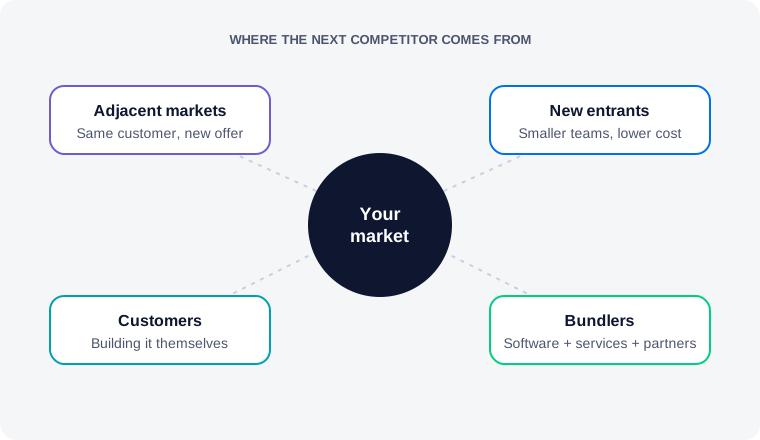
Most competitive intelligence is designed to identify threats from companies that resemble our own. We study competitors offering similar products, targeting similar customers, hiring from similar talent pools, and operating within familiar industry boundaries. We monitor their pricing, product launches, market share, and distribution strategies.
These practices remain valuable. But they can also reinforce assumptions about what competition looks like.
As AI changes the cost and complexity of building products, accessing expertise, and coordinating business operations, some of the most consequential competitive threats may come from organizations that bear little resemblance to today’s market leaders. And by the time these organizations appear in traditional competitive analyses, the underlying economics of the market may already have changed.
The advantages of scale are being redistributed
Historically, building a competitive business in many industries required substantial investment in people, infrastructure, technology, and distribution. Scale provided access to capabilities smaller organizations struggled to replicate. Large enterprises could employ specialist teams, build sophisticated systems, and spread fixed costs across a substantial customer base.
These advantages haven’t disappeared. But the cost of accessing certain capabilities is changing quickly.
AI-assisted software development reduces some of the effort required to create and maintain products. Cloud infrastructure makes enterprise-grade computing available without significant capital expenditure. Digital platforms provide access to distribution, payments, analytics, and increasingly sophisticated operational services. AI expands what relatively small teams can accomplish across research, product development, marketing, customer support, and other functions.
Collectively, these developments can lower the resources required to enter certain markets. They also create opportunities to assemble capabilities that previously had to be built internally. A new competitor may require fewer employees, less capital, and a shorter development cycle to bring a credible offering to market.
The implications extend beyond startups. Established organizations can use the same developments to enter adjacent markets, expand their offerings, and pursue opportunities that previously appeared commercially unattractive.
Why industry boundaries become less useful
Industries are often defined by the capabilities companies traditionally needed to compete in them. Banks provide financial services. Software companies build software. Professional services firms provide specialized expertise. These distinctions remain relevant for regulatory, operational, and commercial reasons.
But customers tend to care more about the outcomes they need than the industry classifications of the companies providing them. As technology makes it easier to combine capabilities, businesses have more opportunities to solve customer problems across conventional boundaries.
Consider a company that helps organizations manage regulatory obligations. Historically, the customer might have purchased software from one provider, consulting services from another, training from a third, and assurance services from a fourth. A new entrant could potentially combine elements of these offerings into a single outcome-oriented service, supported by AI and a network of specialist partners.
Its competitive advantage might come from simplifying the customer’s operating model rather than providing a demonstrably superior version of any individual component.
From the perspective of an established software provider, that competitor may initially look like a services business. From the perspective of a consultancy, it may look like a technology platform. From the customer’s perspective, it may simply provide a more effective way to solve the problem.
This is why the boundaries of a market can become a strategic liability when organizations treat them as permanent.
The relationship between strategic clarity and AI value
The emerging research supports the importance of looking beyond individual technology implementations. BCG’s September 2026 Applied AI Index found that companies performing strongly in both strategic clarity and applied AI generate five times as much value from AI as companies that do not.
The finding is important because access to technology alone is becoming a weaker explanation for differences in business performance. Organizations need to make deliberate choices about where and how technology changes their economics. That includes decisions about which markets to serve, which capabilities to develop, and which customer problems they are uniquely positioned to solve. The same choices increasingly shape the nature of competitive advantage.
Market creation begins before demand is obvious
One of the more interesting consequences of changing technology economics is the opportunity to create markets around problems that were previously too expensive to solve.
Traditional market analysis often begins with demonstrated demand. How large is the category? How much do customers currently spend? Which vendors hold market share? These are important questions when evaluating established markets. They are less reliable when a new capability changes what customers can reasonably expect.
Customers may have accepted an expensive, fragmented, or labor-intensive process for years because there was no practical alternative. When a materially better way of solving the problem becomes possible, demand can emerge around an offering that didn’t previously exist.
This requires a different approach to strategic opportunity identification. Rather than asking only where customers are spending money today, leaders should investigate where people are tolerating friction, delay, complexity, or unacceptable trade-offs. Some of the most valuable emerging markets may be defined by the elimination of those constraints.
Where established companies remain advantaged
None of this means new entrants will automatically displace established businesses. Distribution, trust, regulatory expertise, capital, customer relationships, and operational scale remain meaningful sources of advantage. In many industries, these assets are difficult to replicate and may become more valuable as technology makes product functionality easier to reproduce.
The question is how effectively incumbents use those advantages. A company with deep customer relationships and access to proprietary information may be exceptionally well positioned to create new services. A company with strong distribution may be able to commercialize new capabilities faster than a startup. An organization with regulatory expertise and trusted market standing may have an advantage entering markets where assurance and accountability matter.
But these advantages create value when they are actively developed and deployed. Scale also introduces constraints. Existing revenue models, organizational structures, investment processes, and performance expectations can make it difficult to pursue opportunities that challenge the established business. That creates an opening for competitors prepared to operate under different assumptions.
Rethinking competitive intelligence
Leadership teams should expand their competitive analysis beyond the organizations currently competing for the same revenue. Several questions are worth exploring:
- Which capabilities that currently require significant investment are becoming inexpensive or widely accessible?
- What customer problems remain poorly solved because existing industry structures make them difficult or expensive to address?
- Which organizations outside our category already possess relationships, data, distribution, or expertise that could help them enter our market?
- How would a new entrant design this business if it had no legacy systems, organizational structures, or revenue model to protect?
- What could we create if we combined our existing advantages with capabilities that have recently become accessible?
The answers may reveal opportunities as well as threats. They may also challenge some familiar assumptions about the future of the business.
Competing in a changing market
The next generation of competitors will still need to build sustainable business models, earn customer trust, and demonstrate economic value. Technology does not eliminate those requirements. It does, however, change which capabilities are scarce, how quickly new offerings can emerge, and what it costs to test a different approach.
For established organizations, this creates a strategic opportunity to reconsider where their advantages lie and how those advantages could be applied to new markets. For founders, it creates opportunities to address problems that were previously beyond the practical reach of smaller businesses. Both groups need to pay attention to how the economics of building and delivering value are changing.
Your next competitor may already be solving your customers’ problems. You just may not recognize them as a competitor yet.