We’ve Optimized Away Our Ability to Adapt
The hidden cost of building organizations that are exceptionally good at doing what they already do.

Consider the modern organization. Its workforce is carefully aligned with current demand. Technology platforms have been consolidated. Processes have been standardized. Procurement has reduced the supplier base. Automation has eliminated repetitive work. Costs are lower. Output is more predictable. Operating margins are improving. These are the outcomes that generations of executives have been trained to pursue.
Yet something important may have disappeared along the way. The organization has fewer people who understand how work happens outside the formal process. It has fewer alternatives when suppliers fail. It has less spare capacity to experiment with new ideas. The systems that made the business efficient have also made it increasingly dependent on the conditions for which those systems were designed.
When those conditions change, the organization can struggle to respond. This raises an important question about the next era of business management.
Have we become so effective at optimizing organizations that we are reducing their ability to evolve?
The success of specialization
The modern corporation is built on specialization. Functions develop expertise. Processes become repeatable. Technology supports standardization, and management systems coordinate increasingly complex activities. This model has produced enormous economic value. Specialization improves quality, reduces costs, and allows businesses to operate at a scale that would otherwise be impossible.
But specialization also creates dependencies. A team that performs a narrowly defined task exceptionally well may have limited ability to perform adjacent work. A system designed around a standardized process may become expensive to modify when customer needs change. A highly integrated technology environment may support efficient operations while making the replacement of an individual component increasingly difficult.
The economic consequences are often invisible during periods of stability. They become apparent when the business needs to do something different.
The disappearing organizational buffer
Organizations traditionally maintained forms of capacity that were difficult to justify through immediate productivity measures. Experienced employees knew how to resolve unusual problems. Teams had time to develop new ideas. Multiple suppliers provided alternatives. Managers maintained informal relationships across functions. Some of this capacity was inefficient.
Some of it was also the mechanism through which organizations adapted. As businesses became more disciplined about utilization, headcount, and process consistency, these buffers came under pressure. Automation is accelerating the trend. When technology assumes responsibility for routine work, organizations can reduce the resources previously required to perform it. The immediate economics may be attractive.
But routine work often provides the context through which people develop expertise. An employee who spends years handling standard customer situations may become exceptionally capable of recognizing unusual ones. A software engineer who maintains existing systems may understand architectural dependencies that are poorly documented.
An operations specialist who repeatedly resolves minor exceptions may acquire knowledge that becomes indispensable during a major disruption. When these activities disappear, organizations need deliberate ways to preserve and develop the associated capabilities. Otherwise, the savings achieved through automation may come with a gradual reduction in human adaptability.
Efficiency changes the shape of risk
The relationship between efficiency and vulnerability is more complicated than the idea that organizations simply need more redundancy. The OECD’s 2025 Supply Chain Resilience Review found that efforts to relocate production domestically could impose substantial economic costs without consistently improving resilience.
The problem is that vulnerability depends on the configuration of dependencies, not simply their number. A business with three suppliers concentrated in the same geographic region may have less effective diversification than one with two suppliers operating under meaningfully different conditions.
A company with extensive backup infrastructure may discover that its backup relies on the same critical identity, network, or software services as its primary environment. An organization may retain manual procedures but lack employees who have practiced using them. In each case, the appearance of an alternative does not establish its usefulness.
The appropriate measure is whether the organization can actually change how it operates when necessary. That requires understanding how resources, knowledge, suppliers, and technology interact.
The paradox of AI-driven productivity
AI introduces a particularly interesting version of this problem. Organizations are beginning to discover that significant portions of their work can be completed with fewer people. Research, analysis, customer interactions, software development, and administrative processes are becoming increasingly accessible through AI-enabled systems. This creates substantial opportunities to improve operating economics.
A company may be able to serve more customers without expanding its workforce proportionately. A product team may deliver more software with fewer specialized resources. These gains could be transformative. But consider what happens when organizations immediately convert every productivity gain into a reduction in capacity.
An employee previously responsible for routine execution may have time available to investigate customer problems, explore new markets, or improve product quality. If that capacity is eliminated, the organization captures a cost saving. If some of it is redeployed, the organization may develop new capabilities that produce future revenue. Neither choice is automatically correct.
The appropriate decision depends on the commercial value of the alternatives. What matters is recognizing that efficiency gains create a capital allocation decision. The organization can remove capacity, reinvest it, or combine both approaches. The long-term outcome may depend heavily on that choice.
Adaptability has an architecture
Organizations that adapt effectively do not rely exclusively on improvisation or exceptional individuals. They develop structures that make change easier. Their systems are designed so components can be replaced without reconstructing entire processes. Their employees develop transferable capabilities alongside specialized expertise.
Their management practices allow decisions to move toward the people with the relevant information. Their financial plans leave room for experimentation, and their strategic planning processes regularly revisit the assumptions underpinning the business. These characteristics are not free.
Modular technology can involve higher initial costs. Cross-functional training requires investment. Experimentation consumes resources without guaranteed returns. But these costs can be evaluated against the economic value of flexibility. The more rapidly the competitive environment changes, the more valuable certain adaptive capabilities may become.
A business operating in a stable market with highly predictable demand may rationally prioritize consistency and scale. A business exposed to changing technology, uncertain customer expectations, or new competitors may benefit from a different balance. The important point is that organizational design should reflect the conditions in which a business expects to compete.
Designing for two kinds of performance
Executives often assess organizations by how effectively they execute their current strategy. That remains essential. But performance also depends on the organization’s capacity to develop and execute its next strategy. These are related but distinct capabilities. The first requires operational discipline, clear accountability, and effective resource utilization.
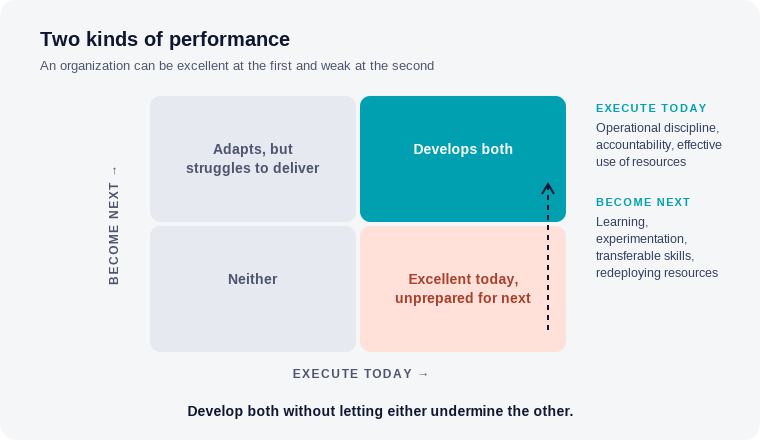
The second requires learning, experimentation, transferable skills, and the ability to redeploy resources. An organization can be excellent at the first and weak at the second. The management challenge is to develop both without allowing either to undermine the other. This suggests a broader performance framework.
Alongside margin, productivity, and utilization, leaders should understand how quickly the organization can introduce a new offering, replace an important dependency, acquire an unfamiliar capability, or redirect resources toward an emerging opportunity. These measures reveal something traditional operating indicators may miss. They show how capable the business is of becoming something different.
What should remain deliberately unoptimized?
One useful exercise is to identify the resources and capabilities that appear inefficient under current conditions but may have substantial value under different ones. Some will be unnecessary. Others may represent important options.
Experienced people with broad institutional knowledge, technology that supports portability, relationships with alternative suppliers, and teams capable of experimentation can all create future flexibility. Leaders should be able to explain why these resources are being retained and what circumstances would justify their use. That turns adaptability from an abstract organizational aspiration into an investment discipline.
It also creates a more meaningful conversation about the purpose of efficiency. Lower costs are valuable. So are greater capacity, improved quality, and faster execution. The question is how those benefits contribute to the organization’s long-term economic position.
The ability to become something else
The next generation of highly successful organizations may look quite different from the companies that dominated the previous one. They may employ fewer people, rely more heavily on autonomous systems, and change their products and operating arrangements more frequently. They may be extraordinarily efficient.
But their competitive advantage will also depend on how quickly they can recognize when the existing model needs to change. The challenge for leaders is to understand which forms of efficiency strengthen the organization’s future options and which quietly eliminate them. A business can be exceptionally well designed for the present and poorly equipped for the future.
As the pace of technological and economic change increases, the ability to adapt deserves the same managerial attention as the ability to execute.
Research references: OECD, Supply Chain Resilience Review (2025)