What If a Company Could Build Itself?
What happens when the resources required to start and operate a business become available on demand?

Imagine an entrepreneur identifies an underserved market. Within hours, a team of AI agents has analyzed the competitive landscape, reviewed customer feedback, developed several product concepts, and assembled an initial commercial proposition.
Another group of agents begins building the product. A research agent tests assumptions. A marketing agent develops positioning and campaigns. A finance agent models pricing, operating costs, and potential returns. The entrepreneur reviews the work, makes decisions, and redirects the team as new information becomes available. Much of this is already technically possible in some form.
The capabilities are uneven, and meaningful human oversight remains necessary. But the direction of travel is clear. Activities that once required hiring specialists, contracting agencies, or assembling a founding team are becoming available as software-enabled services. This has significant implications for entrepreneurship.
The resources required to create a business are changing, and with them, the economics of market entry, competition, and organizational scale.
The declining cost of getting started
Historically, building a company has required access to several scarce resources. Capital funds the early development period. Technical expertise turns ideas into products. Commercial expertise creates demand. Operational capability allows the business to deliver. Founders rarely possess all these capabilities personally. They assemble teams, recruit partners, raise capital, or purchase services.
Each approach introduces costs and constraints. A business may require substantial investment before it can test whether customers want its product. AI is beginning to change this sequence. A founder can use AI-enabled tools to investigate a market, build prototypes, generate creative material, develop software, and analyze early commercial results.
Some of these activities still require experienced specialists. Others can now be completed by individuals who previously lacked the technical skills to perform them. The effect is a reduction in the time and resources required to test certain business ideas.
Harvard Business Review explored this phenomenon in 2026, describing the compression of time, cost, and headcount required for startups to develop and improve products. The important implication extends beyond cheaper company formation. It changes the number and type of ideas that become economically worth pursuing.
The new economics of experimentation
Consider an opportunity that might generate $500,000 in annual revenue. Historically, a company pursuing that market might have needed to employ developers, marketers, operations staff, and customer-support specialists. The cost of establishing the business could make the opportunity unattractive.
If a founder can now access much of that capability through AI services, automation, and a small number of specialized contractors, the economics may look very different. The business no longer needs to support the same fixed-cost structure before it becomes viable. Smaller opportunities become commercially interesting.
Niche products can be tested more quickly. Services can be developed for customer segments too small to justify conventional software development. Entrepreneurs can pursue several experiments without committing to a full organization around each one. This creates the possibility of a market containing many more specialized businesses. It also creates a different competitive environment.
Established companies may find themselves competing with new entrants that have lower operating costs, fewer organizational constraints, and the ability to introduce products rapidly. The emerging advantage may belong less to those with the largest teams than to those who can assemble the most appropriate capabilities around a commercial opportunity.
From companies that employ people to companies that orchestrate capabilities
The traditional business organization is structured around people and functions. A company hires employees, assigns responsibilities, establishes reporting relationships, and creates processes through which work is coordinated. Agentic systems introduce another possible configuration.
Instead of employing a permanent team for every capability, a business may orchestrate a combination of human specialists, autonomous agents, software services, and external providers. The organization becomes a system for coordinating capabilities. This requires a different kind of management.
An AI research agent may gather market information. A strategy agent may develop recommendations. A product agent may translate approved requirements into software. Another system may test the product, while a commercial agent prepares experiments to assess demand. These activities can be connected into workflows, with information passing between them. But coordination is not automatic.
Each agent requires a defined responsibility, access to appropriate information, clear limits on its authority, and criteria for evaluating its work. The arrangement also needs mechanisms for resolving disagreements, handling errors, and escalating decisions that require human judgment. Without these structures, a collection of agents may produce an impressive volume of activity with little coherent business value.
The defining capability is therefore orchestration.
The founder becomes an operating architect
The entrepreneur’s role changes when execution becomes easier to acquire. In a conventional startup, founders often spend substantial time performing work because they cannot afford to delegate it. They write copy, prepare financial models, build prototypes, manage customer communications, and coordinate suppliers. AI can reduce some of that burden.
But removing execution constraints places greater importance on other decisions.
- Which market is worth pursuing?
- What evidence demonstrates that a customer problem is real?
- What proposition offers meaningful differentiation?
- How should the business make money?
- Which activities can be delegated, and which require human involvement?
- How much autonomy should an agent have when interacting with customers, spending money, or modifying a product?
The founder increasingly becomes the architect of a commercial system. The work involves defining objectives, allocating resources, evaluating evidence, and making decisions about the business’s direction. This creates a paradox. The more accessible execution becomes, the more important judgment may become. An entrepreneur who can create ten products quickly still needs to know which one deserves investment.
The limits of autonomous entrepreneurship
The prospect of companies operated primarily through agents is compelling, but important constraints remain. Technical capability is one. The Stanford 2026 AI Index found substantial improvements in agent performance, yet benchmark results still reveal meaningful failure rates on multistep computer tasks. Real business operations introduce additional complexity.
Customers communicate ambiguously. Supplier arrangements change. Regulations impose obligations. Financial transactions require authorization. Systems encounter unexpected conditions. An agent may complete individual tasks effectively while failing to understand the wider commercial implications of its actions. The second constraint is economic.
AI agents require models, infrastructure, software access, monitoring, and ongoing maintenance. Their costs may be significantly lower than some traditional alternatives, but they are not negligible. A process that appears inexpensive in a demonstration may become costly when repeated thousands of times, particularly if it requires extensive checking and correction. A third constraint is accountability.
A business remains responsible for its commitments, customer relationships, financial decisions, and legal obligations, regardless of whether particular activities are performed by people or technology. The most commercially promising autonomous businesses will therefore need more than capable agents. They will need operating systems that make agent activity dependable, observable, and economically rational.
A different architecture for starting companies
A useful model separates the business into four layers.
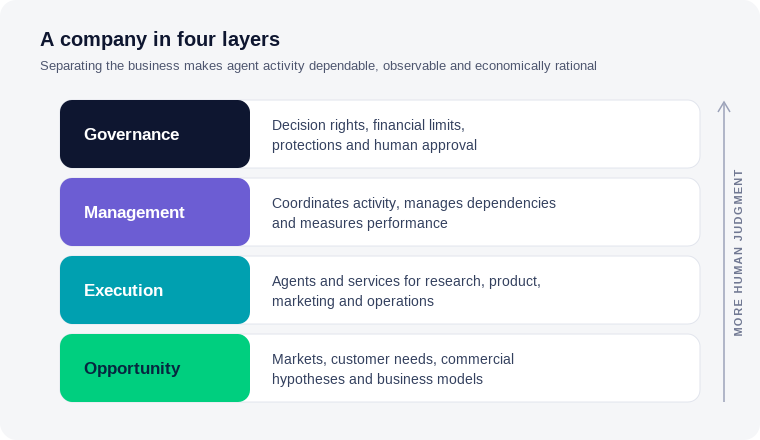
- The opportunity layer identifies markets, customer needs, commercial hypotheses, and potential business models.
- The execution layer contains agents and services responsible for research, product development, marketing, operations, and administration.
- The management layer coordinates activity, manages dependencies, measures performance, and determines whether work meets defined standards.
- The governance layer establishes decision rights, financial limits, customer protections, and the circumstances in which human approval is required.
This architecture offers a way to think about business formation as a repeatable process. An entrepreneur could begin with a commercial hypothesis and assemble the capabilities required to test it. As evidence accumulates, the business could expand, replace, or redeploy those capabilities. If the opportunity proves unattractive, the experiment could be closed without dismantling a large permanent organization.
If it succeeds, the founder could invest in the capabilities that create durable advantage. This model is particularly interesting because the same underlying infrastructure might support multiple businesses. The research, product-development, financial, and operational capabilities need not be reconstructed for every new venture. What changes is the commercial opportunity being pursued.
What becomes scarce when execution becomes abundant?
If the cost of creating products and launching businesses continues to decline, markets may become more crowded. Competitors will be able to imitate features, test propositions, and enter categories more quickly. Technical execution, while still important, may provide less enduring differentiation. Other assets could become more valuable.
Customer trust. Proprietary information. Distribution. Specialized domain knowledge. Access to difficult markets. Strong commercial relationships. And perhaps most importantly, the ability to identify opportunities that others have overlooked. The economics of company creation may also change what makes an entrepreneur successful.
Founders who can formulate strong hypotheses, interpret weak market signals, and allocate resources effectively may be able to manage businesses of a scale that previously required substantially larger organizations. The advantage will come from making better commercial decisions and building systems capable of executing them reliably.
The company as a living system
There is a larger implication to consider. Traditional businesses are expensive to create and difficult to change partly because their capabilities are embodied in permanent organizational structures. People are hired. Departments are formed. Technology is implemented. Processes become established. Once assembled, these structures influence what the business can do next.
If capabilities become more modular, accessible, and transferable, organizations may become easier to reconfigure. A company could expand into a new market by assembling additional capabilities. It could alter its product strategy without rebuilding its entire operating model. It could operate several small businesses through shared infrastructure, each with its own commercial proposition and performance measures.
This would make the organization more dynamic. The boundaries between founding, operating, and transforming a business could become less distinct. Of course, successful companies will still require human relationships, sound judgment, capital, and meaningful accountability. But the mechanism through which those ingredients are combined may change substantially.
At Eudai, we’re exploring these questions through Eudai Works, an AI-enabled venture operating model designed to bring together the capabilities required to research, validate, build, launch, and operate a business. We’ve written about how the idea came about in The Origin of Eudai Works.
The premise is that many of the functions traditionally assembled through separate teams, tools, and service providers can increasingly be coordinated through autonomous systems, with people retaining authority over consequential decisions.
The more interesting experiment is economic.
How much can the cost and complexity of venture creation be reduced? Which capabilities can be reliably delegated? And how does the founder’s role change when execution becomes more accessible?
These are questions we intend to explore through practical application, not simply theoretical analysis.
The next entrepreneurial advantage
We are approaching a period in which the ability to build something may become far less scarce than the ability to determine what is worth building. That changes the entrepreneurial equation. The question is no longer simply how quickly and cheaply a company can be created.
It is how effectively an entrepreneur can identify an opportunity, assemble the capabilities required to pursue it, and develop a business that creates sustainable economic value. The company that builds itself is not necessarily a fully autonomous enterprise. It may be an enterprise whose founder can continuously assemble, direct, and evolve the capabilities needed to compete.
That could become one of the most consequential changes in the economics of entrepreneurship.
Research references: Harvard Business Review, How Agentic AI Supercharges Startups and Threatens Incumbents (2026)