The Origin of Eudai Works
How an idea about human potential became a new way to build businesses.

Eudai began with a simple conviction: opportunity is everywhere, but the ability to act on it is not.
For years, building something new followed a familiar pattern. An entrepreneur had an idea. An organization saw an emerging opportunity. A market began to change. What happened next depended largely on access to the right people, capital, technology, and time.
Turning an idea into a functioning business meant assembling a team. Researchers, strategists, designers, developers, marketers, and operators. Each brought essential capabilities, but coordinating them required resources that many people and organizations simply didn't have.
The result was a world full of unrealized potential. Good ideas stayed in notebooks. Experienced professionals with deep industry knowledge never started the businesses they imagined. Companies invested heavily in innovation programs that produced compelling presentations but struggled to produce commercial outcomes. And even when a business launched, operating it introduced another layer of complexity.
The cost of building had become a barrier to the act of creating.
Eudai was founded around the belief that emerging opportunities should become meaningful capabilities and commercial value. Its work centered on helping businesses navigate new markets, develop strategies, commercialize technologies, and build the organizational capabilities required to succeed.
Then the economics of execution began to change
Artificial intelligence was evolving from a technology that could generate content and answer questions into systems capable of researching, reasoning, creating, using tools, and coordinating increasingly complex work.
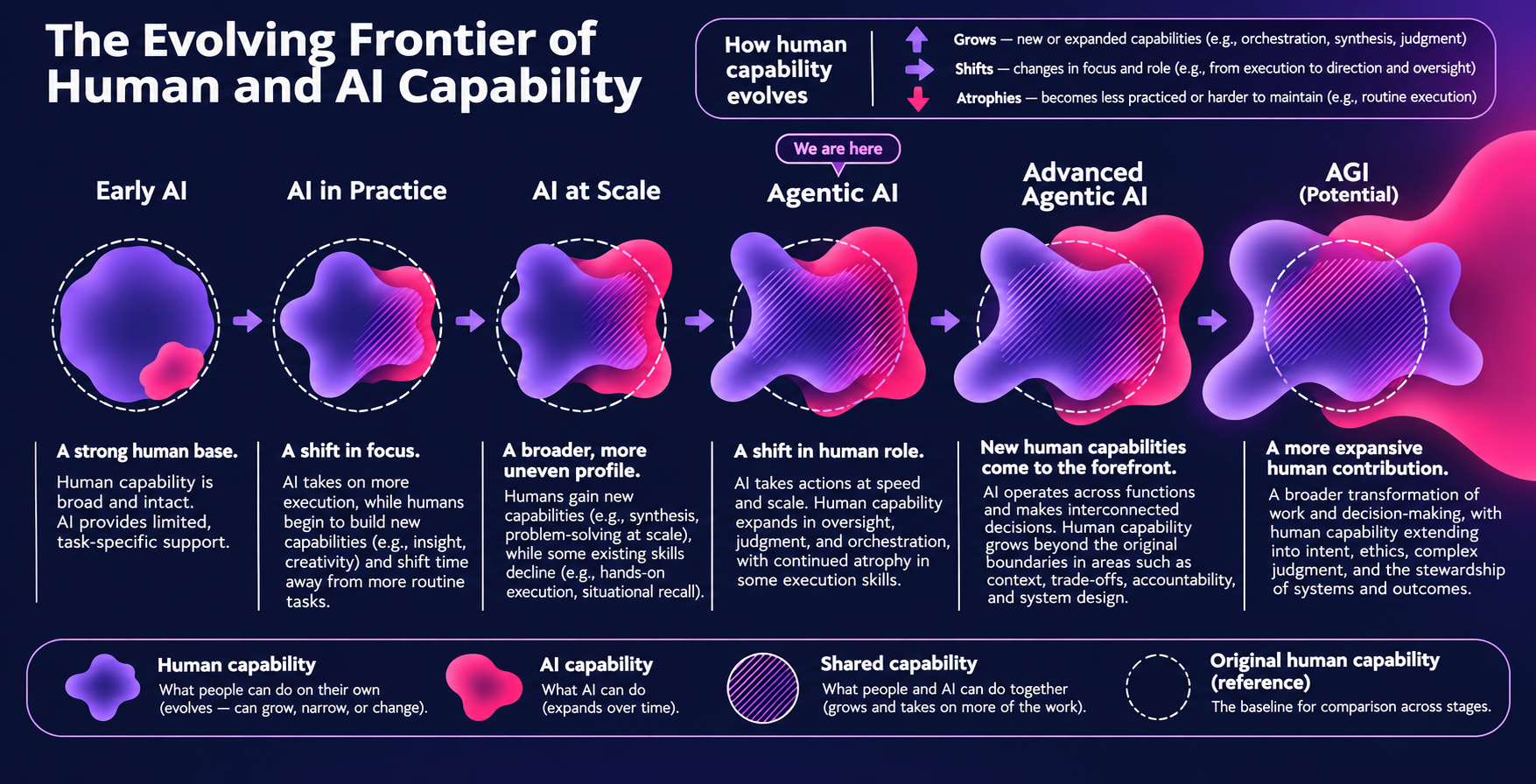
What has changed is where human capability goes. Early AI offered limited, task-specific support while people did the work. Agentic AI takes actions at speed and scale, and the human role shifts toward oversight, judgment, and orchestration. As AI begins operating across functions, the capabilities that come to the forefront are context, trade-offs, accountability, and system design.
For the first time, it became possible to imagine a venture team that didn't have to be assembled from scratch for every new business. A team that could investigate an opportunity, test commercial assumptions, build an initial product, prepare a launch, and manage defined operational activities. A team that could keep working between decisions.
That possibility raised a more consequential question:
What if the infrastructure required to start and operate a business could become a capability that anyone with a credible opportunity could access?
Not another collection of AI tools that founders would have to learn, configure, and manage themselves. Not a chatbot that produced a business plan. An operating system for building businesses.
One where specialized intelligent agents work together across the venture lifecycle, coordinated through shared objectives, evidence, workflows, and operating limits. Where the founder remains responsible for the vision, investment, and consequential decisions, while much of the work required to execute those decisions happens autonomously. And where human expertise is applied at the points where judgment, experience, and accountability matter most.
Beyond making businesses easier to start
But the opportunity went beyond making businesses easier to start.
Traditional businesses are built around relatively fixed structures. People, processes, technology, and operating models are assembled to support a particular strategy and anticipated level of demand. As markets evolve, adapting those capabilities can be expensive, disruptive, and slow.
What if a business could evolve its capabilities as quickly as its opportunities changed? What if the same intelligent systems that helped establish a venture could continuously identify emerging opportunities, respond to changing customer needs, experiment with new approaches, and adapt the way the business operates?
A venture could begin small, expand its capabilities as demand grows, and redirect resources when circumstances change. Founders and leadership teams could spend more of their time making consequential decisions, with intelligent systems coordinating much of the work required to act on them.
Eudai Works emerged from this larger possibility: making businesses easier to create, more economical to operate, and more capable of adapting as their markets evolve.
The name was deliberate
Eudai draws its inspiration from eudaimonia, the ancient Greek idea of flourishing and realizing potential. Works represents what makes that potential tangible: the activity of creating, building, producing, and bringing something into existence.
Together, they express a belief that has guided Eudai from the beginning. Human potential is realized through what we are able to create.
What it makes possible
Eudai Works brings that philosophy into a new technological era. It is designed to make venture creation more accessible, experimentation less expensive, and the path from opportunity to commercial execution more direct.
For an experienced professional, it could mean finally turning years of expertise into an independent business. For a founder, it could mean reaching the market without first assembling an entire operating team. For an established company, it could mean testing a new commercial opportunity without building another permanent organizational structure. And for Eudai itself, it opens the possibility of creating and operating new ventures through the same intelligent infrastructure.
The ambition extends beyond making existing work faster. It is about expanding who gets to build, what becomes economically possible, and how much more people can accomplish with the resources available to them. It is about changing the relationship between opportunity and execution, giving people and organizations the capacity to respond, build, and grow without continually rebuilding the infrastructure around them.
Because the most important consequence of intelligent systems may not be the work they replace. It may be the businesses, capabilities, and opportunities they make possible for the first time, the idea behind What If a Company Could Build Itself?.
Eudai Works was created to explore that possibility, and to turn it into something real.
One question to consider
Which opportunity have you set aside because the cost of building it seemed too high, and does that assumption still hold?