Who Owns AI Governance?
AI is becoming a board-level responsibility. But new research suggests that formal accountability has yet to catch up.

Only 4% of corporate leaders say their board or a board committee holds ultimate responsibility for AI governance, according to research from JUST Capital.
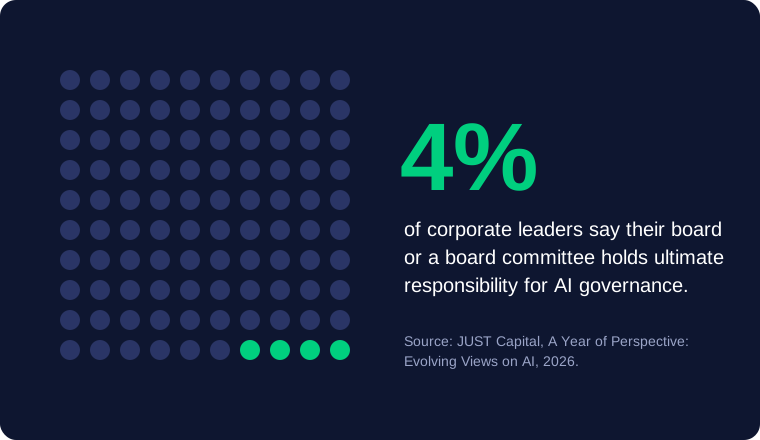
It’s a striking finding given the decisions organizations are already making about AI adoption, investment, risk, and accountability.
Boards are expected to oversee the strategic and operational implications of these decisions. Yet many directors are still working out what effective AI governance looks like in practice, where board oversight begins, and how responsibilities should be distributed across committees and management.
Part of the difficulty is that AI governance is federated. Decisions about AI are made across business units, functions, and vendors, and responsibility for overseeing them is spread across management, board committees, and the full board. That may help explain why so few leaders point to the board as the owner.
Boards need a better way to oversee that system: to know which decisions require them to zoom in, and where they can stay at the 40,000-foot view, as operating, regulatory, and legal conditions keep changing.
Moving from awareness to effective oversight
AI governance is frequently discussed in terms of policies, principles, and regulatory obligations. Those are important foundations. But directors also need to understand how governance works when decisions become consequential:
- What information should management bring to the board?
- Which decisions require board-level scrutiny?
- How should directors evaluate trade-offs between innovation, commercial opportunity, and risk?
- What evidence would demonstrate that the board exercised appropriate oversight?
These are the questions behind the decision system for AI governance that Vela Board Advisors has used with boards for the past 18 months.
It provides a practical framework for examining AI governance across four interconnected dimensions. It helps directors identify potential blind spots, consider how responsibilities intersect, and develop a more consistent approach to oversight. It gives boards a structured way to examine their existing practices and determine where greater clarity or capability may be needed.
From governance principles to boardroom decisions
Vela recently brought the system to the Private Directors Association’s annual conference, where directors worked through an AI governance scenario from different board and committee perspectives. The discussions revealed how easily the same situation can produce different interpretations of responsibility, acceptable risk, and appropriate action. They also reinforced why AI governance cannot be reduced to a checklist.
Boards need opportunities to examine difficult decisions, test their assumptions, and understand how their governance arrangements would perform under pressure.
Continuing the conversation in Dallas
On October 27, Dorsey & Whitney LLP will host an invitation-only AI Board Governance Program in Dallas. Together with Joanna Ridgway, I’ll share updates to the system, shaped by 18 months of feedback from directors, and facilitate a discussion built around a shareholder lawsuit case study.
We’ll explore how directors apply governance principles to real decisions, navigate competing responsibilities, and establish a defensible record of oversight. The session is designed to move beyond awareness of AI risk toward the practical questions boards need to be prepared to answer.
Tuesday, October 27, 2026 · 4:00–6:30 PM · Dallas, Texas
Board directors and senior executives interested in attending can request an invitation. You can also see our other upcoming events.
AI governance will continue to evolve alongside the technology itself. Boards don’t need to predict every development, but they do need a clear understanding of their responsibilities and a practical way to exercise them.
Accountability becomes meaningful when it can be demonstrated through decisions, evidence, and action.
Source: JUST Capital, A Year of Perspective: Evolving Views on AI, 2026.