What Grace Hopper’s Cancellation Says About the Economics of Community
The cancellation of Grace Hopper Celebration raises a bigger question about how we value the institutions that help industries grow.

The cancellation of the 2026 Grace Hopper Celebration should get the technology industry’s attention.
AnitaB.org announced that this year’s event, scheduled for October 27–30 in Anaheim, would not proceed. Individual registrations and sponsorship commitments had fallen significantly below expectations, leaving the organization without the funds required to cover operating expenses.
The organization also acknowledged that the cancellation had adversely affected its broader finances and that it was evaluating strategic alternatives.
For an event that has spent decades bringing women in technology together, that’s a consequential development.
And it raises questions about more than the future of one conference.
The business model behind the mission
Professional communities create value in ways that are notoriously difficult to capture on a balance sheet.
They facilitate relationships, develop talent, distribute knowledge, establish professional norms, and connect people to opportunities they might otherwise never encounter.
Much of that value accrues outside the organization responsible for creating it.
A connection made at a conference might eventually lead to a new job, a successful startup, an investment, or a collaboration that changes an industry.
The organization hosting the event rarely participates in those economic returns.
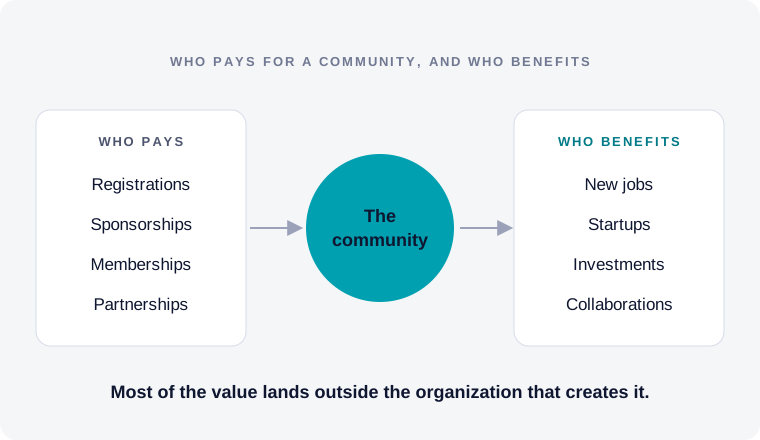
Instead, it must fund its operations through more immediate transactions: registrations, sponsorships, memberships, and partnerships.
That creates an inherent tension between the long-term value of a community and the short-term economics required to sustain it.
As long as sponsors recognize the value and participants can afford to attend, the model works.
When either side withdraws, the underlying vulnerability becomes apparent.
Grace Hopper appears to have experienced pressure from both.
Sponsorship is a reflection of corporate priorities
Corporate sponsorship has always involved a mixture of objectives.
Companies invest in events to recruit, build relationships, strengthen their brands, demonstrate commitment to particular communities, and associate themselves with ideas or causes that matter to their stakeholders.
Those investments compete with other demands on corporate budgets.
When priorities change, sponsorship is relatively easy to reduce because its benefits are often distributed across several functions and realized over time.
The same event might support recruitment, employee development, innovation, corporate reputation, and business development.
Yet no single department necessarily owns the full value.
That makes sponsorship particularly exposed when organizations become more disciplined about attribution and near-term returns.
We don’t yet know how much of Grace Hopper’s sponsorship decline reflects changing corporate priorities, tighter budgets, a different recruiting environment, or dissatisfaction with the event’s commercial proposition.
But the decline raises an important question.
Have we developed sufficiently sophisticated ways to measure the value of the professional ecosystems companies depend on?
Organizations routinely discuss the importance of talent pipelines, innovation networks, and access to diverse perspectives.
The mechanisms that sustain those outcomes often remain dependent on discretionary funding.
The value proposition may also be changing
The economics of large conferences deserve scrutiny in their own right.
Attendance requires far more than the ticket price. Travel, accommodation, time away from work, and the opportunity cost of spending several days at an event all influence participation.
At the same time, professional networking and access to expertise are changing.
People can develop meaningful communities through smaller gatherings, digital networks, professional cohorts, and specialized industry programs.
A large event can still offer extraordinary value, particularly through the concentration of people and opportunities in one place.
But size and legacy alone cannot guarantee continued relevance.
Attendees and sponsors increasingly need a compelling reason to invest their resources.
For organizers, this creates a strategic challenge: understanding which elements of their offering remain uniquely valuable, which need to evolve, and how that value can be delivered sustainably.
It is a commercialization question as much as a programming question.
Ecosystems need commercial infrastructure
Innovation rarely emerges from isolated organizations.
Industries develop through overlapping relationships among employers, educators, researchers, entrepreneurs, investors, professional associations, and communities of practice.
These networks help knowledge circulate and opportunities become visible.
They also provide the social infrastructure through which people enter industries, build credibility, and advance their careers.
Professional communities perform an important role within that system, but their funding structures are frequently less mature than their missions.
The Grace Hopper cancellation illustrates the risk of concentrating so much organizational and community value in an annual event whose viability depends on securing large commitments before it begins.
A more resilient model might distribute value and revenue across the year through research, professional development, membership, employer partnerships, smaller gatherings, and other services.
Those approaches introduce their own commercial challenges. Not every community wants a subscription, and not every valuable activity can or should be monetized.
But financial sustainability requires a clear understanding of who benefits, who can pay, and what forms of value are sufficiently important to support recurring investment.
Market relevance must be continually earned
There’s a broader lesson here for organizations operating in established and emerging markets.
A strong mission, recognized brand, and historically successful offering can create confidence that demand will persist.
Yet the conditions supporting that demand can change.
Customers revise priorities. Sponsors reconsider budgets. New alternatives emerge. Distribution becomes more fragmented. The economics of participation shift.
Organizations need mechanisms for detecting these changes early and adapting their commercial models accordingly.
That means examining customer behavior, understanding how value is perceived, testing new offerings, and challenging long-standing assumptions about revenue.
It also means recognizing when the market has evolved beyond the model that originally made an organization successful.
These are difficult decisions for institutions built around a mission because changes to the commercial model can feel like changes to the identity of the organization itself.
But sustaining a mission requires sustaining the capabilities that make it possible.
What gets lost when a community disappears?
The immediate consequences of the cancellation are tangible.
People have made travel arrangements, committed financial resources, planned recruitment activities, and anticipated opportunities to connect.
The longer-term implications are harder to calculate.
- What opportunities will never emerge because a particular relationship wasn’t formed?
- Which early-career professional loses access to a mentor, employer, or community?
- Which collaboration never gets started?
These questions are difficult to quantify precisely because the value of professional ecosystems is distributed, cumulative, and often delayed.
That doesn’t make the value any less real.
It does suggest that the organizations supporting these ecosystems need business models capable of reflecting how that value is created and who benefits from it.
The cancellation of Grace Hopper is a warning about what can happen when that alignment breaks down.
It is also an opportunity to reconsider how we build, fund, and sustain the communities on which innovation depends.
If professional communities are part of the infrastructure of innovation, their commercial sustainability deserves the same strategic attention as the technologies and companies they help create.