We Knew This Would Be Choppy
AI capabilities are advancing unevenly. The management challenge is growing alongside them.

There is a tendency to describe technological progress as a journey along a relatively predictable path. Capabilities improve. Costs decline. Adoption increases. Organizations discover new applications, and eventually the technology becomes part of ordinary business infrastructure. Artificial intelligence has broadly followed some elements of this pattern.
Yet anyone working closely with the technology knows that its progress is considerably less orderly than the adoption curves suggest. A system can write sophisticated software while struggling with a seemingly simple instruction. An agent can complete a complex research assignment and then make an inexplicable error when transferring information between applications.
A capability that was unreliable six months ago can suddenly become commercially useful. An application that works exceptionally well in testing may behave differently when introduced into a real operating environment. We knew this would be choppy. The more consequential question is whether organizations are developing the managerial capabilities to navigate that unevenness.
The frontier is jagged
Research into AI performance increasingly reveals a landscape in which capabilities develop at different rates. The Stanford 2026 AI Index documents rapid advances across reasoning, coding, and agentic systems, alongside persistent limitations.
On OSWorld, a benchmark measuring agents’ ability to complete tasks across computer interfaces, reported success rates rose from approximately 12% to 66%. That represents extraordinary progress in a relatively short period. It also means that agents still failed roughly one-third of the benchmark tasks. Those failures are not evenly distributed across all types of work.
A model may be highly capable within a particular domain while remaining unreliable when tasks require unfamiliar environments, longer sequences of actions, or the coordination of multiple systems. This unevenness matters because businesses do not generally operate through isolated benchmark tasks. They operate through workflows, relationships, decisions, and interconnected obligations.
A system that succeeds in nine individual activities may still fail to complete the process if the tenth activity is essential. The economics of deployment depend on the reliability of the complete process, the cost of detecting mistakes, and the consequences of failure.
Capability is only one dimension of usefulness
Consider two AI applications. The first helps a professional analyze complex information, offering recommendations that the professional reviews before making a decision. The second performs a sequence of actions independently, updating customer records, issuing communications, and committing resources. The underlying models may be similarly capable. But their operational requirements differ significantly.
The first can deliver value even when its outputs are imperfect. The human user can identify errors, apply judgment, and decide whether the recommendation is useful. The second requires more extensive controls because mistakes may affect customers, financial records, and other systems before they are detected. Moving from assistance to autonomous execution therefore introduces additional requirements.
The system needs appropriate permissions. It must recognize when an action exceeds its authority. It needs ways to recover from mistakes and mechanisms for escalating unexpected conditions. The relevant question is no longer simply how intelligent the AI is. It is whether the entire arrangement can perform a defined responsibility reliably enough for its intended business use.
This is where AI adoption becomes an organizational design problem.
Human capability is changing too
Discussions of AI progress often compare an increasingly capable machine with a relatively static human workforce. That comparison overlooks an important part of the transformation. People are learning to work differently.
Professionals who previously needed technical specialists to build prototypes can now develop and test their own ideas. Small teams can analyze information, produce creative assets, and experiment with products at a scale that would once have required extensive support. The capabilities available to individuals are expanding. At the same time, the skills required to use those capabilities effectively are changing.
Knowing how to perform a task remains useful. Knowing how to define the task, assess its output, detect errors, and integrate results into a larger objective may become more valuable. The challenge is that people do not acquire these capabilities automatically.
An experienced employee may be excellent at using an AI system without understanding where its judgments are unreliable. A junior employee may learn to produce sophisticated work before acquiring the domain knowledge needed to evaluate its quality. Organizations must develop both the ability to delegate work to AI and the ability to exercise informed judgment over what AI produces.
This creates a second frontier alongside technological progress: the expanding and uneven capabilities of the people who work with it.
The management problem is moving
Traditional technology management assumes that organizations can specify a system’s behavior, verify its performance, and control changes through established processes. AI complicates each step. A model update can alter performance across many different activities. A change that improves accuracy in one context may introduce unexpected behavior elsewhere.
An agent may encounter circumstances that were not anticipated when its workflow was designed. And when several systems interact, their combined behavior may be more difficult to understand than their individual functions. This does not make effective management impossible. It changes what managers need to know.
They must understand where a system performs reliably, what conditions affect its behavior, and which decisions require human authority. They also need evidence of how performance changes over time. A deployment decision should not be treated as a permanent declaration that a system is suitable for a particular purpose. Suitability is conditional.
It depends on the task, the environment, the consequences of error, and the controls surrounding the technology. As those conditions change, the assessment may need to change with them.
This challenge surfaced in recent conversations with directors and business leaders at NYSE Wired.
As AI becomes embedded in consequential business decisions, boards need to understand more than the technology’s capabilities at a particular moment.
They need to understand how management evaluates changing model behavior, where human judgment remains essential, and how the organization responds when outcomes differ from expectations.
The same questions extend throughout the enterprise.
As AI capabilities advance, organizations must continuously reassess which activities can be delegated, what evidence is needed to establish reliability, and which decisions require human authority.
The technology is evolving. The organization’s ability to manage it must evolve alongside it.
Why fixed AI strategies age quickly
Many organizations still approach AI transformation through conventional planning cycles. They identify use cases, allocate budgets, create implementation roadmaps, and set adoption targets. These activities provide useful structure. But a strategy built around a fixed understanding of available capabilities can become obsolete long before the planning period ends.
A workflow that was too expensive to automate at the beginning of the year may become viable by the end of it. A competitive advantage based on access to a specialized capability may disappear when that capability becomes broadly available. An organization may invest heavily in a custom solution only to discover that its underlying functionality is becoming part of a standard software platform.
The appropriate response is to treat technological assumptions as variables that require regular reassessment. Organizations need to distinguish durable investments from temporary advantages. Proprietary data, customer relationships, distribution, domain expertise, and organizational capabilities may retain value even as individual AI tools change. Specific models and applications may not.
This has implications for architecture, procurement, talent development, and capital allocation. The ability to replace a model or change the underlying technology without reconstructing the entire business process may become an important source of strategic flexibility.
Managing the uneven frontier
There are three questions every organization deploying AI should be able to answer.
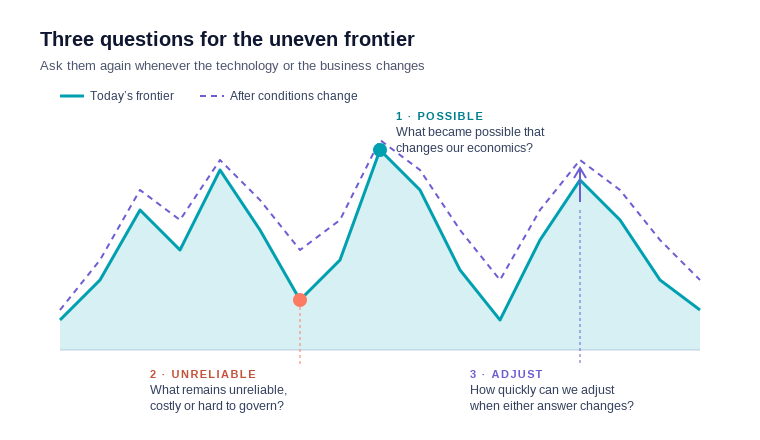
- First, what has become possible that materially changes the economics of our business?
- Second, what remains unreliable, expensive, or difficult to govern?
- Third, how quickly can we adjust when either answer changes?
These questions are more useful than broad declarations about becoming AI-first. They require leaders to connect technology capabilities with commercial outcomes, operating requirements, and organizational readiness. They also demand continuous learning. Companies will need ways to evaluate emerging capabilities, run controlled experiments, capture operational evidence, and translate that evidence into investment decisions.
Some applications will justify rapid deployment. Others will remain better suited to assisted workflows. Certain uses may require more mature technology or more robust controls. The appropriate decision will depend on the economics and consequences of each use.
The next phase of AI leadership
The most consequential aspect of AI’s uneven progress may be the management challenge it creates. Technological capability is advancing quickly. Human capability is evolving alongside it. Organizational systems for coordinating both are developing at different speeds. That creates a widening set of possibilities and a growing number of decisions about where and how to apply them.
Competitive advantage will depend partly on how effectively organizations navigate this changing relationship. Leaders will need to become more skilled at distinguishing technical demonstrations from operating capabilities, and operating capabilities from commercial opportunities. They will also need to make decisions under conditions in which the underlying technology may change faster than conventional management structures.
The AI frontier will continue expanding unevenly. The organizations best positioned to benefit will be those that learn how to move with it.
Research reference: Stanford HAI, 2026 AI Index Report