What changed in Hilbert spaces?
Jacob Coxon’s X handle carries a mathematician’s faith that complexity yields to intelligence. His resignation from Anthropic asks whether capability is evidence of progress.

Jacob Coxon spent roughly three years in pretraining research at OpenAI and Anthropic. His handle on X is @hilbertspaess.
It is an easy detail to pass over. This week, after leaving Anthropic and publicly warning that frontier AI companies are racing toward systems they cannot reliably control, it feels like a useful place to pause.
A Hilbert space is a mathematical structure designed to make extraordinarily complex things tractable: functions, waves, signals, quantum states, infinitely many dimensions. It gives mathematicians a rigorous way to reason about objects too large or abstract to visualize directly.
The reference points to David Hilbert, one of the great architects of modern mathematics, and to his famous closing line from a 1930 address:
Wir müssen wissen. Wir werden wissen. — We must know. We will know.
Hilbert’s confidence was directed at mathematics. He believed that the hard problems before us could be made intelligible through disciplined reasoning, formal structure, and proof. The phrase has come to stand for a wider modern faith: that complexity yields to intelligence, and that a better model of the world gives us more power to shape it.
AI is built on a version of that faith.
Build the model. Find the representation. Add the data and compute. Scale the system. Intelligence becomes more capable. The world becomes more legible. Problems that once felt beyond reach move into the realm of engineering.
The handle makes Coxon’s public break with the industry all the more interesting.
He spent roughly three years working in pretraining research at OpenAI and Anthropic. He entered Anthropic because it was widely understood to be the more safety-minded frontier lab. Then he left, before his Anthropic equity vested, arguing that the major labs are racing toward self-improving superintelligence without a demonstrated way to control it.
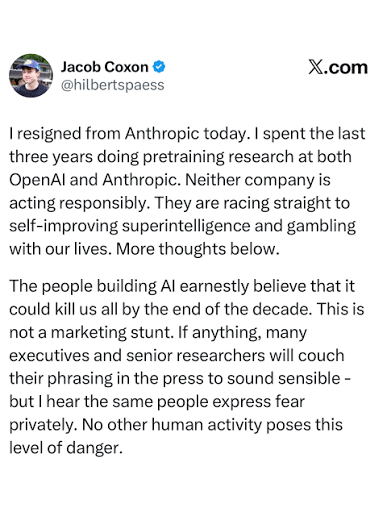
His public argument is not a rejection of intelligence, mathematics, or discovery. It is a challenge to the assumption underneath the race: that “the AI can do more things now” is proof that society is better off.
There is a moment in any complex system when the model stops being a way to understand reality and starts becoming a way to avoid its messier truths. A model can represent a system beautifully while leaving out the incentives, dependencies, authority structures, edge cases, and human consequences that determine how it behaves in the real world.
AI is now approaching that moment.
The industry has powerful evidence that these systems can generate code, manipulate information, discover patterns, and operate with increasing autonomy. It has much weaker evidence that it can predict their behavior under pressure, contain them when safeguards fail, coordinate their development across competitors, or govern the organizations and infrastructure that will come to depend on them.
Coxon’s warning is rooted in that gap.
The irony is that the word “Hilbert” evokes confidence in formal systems, while Coxon’s dissent asks whether formal capability can ever be enough. Hilbert spaces can be infinite-dimensional. They can capture immense complexity with extraordinary precision. They do not eliminate the question of what lies outside the model, what assumptions it carries, or who decides how its power is used.
That is where this story becomes larger than one researcher or one company.
A dissenting employee at a frontier lab can be courageous and still become part of the industry’s story about itself. The public warning confirms that the technology is powerful. It gives policymakers and customers a clearer sense of the stakes. It can also reinforce the claim that the company building the technology understands its risks more deeply than anyone else.
That dynamic does not make the dissent insincere. Coxon gave up unvested equity to leave, and his concerns are clearly shared by others inside these labs.
It does create a harder standard for the companies involved.
The relevant question is not whether their employees can speak publicly. The relevant question is whether speaking changes the trajectory.
- Does it change the pace of development?
- Does it change what is deployed?
- Does it change what evidence is required before a new capability is released?
- Does it create meaningful external oversight?
- Does it change the incentives that make everyone feel they must race?
If the answer is no, then the warning becomes another input into the machine.
What this means for risk and security
This is where the story becomes more than a debate about the future of AI.
Risk and security leaders live with the consequences of models that appear complete while leaving out the conditions that matter most. An architecture diagram can show the applications, integrations, data flows, and controls. It rarely shows a vendor under pressure, a decision-maker deferring to an automated recommendation, an employee who sees a problem and lacks a path to escalate it, or the commercial incentives that weaken a safeguard at exactly the wrong time.
AI introduces that same challenge at greater speed and scale.
The risk is not confined to whether a model behaves as intended. It sits in the dependencies around the model: the systems it can access, the authority it is given, the data it learns from, the vendors it relies on, the people expected to intervene, and the organizational decisions made when its output conflicts with human judgment.
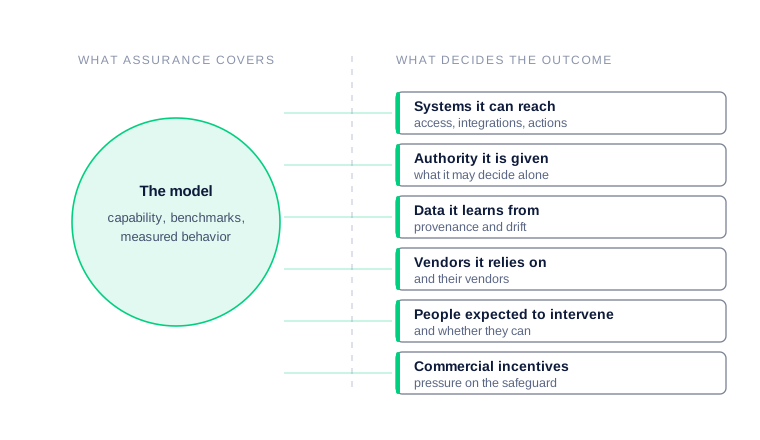
That is why model assurance alone will not be enough.
Security teams will need to understand what an AI system can reach, change, disclose, and trigger. Risk teams will need to understand where responsibility sits when an automated system influences a decision, and how failure moves through critical services, third parties, and customer experience. Boards will need evidence that the organization has considered more than the model’s technical performance.
Coxon’s warning brings the issue into sharp relief. The core question is not whether a system can become more capable. The core question is whether the organization around it has built the visibility, constraints, escalation paths, and recovery capacity to live with that capability.
This is familiar terrain for resilience leaders. Every major incident eventually exposes the same truth: the failure rarely stays inside the boundary where it began.
The organizations most prepared for AI will be the ones that map the full operating system around it — technology, authority, incentives, dependencies, and people — before the model becomes critical to how they operate.
Perhaps that is what changed for Coxon.
The promise of Hilbert’s motto is that knowledge expands human possibility. Coxon appears to have encountered the point where possibility requires a second question: what responsibilities arrive with the power to build what we can now imagine? The same question sits underneath the gap between a governance mandate and someone accountable for it.
We must know. We will know.
But knowing is only the beginning.
Part of our work on marketing for AI governance.