Your Customer Acquisition Strategy Is a Resilience Problem
Some of the most consequential dependencies in a business sit upstream of delivery, in the systems through which customers find you.

Most organizations don’t think of customer acquisition as a resilience issue. Search belongs to marketing. Social belongs to communications. Analyst relations sits somewhere between marketing and strategy. Partnerships and sales have their own channels and owners.
Then one of those channels changes.
Google changes how it presents results. An algorithm update reduces traffic to pages that performed reliably for years. A social platform changes what gets distributed. An AI assistant answers a buyer’s question without sending them to your website. A review site changes its methodology, or a marketplace changes its rules.
Nothing is technically down. Customers can still buy from you and every internal system may be operating exactly as designed. But if fewer customers can find you, understand you or include you in their consideration set, the business has still experienced a meaningful disruption.
That makes customer acquisition a resilience problem too.
It also means the people who own growth can borrow the vocabulary resilience teams already use: single points of failure, disruption and contingencies.
We built dependencies without calling them dependencies
When resilience teams map critical dependencies, they tend to focus on the things required to deliver a product or service: technology, cloud infrastructure, suppliers, data, people, facilities and telecommunications.
There is another set of dependencies sitting further upstream, though: the systems through which demand reaches the organization in the first place.
For many businesses, those systems are increasingly controlled by someone else. Google influences what appears when someone searches. LinkedIn determines what gets distributed. Marketplaces determine which products surface. Review sites influence which vendors make a shortlist. Analysts help define categories and the companies associated with them. AI systems increasingly mediate questions that previously resulted in someone clicking through to a website.
These may sit on a marketing plan as channels, but some have become part of the commercial infrastructure of the business. And companies often have remarkably little control over how they operate.
The dependency is easy to miss when everything is working
This is a familiar resilience problem. Dependencies tend to become most visible when they fail.
If organic search has reliably generated a significant share of inbound pipeline for five years, it can start to feel like an attribute of the business. In reality, that performance depends on another company’s product, algorithm, business model and decisions continuing to work in ways that benefit you.
The same is true of social reach, marketplace rankings, app-store visibility, paid-media economics and increasingly AI-generated discovery.
None of these channels needs to disappear completely to create a problem. A gradual decline in visibility may be enough. A competitor becoming the default source cited in AI answers may be enough. A platform changing its economics may be enough. A growing share of customers getting the information they need without ever visiting your site may be enough.
That is what makes this kind of disruption easy to overlook. The dependency can continue functioning while becoming materially less valuable to the business.
It is already happening to well-known companies. Chegg built much of its business on students searching for answers and clicking through to its pages. In May 2023, its CEO told investors that ChatGPT was hurting new customer growth, and the stock fell 48% in a single day. Then Google introduced AI Overviews, and Chegg’s non-subscriber traffic fell by about half year over year. The company sued Google and cut 45% of its workforce.
Chegg demonstrates the bigger point: you can be very good at optimizing for a distribution system and still be vulnerable when the distribution system itself changes.
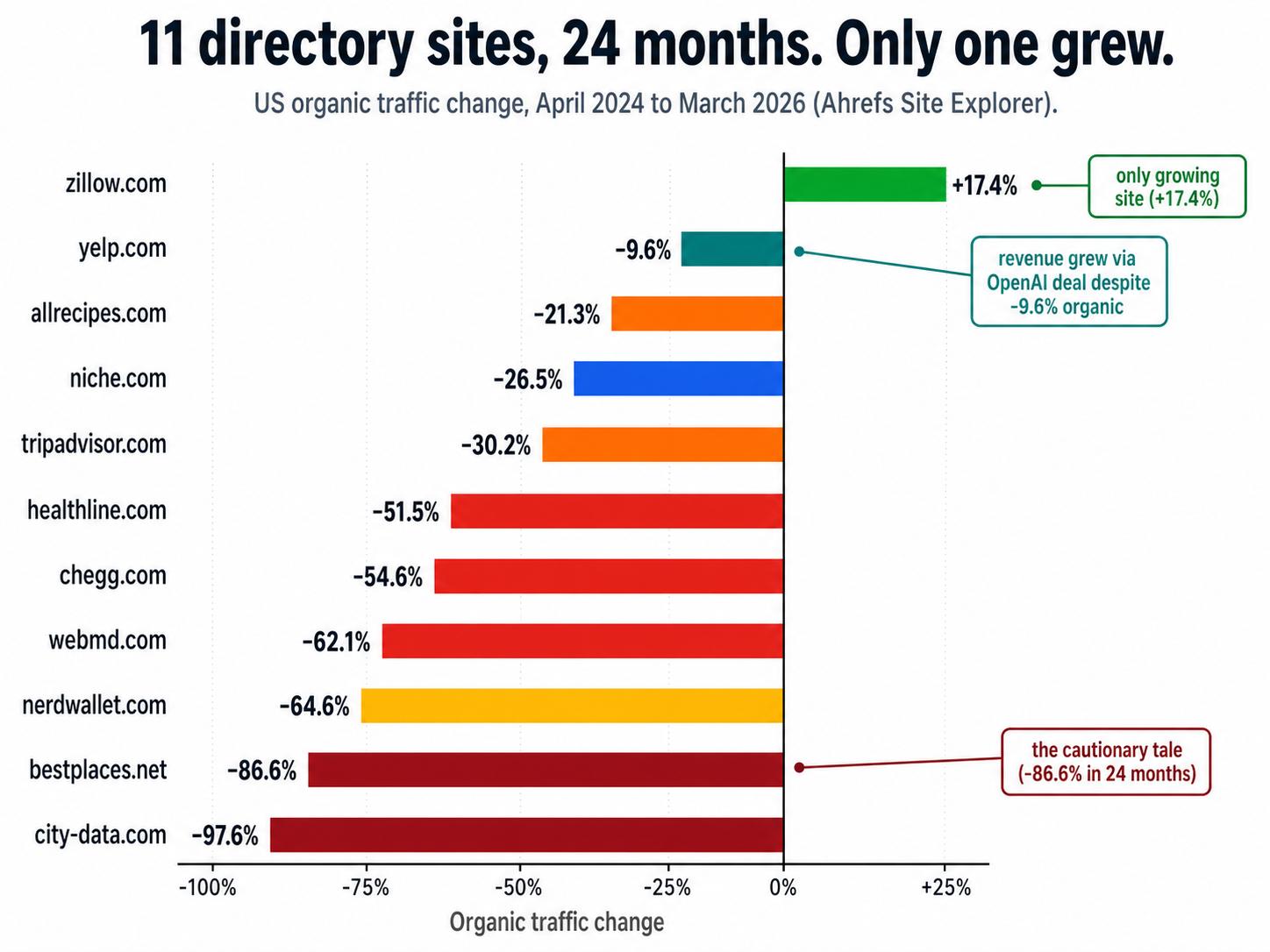
Tripadvisor has told investors it is seeing ongoing declines in visitors “due to the changing search landscape and the rise of AI overviews.” Revenue in its legacy hotels business, which depends on people arriving from search, fell 21% year over year in the second quarter of 2026.
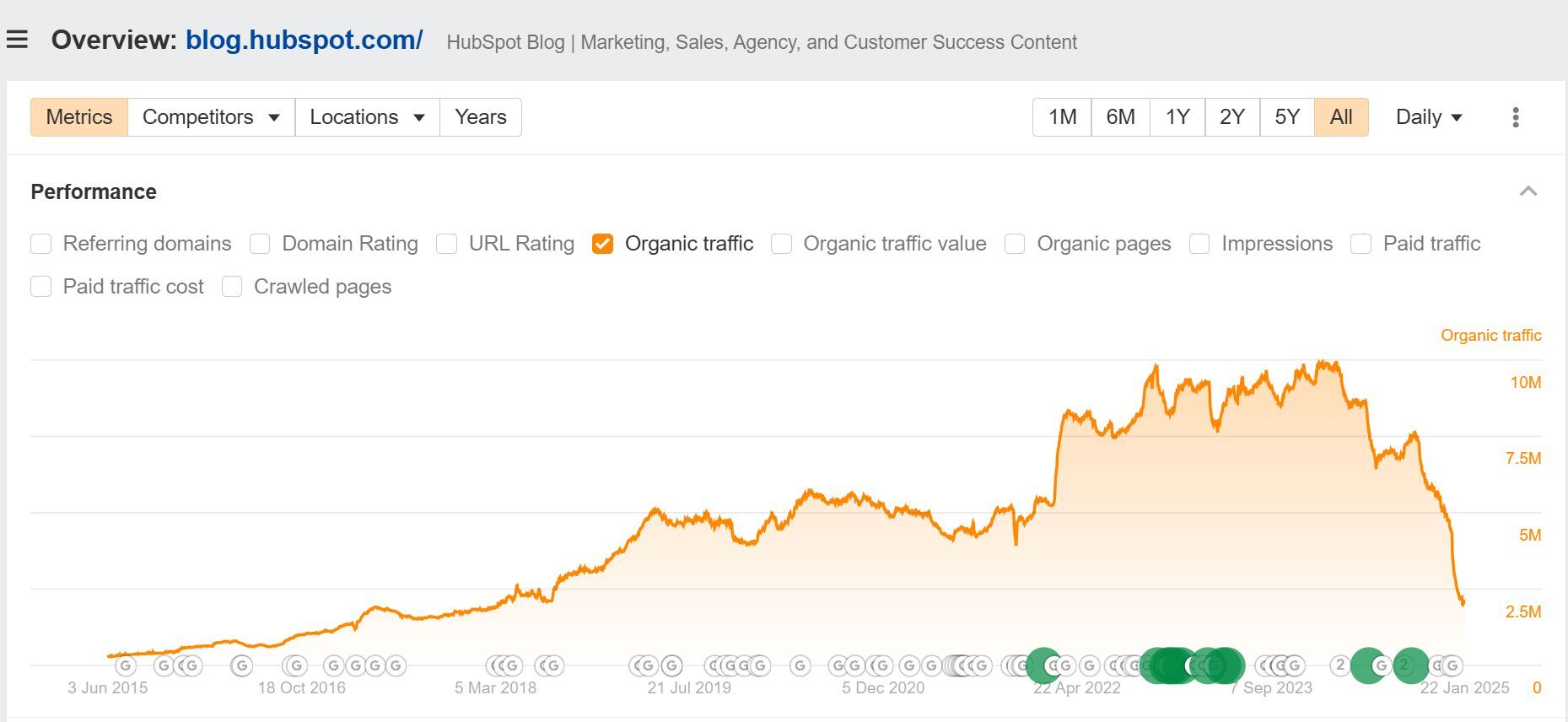
HubSpot, the company that popularized inbound marketing, saw its blog’s organic traffic fall by an estimated 70–80% from late 2024. Its revenue kept growing, in part because it had already spread its audience across YouTube, podcasts, newsletters and social. The dependency was the same. The exposure was not.
When a chart of that drop circulated on LinkedIn in January 2025, the reaction across marketing was some version of “no one is safe.” If one of the best-resourced content teams in the world could lose most of its search traffic in a few months, no growth plan should assume the channel will hold.
AI makes the dependency more complicated
Search already gave companies limited control over how customers discovered them. Generative AI introduces another intermediary into that relationship.
A buyer can now ask an AI system to explain a market, identify vendors, compare approaches, summarize customer feedback or recommend questions to ask during procurement. The resulting answer might draw from your website, a competitor’s website, an analyst report, a customer review, a Reddit discussion, an old article or sources you have never seen.
Your company may appear in that answer. It may not. The information may be current and accurate, or it may reflect a version of the market that has already moved on. And the buyer can make meaningful progress toward a decision without ever becoming visible in your website analytics.
Marketing teams are responding with SEO, AEO and GEO strategies designed to improve visibility across these environments, and that work has a role.
The resilience question is different: what happens if the discovery environment continues to change faster than you can optimize for it?
This is also a concentration-risk question
Consider two companies selling into the same market.
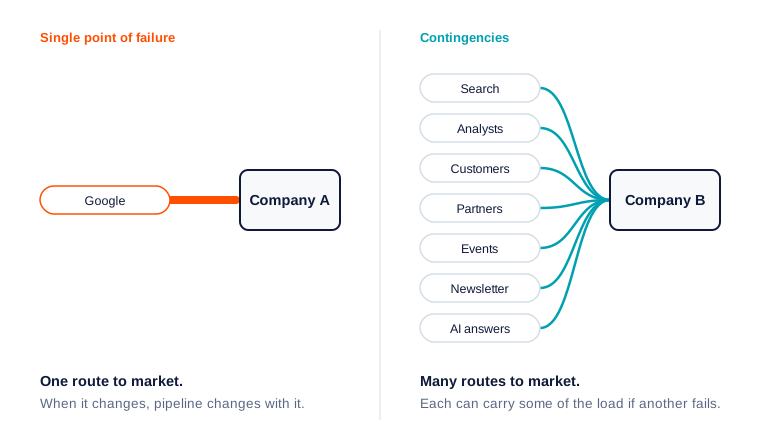
The first gets most of its demand through organic search and paid media. The second benefits from those channels too, but customers also hear about it from analysts. Its research gets cited by industry experts. Customers recommend it publicly. Its executives speak at conferences. Partners introduce it into opportunities. Its newsletter has an established audience, and people increasingly search for the company by name.
The second company hasn’t eliminated platform dependency. It has simply created more paths through which the market can find and validate it.
In resilience terms, the first company has a single point of failure. The second has contingencies.
Resilience teams already understand this principle in other contexts. We don’t generally consider a critical service resilient simply because its sole supplier happens to be excellent. We look at concentration, alternatives, substitutability and what happens when the expected route is no longer available.
Commercial dependencies deserve some of the same scrutiny.
Social proof is part of the resilience architecture
This also changes how we might think about something normally treated as a marketing tactic: social proof.
Case studies, named customers, customer quotes, independent reviews, analyst recognition, research citations, media coverage and expert recommendations all help buyers establish whether a company is credible. They may also influence how that company is represented across search and AI-mediated discovery.
Collectively, however, they do something more fundamental: they distribute what the market knows about you.
If almost everything authoritative about your company exists on your own website, knowledge of the company is relatively centralized. If customers, analysts, journalists, partners and practitioners are independently discussing your work, evidence about the company exists across a much broader information environment.
This is why getting other people to talk about you matters beyond PR. What you say about yourself is only one input into how the market understands you. Increasingly, buyers — and the systems helping them research — have many other sources available.
You cannot manufacture that external evidence entirely on your own domain.
So where does resilience come in?
The resilience team’s job isn’t to run SEO, tell marketing how to optimize for ChatGPT or take ownership of customer acquisition strategy. Its contribution is the same one strong resilience teams make elsewhere in the organization: make important dependencies visible before they become failures.
That means asking questions that may not currently appear in a business continuity assessment. How dependent is growth on platforms the company doesn’t control? Which external systems materially influence whether customers discover the business? How concentrated is pipeline by channel? Which apparently different channels actually share the same underlying dependencies? How quickly would the organization recognize a meaningful change?
From there, the questions become more operational. What would a 20%, 40% or 60% reduction in a major source of demand mean for the business? Which other channels could absorb it? How long would those alternatives take to become effective?
For business teams, those questions reduce to three:
- Single points of failure: which channel, platform or intermediary would materially hurt pipeline if it changed?
- Disruption: what would a partial loss look like, and how quickly would we notice it?
- Contingencies: which alternatives exist today, and how long would they take to carry real volume?
That last question is particularly important because many of the alternatives have long lead times. You can redirect technology workloads relatively quickly under the right conditions. You cannot create five years of brand recognition, customer advocacy or industry relationships on Tuesday afternoon.
Exercise the strategic failures
Resilience scenarios are often easiest to imagine when something breaks. Customer acquisition creates a more interesting class of scenarios because nothing necessarily has to fail.
Imagine organic traffic falling 40% over six months while overall demand in the market remains stable. Or AI-generated answers becoming a major research channel in your category while your company rarely appears in them. Perhaps your largest source of inbound leads changes its algorithm and qualified traffic begins steadily declining, or inaccurate information about your company starts appearing repeatedly in AI-generated answers.
Another scenario might be even less visible: a competitor publishes proprietary research that becomes the source analysts, journalists, practitioners and eventually AI systems routinely cite when explaining your category. Your website still works. Your campaigns still run. Your products are still available. But the information environment around the buying decision has shifted.
There is no incident bridge for any of these situations. Customers are still buying. The organization remains operational. Yet the economics of finding the next customer have changed.
Exercising those scenarios can expose capabilities that take years rather than days to develop: brand recognition, direct audiences, customer advocacy, proprietary research, analyst relationships, partnerships, communities, media relationships and executive visibility.
Those capabilities are usually discussed as growth investments. They are also options the business can draw on when a previously reliable path to market becomes less reliable.
In resilience language, they are contingencies. Like any contingency, they only help if they exist before the disruption.
Resilience isn’t only about whether the system stays up
Operational resilience has understandably focused on whether organizations can continue delivering important services through disruption. That remains essential, but the environment organizations operate within is becoming volatile in ways that do not always resemble traditional operational failures.
AI changes interfaces. Platforms change economics. Customer behavior shifts. Categories form and dissolve. Language changes. Intermediaries gain and lose influence. The systems themselves can remain available throughout all of it.
A business can therefore remain completely operational while the assumptions supporting its growth become obsolete.
Resilience teams have something useful to contribute to that problem. They don’t need to own the commercial strategy or predict which platform will matter next. They can help the organization identify where assumptions have quietly become dependencies, test what happens when those assumptions stop holding, and understand which capabilities need to exist before they are urgently required.
Sometimes the system you depend on doesn’t go down.
It keeps working. The world around it just stops working the way your strategy assumed it would.