AI Adoption Is Really a Problem of Imagination
New research suggests that one of the biggest constraints on AI transformation is our ability to envision different ways of working.

Same tools. Same training. One group of companies earned nearly twice the revenue.
That’s the headline from a new field experiment by Hyunjin Kim, Dahyeon Kim, and Rembrand Koning of INSEAD and Harvard Business School. They gave 515 high-growth startups AI tools, resources, and technical training. Half also got something extra: examples of how other businesses had reorganized their workflows and operations around AI.
That second group:
- Found 44% more AI use cases, mostly in strategy and product development
- Completed 12% more tasks
- Were 18% more likely to land paying customers
- Generated 1.9x the revenue
- Needed 39.5% less outside capital, without cutting headcount
The researchers call the underlying issue the AI mapping problem: the difficulty of discovering where and how AI can create value inside a business. It’s a working paper and a short experiment with early-stage companies, so it isn’t a forecast for every enterprise. But the design isolates one variable, and that variable was imagination. The difference wasn’t access to technology. It was exposure to other ways of working.
We automate what we already understand
Most companies find AI opportunities the same way. Survey employees about repetitive tasks. Document processes. Ask each department what it could speed up. That produces useful improvements, and it quietly locks in how the business already runs.
If a marketing team spends 20 hours on a report, the obvious move is to produce it faster. The better question is why the report exists, who reads it, and whether a different flow of information would lead to better decisions. If service agents spend their day routing requests, AI can route faster. Or the company can rethink who resolves requests and where authority should sit.
Start from tasks and you’ll improve tasks. Start from how value is created and a much bigger set of options appears. A professional services firm that uses AI to speed up research gets better utilization. A firm that rethinks delivery might offer continuous insight instead of projects, serve clients who couldn’t afford it before, or package expertise that used to be sold by the hour.
From a good idea to a new way of operating
Spotting the opportunity is only the start. Ten years ago, Gartner connected Design Thinking, Lean Startup, and Agile into one model for building products. I’ve been adapting that idea for something broader: how an organization keeps discovering, testing, and adopting new ways to operate. Our new guide, Resilient operations and continuous adaptation, lays out that model in three phases.
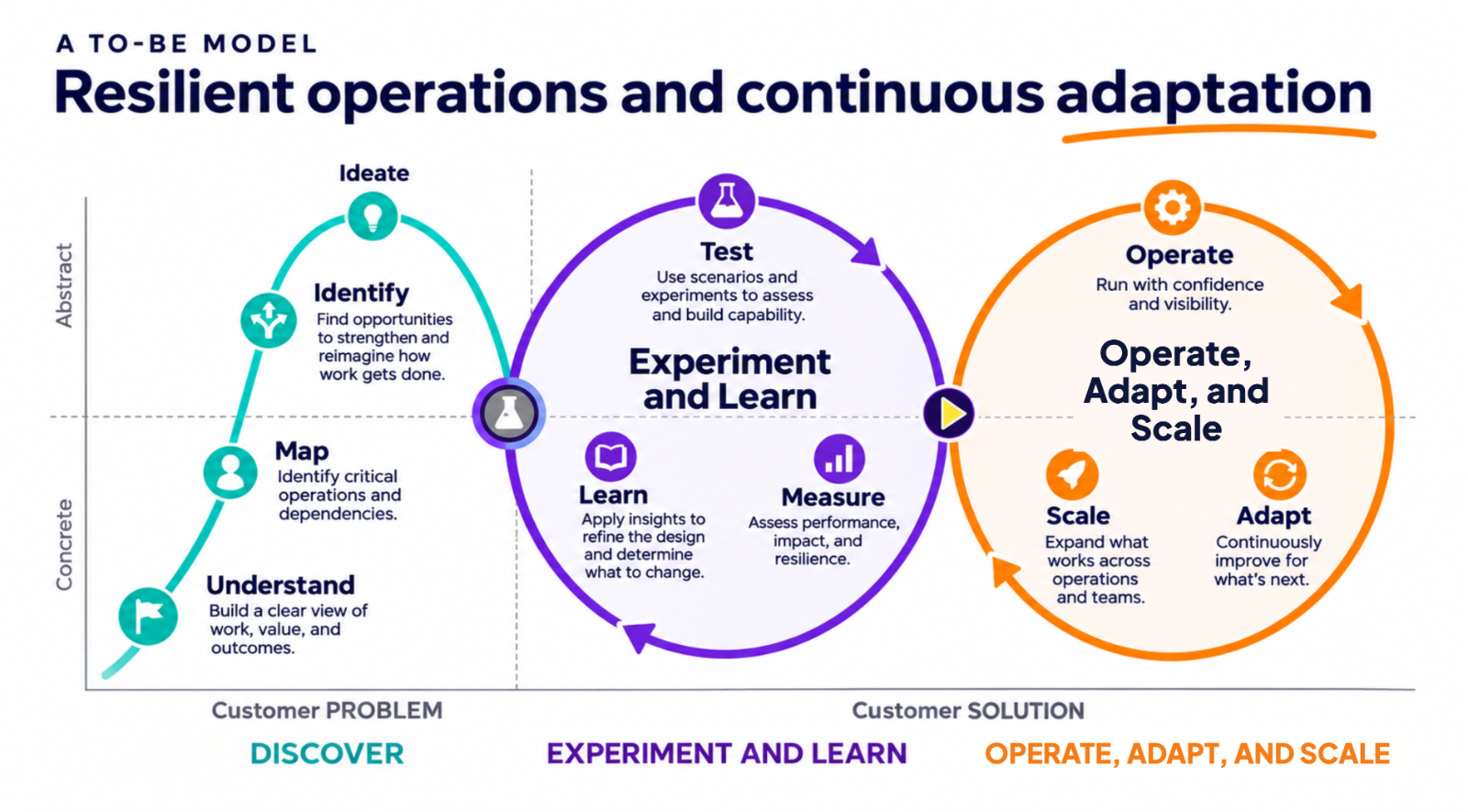
- Discover. Build a clear view of how work, value, and dependencies actually fit together, then look for what could work differently. This is where outside examples matter most.
- Experiment and learn. Test the alternative with a prototype, a redesigned workflow, or a limited pilot, and measure business outcomes rather than adoption.
- Operate, adapt, and scale. Change the roles, processes, and commercial models needed to run it reliably, then feed what you learn into the next round.
Why it stalls
Most organizations already have innovation programs, transformation teams, and product methods. The trouble is the handoffs. Strategy spots an opportunity but can’t change operations. Innovation builds a prototype with no route to production. Operations knows the current model’s limits but rarely sees what’s newly possible. Technology ships capabilities without the commercial context.
Each team sees part of the picture. Leaders decide whether those parts meet: which assumptions can be challenged, where teams can experiment across boundaries, and whether what experiments reveal actually changes investment decisions.
The advantage is in what you can see
The strongest gains in the study went to the strongest startups. AI widened what the best firms could do. Established companies have even more to work with, including customers, distribution, expertise, and relationships that already contain the next opportunity. They also have more habits that hide it. Meanwhile, new competitors are designing businesses with none of those habits.
Mapping can’t be a one-time exercise. The technology will keep moving, and the organizations that win will be the ones that get better at imagining, testing, and adopting new ways to operate.
The possibilities available to a business are shaped by what its people are capable of seeing.