The Trouble With Calling Everything Superintelligence
AI has a new name. What happens when the language of a technology gets ahead of the technology itself?

Artificial intelligence has a branding problem. Apparently, the solution is to call it superintelligence.
On September 29, the US government formally adopted “Super Intelligence” (SI) as its preferred terminology for artificial intelligence. Some technology leaders have embraced the shift, including Elon Musk, who announced plans to rename SpaceXAI to SpaceXSI.
It's an interesting moment in the evolution of a technology category. And from a marketing and strategy perspective, there is quite a lot to unpack.
Because changing what we call something changes the expectations we attach to it.
The category was already struggling with its own definition
Artificial intelligence has never been a particularly precise commercial category.
It describes everything from relatively simple predictive models to generative systems capable of producing sophisticated content, writing software, and operating across increasingly complex workflows.
The same two letters appear on products with dramatically different capabilities, architectures, autonomy, and risk profiles.
That ambiguity has created a remarkably large market. Almost any software company can plausibly claim an AI capability. It has also made it harder for customers to distinguish meaningful technological advances from features that have simply been repackaged.
Now we're introducing an even bigger term.
Superintelligence already has an established meaning in technical discussions: systems that substantially exceed human cognitive capabilities across virtually every domain. It is generally understood as a future possibility, rather than a demonstrated description of today's technology.
Using that term as a general replacement for AI collapses an important distinction.
A customer service chatbot, an autonomous agent, and a hypothetical system capable of outperforming humanity across scientific disciplines would all occupy the same category.
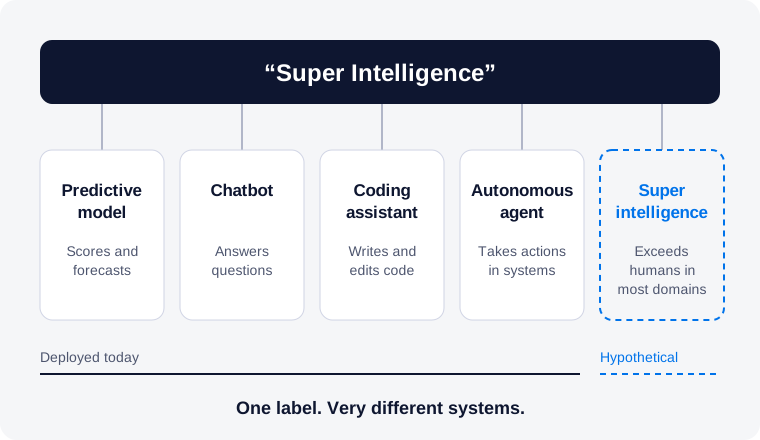
We're making an already broad category broader, while simultaneously making a much larger promise about what belongs inside it.
Words create expectations. Expectations create obligations.
Good positioning helps people understand what a product does, why it matters, and how to evaluate it.
Category names perform a similar function at market scale.
Consider what happened when software became cloud software. The terminology helped buyers understand a different delivery and operating model. It also came with expectations about accessibility, scalability, availability, and security.
The term was useful because it described something buyers could observe and evaluate.
Superintelligence is different.
It describes a degree of capability that has not yet been established across today's commercially available systems. Adopting it as an umbrella term changes the implied promise without necessarily changing the underlying product.
That creates a positioning problem.
If intelligence is now super, what does a buyer reasonably expect? Greater autonomy? More reliable reasoning? Better judgment? The ability to operate without human intervention?
And how should any of those expectations be measured?
Those questions matter because language influences purchasing criteria, investment decisions, product roadmaps, and ultimately trust.
A category can generate enormous attention by raising expectations. Sustaining that attention requires evidence.
There's also a governance problem hiding in the terminology
One of the more consequential developments in enterprise AI has been the shift from systems that produce outputs to systems that can take actions.
The distinction is material.
A model that summarizes a document presents a different operational risk than an agent that can access customer records, modify configurations, initiate transactions, or interact with other systems.
Neither capability is adequately described by simply calling it intelligent, artificial or otherwise.
Boards and executives need language that helps them distinguish what a system can do, what it can access, where it can act independently, and how its behavior can be verified.
This is where an expansive category label becomes unhelpful.
If everything is superintelligence, the term tells us remarkably little about the capabilities we're actually governing.
We already have a tendency to organize AI governance around the technology itself rather than the decisions, permissions, dependencies, and consequences associated with its use.
A more ambitious name does little to resolve that.
For governance purposes, capability should be demonstrable, autonomy should be bounded, and accountability should remain identifiable.
Those requirements don't become more sophisticated because the terminology does.
The market is trying to reposition itself
There is a commercial logic behind the rebrand.
AI has spent several years moving through extraordinary levels of investment, adoption, experimentation, and public attention. Along the way, the category has accumulated some baggage.
Buyers are becoming more demanding. Boards want evidence of returns. Employees have questions about how their roles will change. Communities are confronting the physical infrastructure required to support increasingly powerful systems.
The initial novelty has worn off.
This is a familiar point in the development of an emerging technology market. As a category matures, the conversation moves from what is possible to what is practical, affordable, reliable, and worth adopting.
Repositioning can help a category regain attention or create room for a new narrative.
But a new name doesn't necessarily solve the problems that made the old one less compelling.
That requires advances in capability, stronger evidence, better product experiences, and a clearer relationship between investment and outcomes.
It also requires a more disciplined understanding of where the technology creates value.
What would a more useful vocabulary look like?
The difficulty with artificial intelligence has never been solely the word artificial.
It's that we regularly use one category to describe several fundamentally different kinds of systems.
A more useful market vocabulary would help distinguish levels of autonomy, breadth of capability, reliability, and operating context.
It would make it easier to separate a system that recommends a decision from one authorized to execute it. A model optimized for a narrow task from one that can generalize. A compelling demonstration from a capability that performs consistently under real operating conditions.
These distinctions are becoming more important as organizations move beyond individual applications and begin connecting AI systems to business processes, infrastructure, and consequential decisions.
The quality of our language should improve with the sophistication of the technology.
A category is ultimately a promise
There is something revealing about the desire to rename AI at this particular moment.
The industry is still working to establish the value, reliability, and limits of systems that are already widely deployed. At the same time, the language is moving toward capabilities that remain largely aspirational.
Perhaps superintelligence will eventually become an appropriate description for a distinct class of systems.
If it does, we'll need the term to mean something.
A category name is more than a marketing asset. It shapes how a market understands what exists, what is coming, and what it should be prepared to trust.
And right now, the most valuable contribution to the AI conversation may be greater precision about the capabilities already in front of us.
We have plenty of ambition. What the market needs now is a better way to tell what has actually been achieved.