When Google Starts Disrupting Its Own Advertising Business
AI is changing how people search, how platforms make money, and the economics of reaching customers. What happens to marketing when the model that supported digital growth starts to change?

Google lost more than $500 billion in market value last week. The reason is particularly interesting for anyone involved in marketing, technology, or business strategy: Google’s own AI search experience is beginning to affect the economics of the advertising business that made it one of the world’s most valuable companies.
According to BBC reporting, investors reacted sharply after Alphabet disclosed that its AI-driven search experiences were generating less advertising revenue than traditional searches.
The company’s financial performance was hardly disastrous. Alphabet reported quarterly revenue of $127.6 billion, up 25% year over year. Google Cloud revenue more than doubled, while Search advertising revenue grew 12%. But that last figure was below expectations, and Alphabet was also spending heavily on AI infrastructure.
Google’s chief business officer, Philipp Schindler, acknowledged that rapid growth in AI Mode searches was affecting revenue because those searches currently generate less advertising income.
There is a remarkable tension here. Google has to build the search experience people increasingly want, even if doing so undermines the economics of the experience it has spent decades monetizing. And the implications extend well beyond Google.
The business model behind modern marketing
For more than 20 years, search advertising has been one of the most effective ways for businesses to reach customers. Someone identifies a need, searches for information, compares alternatives, and encounters advertising alongside the results.
Google monetizes the intent expressed through the search. Advertisers pay for access to that intent. Publishers and businesses compete for visibility, traffic, and conversions. The model has supported an enormous ecosystem of marketing agencies, technology providers, publishers, and businesses.
It also shaped how organizations plan and measure growth. Marketing budgets became increasingly tied to search volume, cost per click, conversion rates, and customer acquisition costs. Businesses learned to optimize their websites and content to attract search traffic, then use advertising to capture demand from customers already looking for a solution.
AI is beginning to change the behavior on which those economics depend.
More searches don’t necessarily mean more advertising revenue
One of the most revealing details in Google’s latest results is that search activity is growing. Alphabet reported its fastest year-over-year growth in search queries in five years.
People are using AI to ask longer, more complex questions. Queries can include images, documents, and voice. Instead of conducting several individual searches, users can hold a conversation, refine their requirements, and receive synthesized answers. From a user’s perspective, this can be a substantial improvement. From an advertising perspective, it introduces a different economic model.
A traditional search results page offers multiple opportunities to display advertisements alongside organic listings. An AI-generated response may resolve much of the user’s information need within a single interaction. The user may never visit the websites that contributed to the answer. And the advertising opportunities within that experience are still evolving.
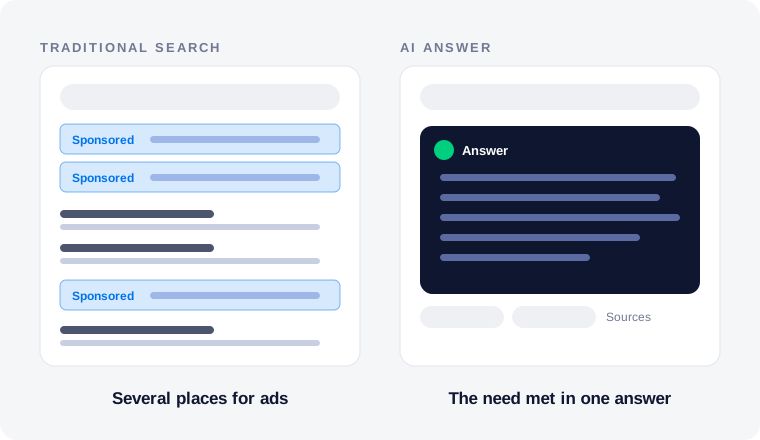
Google disclosed that AI Mode currently monetizes at a lower rate than traditional search. This creates an unusual situation in which a company can increase engagement with its core product while generating less revenue per interaction.
For marketers, it raises an equally important question. If customers increasingly discover products, evaluate options, and make decisions within AI interfaces, how does a business earn visibility and influence those decisions?
What happens to the economics of buying attention?
Paid marketing has always depended on the economics of access. Businesses invest in advertising because reaching the right audience at the right moment can generate more commercial value than the cost of the placement. But those economics depend on the distribution environment. When people change how they discover information, the value and availability of different advertising placements change too.
We don’t yet know exactly what AI-native advertising will look like at scale. Search platforms could introduce new sponsored recommendations, commercial interactions, product placements, and transactional experiences. Some of those formats may ultimately prove highly effective. But the transition introduces uncertainty for advertisers.
A company might continue to invest in familiar search campaigns while a growing proportion of its potential customers conducts research through different interfaces. It might discover that website traffic no longer reflects how frequently its expertise or products appear in customer research. It might also find that customers arrive further along in their decision-making process, having already evaluated alternatives through an AI assistant.
These changes affect attribution, content strategy, customer acquisition, and the relationship between marketing investment and revenue. They also challenge the assumption that yesterday’s most efficient acquisition channel will remain tomorrow’s.
The economics are changing for publishers, too
Google’s advertising model supported an exchange between search engines and the wider web. Publishers, businesses, researchers, and content creators produced information. Search engines indexed that information and directed users toward relevant sources. Those visits created opportunities to generate advertising revenue, acquire customers, establish relationships, and build audiences.
AI-generated answers alter the exchange. A search engine can use information from multiple sources to construct a response that satisfies the user’s immediate need. The original source may receive recognition, but recognition does not necessarily translate into a visit.
This matters for the economics of producing original content. High-quality research, specialist reporting, and authoritative analysis require investment. If those contributions become increasingly valuable to AI-generated answers while generating less direct traffic, publishers and businesses will need to reconsider how that value is captured.
For B2B companies, there may be an opportunity here. Original research, credible expertise, proprietary insights, and distinctive perspectives can make an organization more valuable as a source of information. But businesses will need better ways to understand how that visibility contributes to commercial outcomes. A company’s influence may increasingly extend beyond what its website analytics can observe.
The strategic problem for marketers
I think the biggest implication is that marketing leaders need to reconsider what they’re actually buying when they invest in paid media. Historically, businesses could use advertising to acquire attention, website visits, and customer inquiries. Those measures remain useful.
But as discovery becomes more fragmented and AI interfaces intermediate more of the customer journey, buying a click may represent a smaller portion of the work required to build demand. Businesses need customers to recognize their expertise, understand their value, and consider them credible before a purchase decision is made.
Those outcomes are shaped by many different activities. Original research, product experiences, industry relationships, partnerships, customer advocacy, executive perspectives, and direct engagement all contribute to how a company becomes known. Paid media can extend the reach of those investments.
The strategic question is how much of the marketing budget should be directed toward acquiring immediate attention and how much should develop the market position that makes future customer acquisition possible.
This is particularly important for companies creating new markets or introducing unfamiliar technologies. When customers don’t yet have a clear understanding of the problem or category, there may be relatively little search demand to capture. The company needs to help the market recognize an opportunity before customers begin searching for a solution. That requires a different approach to marketing investment.
Google’s dilemma is an important strategic lesson
There is another reason this story interests me. Google is facing a challenge familiar to many established businesses experiencing technological change. Its existing model is enormously profitable. It has sophisticated infrastructure, deep customer relationships, extensive data, and substantial competitive advantages.
Yet the technology creating its next growth opportunity is also changing the economics of the business it already operates. The company’s leadership cannot assume that the future will preserve the financial relationships that made the current business successful. Neither can its customers.
The same issue is emerging across software, professional services, cybersecurity, financial services, and other industries where AI is changing what it costs to create and deliver value. Capabilities that were previously expensive to develop may become widely accessible. Services that depended on specialized labor may be delivered through different operating models. Products that commanded substantial fees may face new alternatives.
The challenge for established businesses is deciding how to evolve while their existing models are still performing. That requires understanding which advantages are durable, which assumptions are becoming less reliable, and where new sources of value may emerge.
Google is confronting that question at an extraordinary scale. Marketing leaders are confronting a related version of it through their decisions about where to invest.
What should change in marketing strategy?
I would start by asking five questions.
- How dependent is our growth model on paid access to audiences we don’t own? Understand where platform changes could materially affect acquisition economics.
- Where are customers discovering and evaluating solutions before they reach us? Look beyond website visits and attributed conversions to understand the wider decision process.
- What do we produce that is genuinely valuable to our market? Identify the research, expertise, relationships, and experiences that differentiate the business and cannot easily be replicated.
- How are we building direct relationships? Consider the role of customer communities, partnerships, events, newsletters, and other channels that support ongoing engagement.
- What are we learning from our marketing investment? Evaluate whether spending is improving the organization’s understanding of customers, strengthening its market position, or identifying new commercial opportunities.
These questions should influence how performance is measured and how budgets are allocated. They also move the conversation beyond optimizing individual campaigns toward understanding the economics of growth.
The changing value of visibility
Google’s latest results illustrate how quickly the assumptions behind a successful business model can begin to change. Search remains an enormous commercial market. Advertising continues to generate substantial revenue. AI may eventually create new advertising opportunities that are more valuable than those it replaces. But the transition matters.
For marketers, the practical implication is to examine how much of their strategy depends on the continued economics of existing distribution platforms. For founders and executives, the larger lesson is about understanding where value is moving and adapting investment decisions accordingly.
If the company that built the modern search advertising economy is having to rethink how that economy works, shouldn’t the businesses that depend on it be doing the same?