More Data, Less Control
Organizations have never had more information about their operations. Why does managing outcomes remain so difficult?

A modern executive can access more information about an organization than almost any predecessor. Revenue performance is available in real time. Customer behavior can be tracked across digital channels. Operational systems generate continuous performance data. AI can summarize documents, identify patterns, and produce forecasts on demand. The amount of organizational activity that remains invisible is shrinking.
It is tempting to assume that greater visibility translates into greater control. Sometimes it does. Better information can improve decisions, reveal emerging problems, and help organizations allocate resources more effectively. But visibility and control are different capabilities. A company may understand precisely how a market is changing without having the products, capital, or organizational capacity to respond.
It may identify a critical operational dependency without having a practical alternative. It may know that a strategy is underperforming while remaining committed to the investments, incentives, and structures that support it. The problem is not necessarily an absence of information. It is the distance between knowing what is happening and being able to influence what happens next.
How measurement becomes a substitute for management
Organizations have invested heavily in making performance measurable. The logic is compelling. Reliable information reduces uncertainty and creates a basis for accountability. Over time, however, measurement systems can acquire purposes beyond their original intent.
A dashboard intended to help managers understand performance becomes the primary means of evaluating it. Teams begin organizing their activities around indicators that receive executive attention. What gets measured shapes what gets managed. The risk emerges when the metric becomes more important than the outcome it was intended to represent.
A sales team rewarded for pipeline may generate opportunities that have little realistic chance of closing. A technology function evaluated on availability may prioritize keeping systems operational even when customer-facing processes are failing. A leadership team focused on utilization may reduce the capacity needed to respond to unexpected demand.
In each case, the measurement system can report improvement while the underlying business becomes less capable. This is a familiar management phenomenon, but increasingly sophisticated analytical tools can make it harder to recognize. A highly accurate metric can create false confidence when it measures an incomplete representation of the problem.
More information can create more certainty than the evidence supports
AI adds a new dimension to this challenge. Organizations can now generate forecasts, scenario analyses, market assessments, and decision recommendations far more quickly than before. This expands access to analytical capability and makes sophisticated investigation available to more people.
It also introduces an important question: how much confidence should be placed in an analysis? An AI-generated report may be coherent, detailed, and persuasive. Its conclusions may be based on incomplete information, uncertain assumptions, or relationships that do not hold in the organization’s particular context. A prediction can be mathematically sophisticated and still be commercially unhelpful.
Consider a company forecasting customer demand. Its model may accurately identify patterns in historical sales. Yet the business may be entering a market in which customer expectations, pricing dynamics, or competitive offerings are changing. The model can describe yesterday’s relationships with considerable precision while the relevance of those relationships is declining. The danger is not the use of predictive technology.
It is treating the precision of the output as evidence that the future is becoming more predictable. The quality of a decision still depends on whether its assumptions reflect the conditions under which it will be executed.
The difference between oversight and influence
A useful way to examine management control is to separate four capabilities.
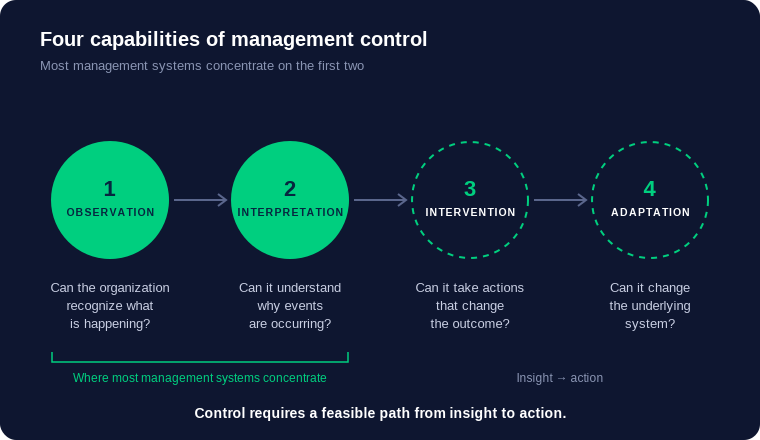
- Observation: Can the organization recognize what is happening?
- Interpretation: Can it understand why events are occurring and what they imply?
- Intervention: Can it take actions that materially change the outcome?
- Adaptation: Can it change the underlying system when existing interventions no longer work?
Many management systems concentrate on the first two. They provide increasingly detailed information and analytical explanations. The more difficult capabilities are intervention and adaptation. A business may observe declining retention and identify the customers most likely to leave. Yet it may lack the ability to address the product, pricing, or service conditions driving those departures.
It may understand the exposure created by a critical supplier but be unable to qualify an alternative quickly enough. It may recognize that an organizational structure no longer supports its strategy while finding it politically and operationally difficult to change. Control requires a feasible path from insight to action. Without that path, additional reporting may improve awareness without improving outcomes.
A recent boardroom simulation at NYU Law’s Academy for Directors and Senior Executives brought this distinction into focus.
Directors were presented with a proposed change to an AI-enabled lending model. The model offered potential commercial benefits, but its behavior was changing in ways that required closer examination.
The discussion quickly moved beyond the model’s technical performance.
What assumptions supported management’s recommendation? What evidence would give directors confidence in the proposed change? And at what point should the board challenge management’s judgment without taking over the decision itself?
The exercise illustrated something important about oversight: access to information is only useful when directors can translate it into the questions, decisions, and actions their responsibilities require.
More information alone does not create better governance. The value comes from how that information informs judgment.
When automation obscures accountability
The movement toward autonomous systems further complicates the relationship between information and control. Traditional organizational accountability often follows identifiable lines of authority. A person makes a decision, another person approves it, and the organization can establish who was responsible for the outcome.
Autonomous systems introduce arrangements in which many decisions occur within technology-enabled workflows. A manager may authorize an agent to complete a class of tasks. The agent may interact with multiple systems, make intermediate decisions, and act within predefined limits. The organization may monitor the overall process while having limited visibility into every consequential step.
Responsibility still exists, but exercising it requires a different set of mechanisms. Managers need to know what authority has been delegated, what the system is permitted to change, and under what conditions it must seek approval. They need the ability to reconstruct consequential actions and intervene when performance departs from expectations.
Equally important, they need to understand when stopping an automated process is economically and operationally feasible. A theoretical ability to disable a system provides limited comfort if the organization can no longer perform the underlying work without it. Meaningful control depends partly on retaining practical choices.
Evidence of control
An organization that wants to demonstrate control should be able to answer more than whether it has policies, dashboards, and oversight committees. It should be able to explain how those mechanisms influence real decisions.
- What happens when a performance indicator deteriorates?
- Who has the authority to respond?
- What information is needed before action can be taken?
- How quickly can resources be redirected?
- What alternatives exist when the established response is no longer effective?
- And how does the organization know that its interventions actually produce the intended results?
These questions shift attention from the existence of management mechanisms to their effectiveness. They also create a stronger basis for board oversight. Directors do not need to participate in every operational decision. They do need confidence that management understands the organization’s important dependencies, can recognize when assumptions are failing, and has the authority and capability to respond.
That confidence should be supported by evidence of decisions and outcomes.
Control as an organizational capability
The next generation of management technology will provide increasingly sophisticated ways to observe, analyze, and predict business activity. Those advances will be valuable. But the commercial benefits will depend on the organization’s ability to convert information into effective action. That requires more than better models.
It requires clear decision rights, adaptable processes, appropriate incentives, available resources, and the capacity to learn from outcomes. The central management challenge is therefore broader than information quality. It is the design of an organization capable of acting on what it knows.
A company with imperfect information and the ability to respond may outperform one with excellent information and little room to maneuver. The most useful measure of control is ultimately found in the organization’s ability to influence outcomes when circumstances change.