When More Marketing Creates Less Growth
McDonald’s latest earnings call offers an interesting lesson in the organizational cost of too many good ideas.

There’s a particular kind of problem that emerges when an organization has plenty of ideas, resources to execute them, and a leadership team eager to demonstrate progress. Everything starts happening at once. New campaigns, new products, new promotions, new partnerships, and new priorities. Each initiative has a business case, someone advocating for it, and a promise to contribute something to growth.
Then performance starts to deteriorate.
McDonald’s provided a remarkably candid example during its second-quarter 2026 earnings call. The company reported U.S. comparable sales growth of just 0.8% while acknowledging that its restaurant teams had been overwhelmed by the number of initiatives introduced during the quarter.
A KPop Demon Hunters promotion, changes to the McValue program, the introduction of a new beverage platform, and a FIFA World Cup campaign arrived in rapid succession. Each required operational preparation, employee training, merchandising, and customer communication. The pace created problems in restaurants, increasing service times and reducing customer satisfaction. Meanwhile, competing marketing messages made it harder for individual offers to gain traction.
McDonald’s had managed to create a situation where its own growth initiatives were interfering with its ability to deliver growth.
The hidden cost of another good idea
Organizations typically evaluate new initiatives based on their anticipated benefits.
- Will the campaign generate traffic?
- Will the product attract new customers?
- Will the promotion increase transaction value?
- Will the partnership create incremental demand?
These are reasonable questions, but they rarely account for the cumulative burden of everything already underway. A new initiative consumes attention, decision-making capacity, operational resources, management time, and customer understanding. Those costs are distributed across the business, making them difficult to attribute to any single project.
At McDonald’s, the burden became visible at the restaurant level. Employees had to understand new offers, respond to customer questions about discontinued promotions, learn new products, and adapt to changing operating requirements. Customers were simultaneously expected to keep up with an evolving collection of campaigns and value propositions.
What looked like an ambitious commercial calendar from headquarters became a complicated operating environment for the people responsible for delivering it.
This is a familiar problem well beyond quick-service restaurants.
Organizations have a finite capacity for change
One of the more persistent assumptions in business planning is that initiatives can be considered independently. A product launch has its own budget, milestones, and projected returns. A marketing campaign has its own performance targets. A transformation program has its own business case.
Collectively, however, they depend on many of the same organizational resources. The same customers are being asked to pay attention. The same salespeople are being asked to communicate changing priorities. The same operational teams are expected to support another rollout.
Adding another initiative can reduce the effectiveness of work already in progress. That creates an important distinction between the theoretical value of an opportunity and the value an organization can realistically capture.
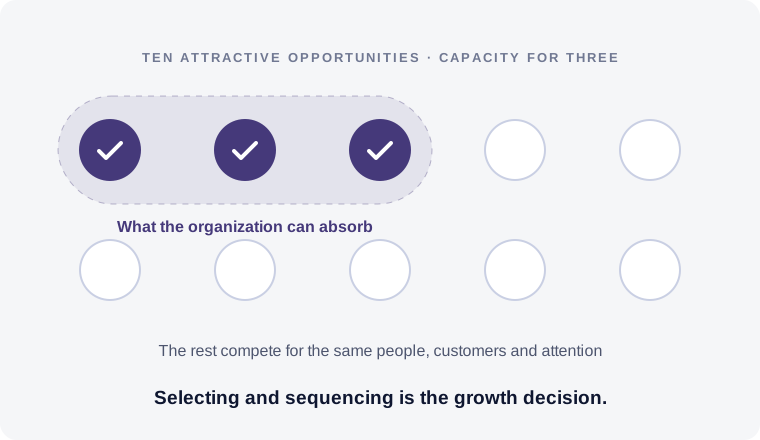
A company might identify ten attractive growth opportunities while possessing the capacity to execute only three effectively. Its commercial performance will depend as much on selecting and sequencing those opportunities as on identifying them in the first place.
Attention is part of the operating model
Marketing often treats attention as a customer acquisition problem. How do we cut through competing messages? How do we reach the right audience? How do we maintain engagement?
But attention is also an internal constraint. Every change in direction requires employees to absorb information, adjust behavior, and explain something new. At McDonald’s, frequent changes to promotional offers created additional customer questions and operational complexity.
There was also an external consequence. As CEO Chris Kempczinski explained during the earnings call, the company was giving major promotions only a few weeks before shifting attention to something else.
That raises a straightforward question: how much time does an initiative need to become effective?
Customers need repeated exposure to recognize an offer and understand its relevance. Employees need time to become proficient at delivering it. Commercial teams need sufficient evidence to learn what is working. When organizations continually replace one priority with another, they can interrupt the very processes through which an initiative begins to generate returns.
Innovation needs an absorption strategy
This problem becomes especially relevant as AI accelerates the pace of product and service innovation. Companies can now generate, prototype, and introduce new capabilities faster than many organizations can evaluate, adopt, and operationalize them. That creates an expanding gap between what is technically possible and what can be implemented effectively.
The answer involves developing a better understanding of organizational absorption capacity.
Before introducing another initiative, leaders should consider several dimensions of readiness.
- Can the organization deliver the new offering consistently without degrading existing performance?
- Will the change make the customer value proposition clearer or introduce additional complexity?
- Do commercial teams have the capacity to support another priority?
- Has the previous initiative had enough time to generate reliable evidence?
- And which existing commitments will receive less attention as a result?
These questions should influence portfolio decisions, resource allocation, and the pace of commercialization. They also require coordination across functions that are often rewarded for different outcomes.
A marketing team might be measured on campaign activity. Product teams might be rewarded for release velocity. Sales teams might be focused on near-term revenue. The cumulative impact of those activities, however, is experienced by customers and operational teams.
Someone needs to manage the whole system.
Activity can become a substitute for progress
There is another uncomfortable dimension to this story. Organizations often use activity as evidence of momentum. A full campaign calendar demonstrates ambition. A steady stream of launches suggests innovation. Multiple initiatives create visible proof that teams are working toward growth.
But activity is an input. Its commercial value depends on what the organization can execute and what customers ultimately do.
This could read as a case for launching less. Always be launching makes a different point: companies get more from launches when launching is a habit, with a standing cadence, a clear bar for what qualifies, an owner for each one, and a review two weeks later on who noticed. That rhythm is what McDonald’s quarter was missing. A cadence spaces launches out so each one gets attention. Tiering decides which launches the whole organization carries and which stay small. The two-week review asks whether the last launch landed before the next one goes out.
Launching often works when the organization launches at a pace it can absorb.
McDonald’s response is instructive. The company outlined plans to simplify restaurant operations, strengthen digital offers, and direct more marketing support toward established value propositions. Those actions suggest a renewed emphasis on execution, consistency, and the effectiveness of existing offerings.
There is an important strategic discipline in recognizing when an organization needs to extract more value from investments already made. Sometimes the most valuable growth decision is to give an existing initiative more time, resources, and organizational attention.
The real constraint on growth
It’s tempting to see growth as a function of the number of opportunities an organization can pursue. More products expand the addressable market. More campaigns generate awareness. More channels create additional points of contact.
But organizations operate within limits. Their people have finite capacity, their customers have finite attention, and their operating models can absorb only so much change before effectiveness begins to suffer.
This makes prioritization a commercial capability in its own right. Strong growth strategies account for the organization’s capacity to execute, sequence initiatives intelligently, and create the conditions for each investment to deliver meaningful returns.
McDonald’s experience is a reminder that even the world’s most sophisticated brands can underestimate the cumulative cost of their own ambitions.
Growth depends on how effectively an organization converts opportunity into value. And that conversion has a capacity limit.