The Politics of Business Value Are Changing Again
What the 2026 midterms reveal about changing expectations of business—and why companies may need to rethink how they create and demonstrate value.

Political shifts have a way of exposing assumptions embedded in business strategy. The November 3 midterm elections delivered Democratic control of both chambers of Congress, creating a significantly different political environment for the final two years of the Trump administration.
Much of the immediate analysis has focused on legislative gridlock, congressional investigations, and the implications for the 2028 presidential race. For business leaders, a more interesting question is beginning to emerge: How will the expectations placed on companies change, and what capabilities will organizations need to navigate them?
The expectations of business are being renegotiated
Over the past decade, American companies have operated through successive shifts in the relationship between business, government, and society. ESG expanded expectations surrounding environmental and social performance. Stakeholder capitalism challenged narrow definitions of corporate value. More recently, political pressure has reshaped corporate positions on diversity, climate commitments, and institutional accountability.
Each shift has influenced what executives measure, what boards oversee, and how companies explain their contribution to the economy. The latest election could introduce another adjustment.
A Democratic Congress may bring greater scrutiny of corporate conduct, competition, labor practices, technology, and executive accountability. Yet the administration retains substantial executive authority, and major legislative change will face meaningful constraints.
The likely result is a period in which expectations, oversight activity, and regulatory priorities do not necessarily move together. This creates a difficult environment for companies built around relatively stable assumptions about policy and stakeholder expectations.
The problem with treating political change as a compliance exercise
Companies often respond to shifts in the political environment by reassessing regulatory exposure, updating policies, and preparing communications. These activities have their place. But they capture only part of the strategic challenge.
Political change can alter the economics of an industry, redefine acceptable business practices, influence investor expectations, and create new markets for products and services. It can also change the questions that customers, employees, regulators, and investors ask about the same business.
An organization that treats these developments exclusively as compliance matters risks overlooking changes to its competitive environment.
Consider the growing importance of artificial intelligence. The questions facing companies extend beyond which AI requirements will apply. They include how automated decisions should be accountable, what evidence companies should maintain, and how the benefits and risks of automation should be distributed.
These are questions about business models, operating systems, and institutional trust.
Building the capability to navigate changing expectations
The companies best positioned for this environment may be those that can translate political and societal signals into strategic decisions. That requires capabilities that cut across traditional organizational boundaries.
Strategy teams need to understand regulatory and stakeholder developments. Risk and legal teams need a stronger connection to commercial decisions. Boards need to explore plausible changes in expectations before those changes become formal requirements.
And leadership teams need to distinguish between policy changes that require immediate action and emerging signals that may reshape the business over time.
This is also an opportunity to reconsider the role of scenario planning. Rather than predicting which political outcome will prevail, companies can examine how different combinations of oversight, regulation, market pressure, and stakeholder expectations would affect their strategy.
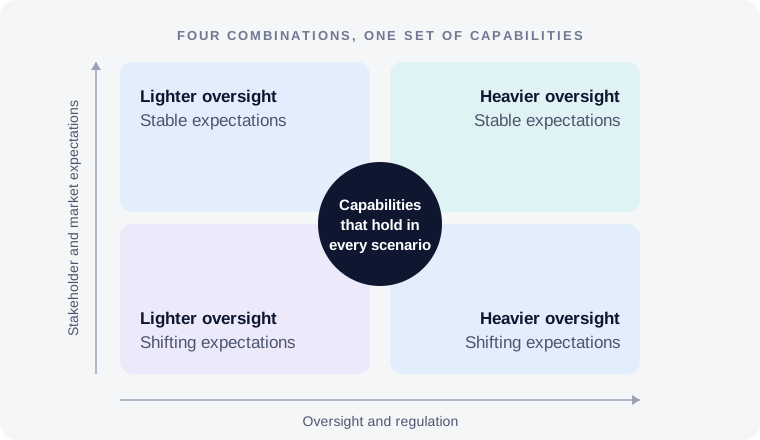
The value lies in identifying which capabilities remain useful across those possible futures.
A different question for leadership
Corporate oversight is likely to become a more visible political issue as the next Congress takes shape. The organizations that navigate this period successfully will need to do more than monitor legislative developments.
They will need to understand how changing expectations influence their customers, business models, talent, technology investments, and ability to create long-term value.
The strategic question is no longer simply what companies will be required to do. It is what they will need to become capable of doing as the definition of responsible business continues to evolve.