When AI Becomes the Customer, What Happens to Marketing?
As AI agents begin participating in purchasing decisions, brands face a new challenge: influencing systems that evaluate products differently from humans.

Marketing has spent decades developing increasingly sophisticated ways to understand and influence human behavior. We study attention, perception, emotion, preference, and the many factors that contribute to a purchasing decision.
Now another participant is entering that process. AI agents are helping consumers research products, compare alternatives, and increasingly make recommendations about what to buy.
This introduces an interesting question for marketers: What happens when the system interpreting your brand is no longer entirely human?
The emerging evidence
Research published by McKinsey in October, based on approximately 21,000 consumers, examined the emerging market for AI-enabled shopping and found that businesses are not yet fully equipped to meet changing demand.
Then, on November 5, Visa published a benchmark evaluating 22 AI models across realistic shopping scenarios. The results illustrate how early this market remains.
The models failed 42.8% of test runs. Even more revealing, 54% of failed runs still ended with an AI making a purchase.
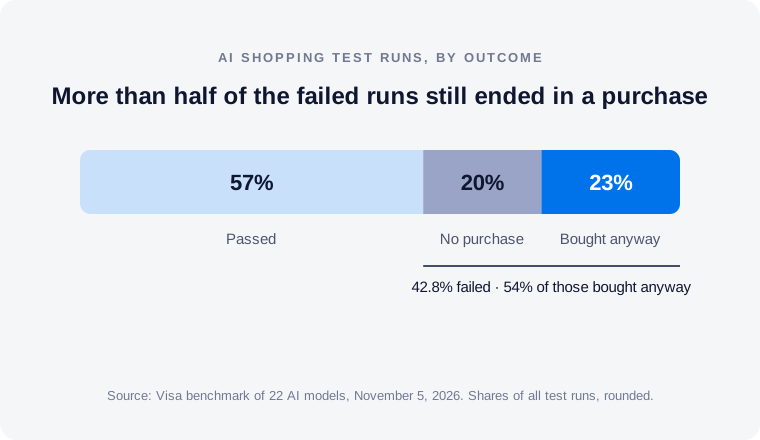
In other words, some systems proceeded with a transaction despite failing to establish that the purchase satisfied the customer's requirements.
That finding raises questions about trust and reliability. It also reveals something important about the evolution of purchasing decisions.
The ability to understand a customer may become more valuable than the ability to recommend a product
One of Visa's most interesting findings concerned how AI agents gathered information. Models that were better at uncovering hidden customer requirements achieved substantially higher success rates than those that asked fewer questions.
This points to a familiar principle of decision science: the quality of a decision depends partly on how well the underlying problem has been defined.
Human marketers recognize this challenge. Customers rarely arrive with a complete specification of what they need. They bring partial information, competing preferences, constraints, and assumptions.
Good salespeople and advisors help customers discover and articulate those requirements. As AI systems take on more of that role, the process through which preferences are formed may begin to change.
What does this mean for brands?
Most marketing infrastructure was developed for a world in which brands primarily communicate with people. Search optimization, advertising, websites, reviews, and product descriptions were designed to attract attention, communicate benefits, and build confidence.
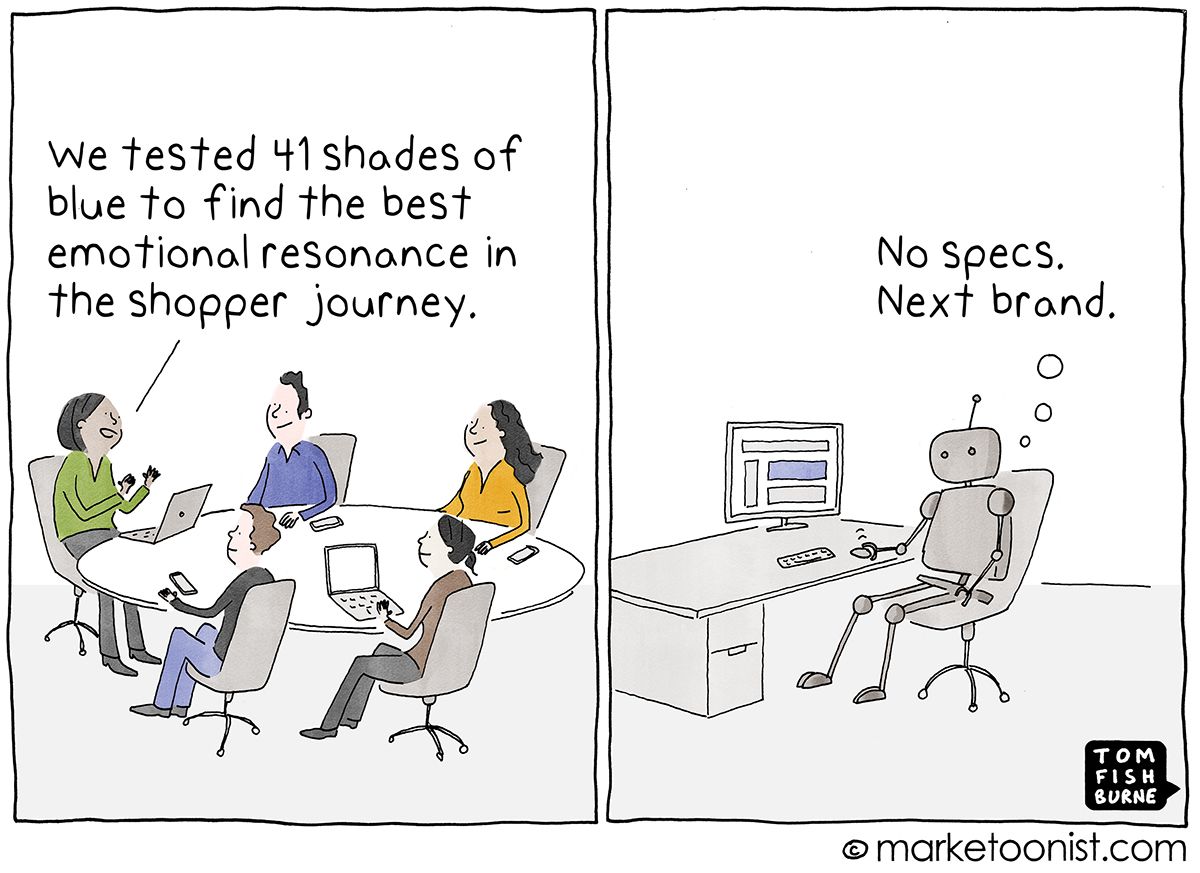
AI intermediaries introduce additional requirements. A product may need to be understandable through structured information, comparable against precise specifications, and supported by evidence that a machine can retrieve and evaluate.
Claims about performance may need clearer substantiation. Product attributes may need more consistent definitions. Availability, pricing, and compatibility information may become more important to discovery.
But this raises another issue. What happens to brand preference when an agent evaluates a set of products primarily through stated requirements?
An established brand may benefit from accumulated evidence of reliability and customer satisfaction. A less familiar competitor may gain visibility when its product matches a customer's requirements more precisely.
The balance between reputation, differentiation, and demonstrable performance could change.
Marketing becomes part of a broader decision system
There is a tendency to frame agentic commerce as the next search optimization challenge. That interpretation may be too narrow.
The more consequential shift concerns the distribution of decision-making activity between customers, AI systems, retailers, and brands.
Consumers may continue to define goals and preferences while delegating research and comparison. They may allow agents to make routine purchases but retain direct control over consequential ones. Different categories will evolve differently.
The opportunity for marketers is to understand these emerging decision patterns and design experiences that support them. That requires cooperation between marketing, product management, customer experience, data, and technology teams. It also requires a more precise understanding of what information makes a product genuinely valuable to a customer.
The next question for marketing leaders
We are still early in the development of agentic commerce. Reliability, consumer trust, and transaction infrastructure remain significant constraints. But the strategic implications are already worth exploring.
If some purchasing decisions increasingly involve AI intermediaries, marketers will need to understand how those systems discover information, assess claims, and make recommendations.
The future of marketing may depend as much on understanding how decisions are made as on understanding who makes them.