What is commercialization strategy?
It has never been easier to build new technology. Turning it into a business that customers adopt, fund and renew is still the hard part.
What is commercialization strategy?
Commercialization strategy decides how a new capability becomes revenue: which customers and use cases to start with, how to package and price it, which route to market to use, and what proof reduces the buyer’s risk. It works best when it shapes the product early, rather than arriving after launch.
Why does good technology struggle to sell?
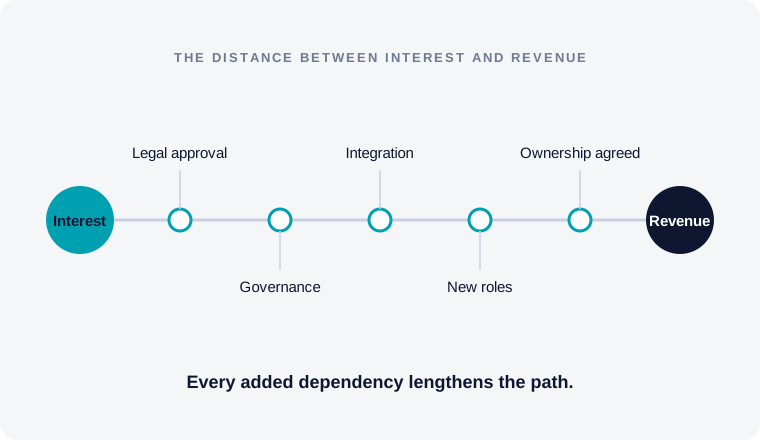
Customers judge a new capability by what it changes for them: where it fits, who owns it, how to justify it and what they would stop doing. Each dependency, from legal approval to integration to new roles, lengthens the distance between interest and revenue. That is why enthusiastic feedback can coexist with disappointing sales.
Which questions should shape it?
These belong early, while the product is still taking shape.
- Which applications offer a sufficiently urgent problem?
- Which customers can act without significant organizational redesign?
- Which adjacent markets already have relevant budgets?
- What evidence would reduce perceived risk?
- Which partnerships could accelerate acceptance?
Why start narrow?
Horizontal technology suggests dozens of markets, but customers buy solutions to specific problems in specific circumstances. Start where urgency, economic value and the ability to adopt meet, then use that market to build evidence and a repeatable model before expanding.
How do launches fit in?
Launches are where commercialization meets the market, and the pace matters. A standing launch rhythm with a clear bar and a review afterwards gives each one time to work, where a crowded calendar can interrupt the returns it was meant to create.
What people ask
How is commercialization strategy different from go-to-market?
Go-to-market plans how to reach and win buyers for an offering whose demand is understood. Commercialization strategy also decides which use case, business model, pricing and partners make the offering viable in the first place.
When should a company start?
Before the product is finished. Decisions about the first customer, the use case and the proof required influence what gets built.
Is it a problem if early customers need a lot of services?
Not necessarily. Early engagements are often how a company learns what will become repeatable. The work is turning them into knowledge and assets that make the next customer easier to win and serve.