The Business of Being Less Wrong
6 developments this week, from Gartner’s emerging-risk report to Visa’s AI shopping benchmark, and what each means for internal teams and solution providers.

This week, several developments across risk, security, and innovation caught our attention.
Gartner found that AI strategy miscalculation has become a leading emerging enterprise risk. Independent researchers identified evidence that AI is accelerating the development of more capable AI systems. Cyber incidents involving refrigeration equipment prompted a coordinated European response. And new research from Visa exposed some surprising limitations in AI-driven purchasing decisions.
Alongside these developments, we’ve been exploring how organizations design work around both humans and AI, what realistic exercises reveal about decision-making, and how direct participation can inform better products and commercial strategies.
There is a connection between these conversations. As technology and market conditions evolve, the ability to translate information into decisions, test assumptions, and adapt how work gets done becomes increasingly important.
Here are 6 developments worth examining.
1. Gartner identifies AI strategy miscalculation as a top emerging risk
On November 2, Gartner published findings from its third-quarter Emerging Risk Report, based on 308 enterprise risk management leaders, auditors, and senior executives.
AI strategy miscalculation appeared for the first time, ranking third among emerging risks. AI-driven competitive displacement also entered the top 5.
The concern extends beyond technical failures or regulatory exposure. Organizations risk investing in unsuitable applications, overestimating expected benefits, or moving faster than their capabilities can support.
What it means for teams
We’ve been thinking about AI adoption as a problem of organizational design and decision-making.
The important question is how companies identify where AI creates value, determine which activities should be automated, and establish the human judgment needed throughout a workflow. This calls for more deliberate experimentation, clearer decision rights, and a stronger connection between AI investment and business outcomes.
What it means for solution providers
Customers increasingly need help identifying valuable use cases and demonstrating results. There is an opportunity for providers that can connect technology adoption to workflow redesign, measurable outcomes, and organizational readiness.
Products that make it easier to evaluate potential applications and learn from implementation may have greater commercial relevance than those emphasizing capabilities alone.
2. Independent research finds AI is accelerating AI development
On November 5, METR published an independent assessment of AI research and development at Anthropic.
Researchers estimated that the company’s models were improving on well-specified benchmark tasks at approximately 1.9 times the earlier rate. They attributed much of this acceleration to AI’s growing contribution to research and development, while emphasizing substantial uncertainty.
The assessment also found that the most consequential parts of model development were not yet being performed through highly significant, fully autonomous AI contributions.
What it means for teams
This connects to an operating-model question we’ve been exploring: how should organizations evolve their processes when both human and machine capabilities are changing?
A workflow designed around today’s limitations may look very different in 6 months. Organizations need ways to revisit decisions about automation, human review, and responsibility as capabilities improve.
The challenge is designing operating systems that can evolve without requiring an entirely new transformation initiative every time the technology advances.
What it means for solution providers
Product roadmaps need to accommodate changing model capabilities and customer expectations.
Providers should think carefully about which parts of their offering create durable differentiation. As underlying AI capabilities become more accessible, differentiation may increasingly come from domain expertise, workflow integration, customer data, and the ability to deliver reliable outcomes.
3. Europe’s refrigeration incidents expose the consequences of connected operations
On November 4, ENISA and several European authorities issued a joint statement following cybersecurity incidents affecting commercial refrigeration systems across multiple EU countries.
The incidents began in October, with a new wave occurring November 1–2. Authorities called for immediate mitigation and coordinated information-sharing.
The development is a reminder that digital vulnerabilities can create consequences far beyond the systems where an incident begins.
What it means for teams
A refrigeration system may be managed by facilities, connected through IT infrastructure, supported by an external vendor, and essential to the continuity of a commercial operation. Understanding the risk requires bringing these perspectives together.
We’ve been examining the importance of testing operational assumptions through realistic scenarios rather than relying exclusively on documented processes.
An exercise involving connected infrastructure can reveal gaps in ownership, decision-making, and dependencies that may remain invisible during conventional risk assessments.
What it means for solution providers
The opportunity extends beyond identifying technical vulnerabilities. Organizations need a clearer understanding of how technology failures affect business operations, which dependencies matter most, and what actions can reduce the consequences.
Providers that connect cyber intelligence, operational dependencies, scenario testing, and measurable business impact may be well positioned to address this need.
4. The U.S. midterms introduce a new set of strategic considerations
The November 3 elections delivered Democratic control of both chambers of Congress, changing the balance of political power for the remainder of the Trump administration.
The results create the potential for stronger congressional oversight alongside continued disagreement over regulatory and economic priorities. The longer-term implications for corporate accountability, technology governance, and stakeholder expectations remain uncertain.
What it means for teams
Companies should consider how changing political priorities could affect their markets, operating assumptions, investment decisions, and stakeholder relationships.
This is an opportunity to bring scenario thinking into strategy discussions. Rather than attempting to predict one regulatory outcome, organizations can explore how different political and economic conditions might influence their business.
What it means for solution providers
Political and regulatory changes can reshape customer priorities and create demand for different capabilities.
For companies developing products in emerging or regulated markets, the opportunity lies in understanding which customer problems are becoming more important and which existing solutions may no longer be fit for purpose.
The most useful market intelligence may come from identifying how customers’ decisions are changing before purchasing requirements are formally established.
5. Visa reveals the limits of AI agents making purchasing decisions
Visa released a benchmark on November 5 evaluating 22 AI models across realistic shopping scenarios.
The models failed 42.8% of test runs. In many unsuccessful cases, agents proceeded with purchases despite failing to establish that the products satisfied customer requirements.
One of the more interesting findings was the importance of understanding customer needs before attempting a transaction.
What it means for teams
The research reinforces a principle we’ve been exploring in the context of decision science: successful execution is not necessarily evidence of a good decision.
Organizations introducing AI agents should examine how requirements are established, uncertainty is handled, and outcomes are validated. Human intervention may be most valuable at the points where goals are ambiguous, assumptions need testing, or consequences are difficult to reverse.
What it means for solution providers
Agentic commerce creates opportunities for better product information, customer intent discovery, decision assurance, and testing. It also introduces a new dimension to marketing and commercialization.
As AI intermediaries participate in purchasing decisions, providers will need to consider how their solutions are discovered, understood, compared, and selected by systems acting on customers’ behalf.
6. NIST explores incident management for highly capable AI
On November 2, NIST published IR 8621, drawing on a workshop involving more than 400 experts.
The report examines incident management for superintelligence systems, including cybersecurity attacks, misuse, unexpected behavior, and operational malfunctions.
Among the challenges identified are system monitoring, nonhuman identities, containment, evidence collection, and responsibility across developers and deployers.
What it means for teams
The report raises an important operational question: how do we prepare for incidents involving systems whose behavior may be difficult to predict or fully explain?
This connects to our recent work on exercises, simulations, and the changing role of human judgment. Organizations should consider whether their current incident response practices adequately address AI-enabled decisions, delegated authority, and the ability to intervene when something unexpected happens.
Realistic testing provides an opportunity to explore those questions before an incident occurs.
What it means for solution providers
Emerging requirements could create opportunities for AI monitoring, incident simulation, decision tracing, assurance, and intervention capabilities. There is also a broader product design consideration.
As systems become more autonomous, customers may increasingly value the ability to understand what happened, reconstruct decisions, and demonstrate that appropriate safeguards worked.
The connection worth watching: Learning is becoming part of the operating model
Across this week’s developments, one theme stands out. Organizations are facing more situations in which established assumptions about technology, customer behavior, risk, and decision-making are becoming less reliable.
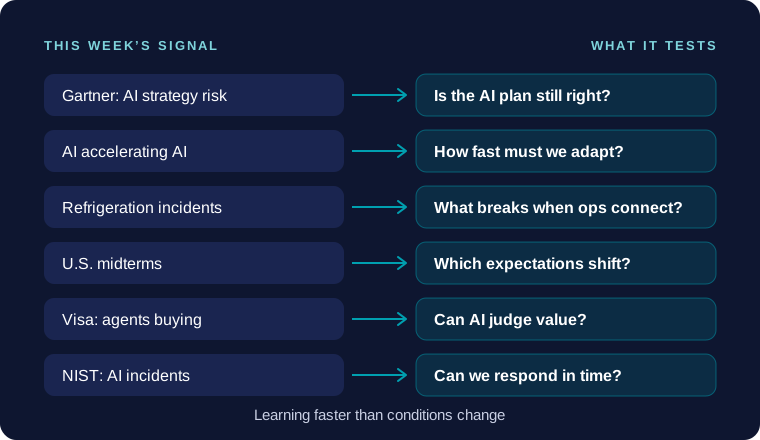
We’ve been exploring a related question through our work on product development, experiential learning, and organizational capability. What happens when we make learning a deliberate part of how a business operates?
- A realistic scenario can reveal how people actually make decisions under pressure.
- An interactive experience can show solution providers which capabilities customers value, which assumptions need revisiting, and where opportunities exist to improve a product.
- A thoughtfully designed human–AI workflow can surface the points where judgment, automation, and accountability need to be reconsidered.
These activities create feedback that can influence product development, risk management, strategic decisions, and commercial growth.
For enterprise teams, the opportunity is to build the capability to test assumptions and adapt how work gets done. For solution providers, it is to use what they learn from customers to develop more relevant solutions, demonstrate value, and identify emerging market opportunities. Both depend on connecting insight to action.
On Eudai this week
We published 3 pieces this week that build on these developments.
What Happens When the Market Gets a Vote? looks at how participatory experiences reveal what customers actually value, and how companies can use them to build better solutions and stronger market positions.
The Politics of Business Value Are Changing Again examines what the 2026 midterms reveal about changing expectations of business, and why companies may need to rethink how they create and demonstrate value.
When AI Becomes the Customer, What Happens to Marketing? explores the challenge brands face as AI agents participate in purchasing decisions and evaluate products differently from people.
Each looks at the same underlying question from a different direction: what changes when the people, systems, and stakeholders shaping a market start making decisions differently.
One question for the week
How much of what your organization believes about its customers, capabilities, and risks has been tested through experience rather than assumed to be true?
At Eudai, we work at the intersection of strategy, innovation, organizational capability, and commercialization—helping companies turn emerging opportunities into solutions, experiences, and sustainable business value.