The Cost of Ambition
This week, the AI investment boom faced a more skeptical market, the IMF warned about a technology-driven correction, and the Grace Hopper Celebration was canceled. The connecting theme is the economics of opportunity.

This week, the AI investment boom faced a more skeptical market, the IMF warned about the consequences of a technology-driven financial correction, and the Grace Hopper Celebration was canceled after falling short on registrations and sponsorships.
Meanwhile, Google continued securing the energy infrastructure needed for AI, Germany prepared a new industrial AI partnership, and a $6.1 billion software acquisition offered another perspective on how investors are valuing established technology companies.
The connecting theme is the economics of opportunity. Capital, infrastructure, customer demand, and organizational capacity are becoming increasingly important in determining which innovations translate into durable commercial value.
This week’s headlines
1. AI stocks tumble as investors question the cost of the boom
October 15–16 | Reuters
The technology sector experienced a sharp selloff this week as rising financing costs and concerns about AI infrastructure debt unsettled investors. The Nasdaq fell approximately 4.5% over the week, while CoreWeave became a focal point of concern over its highly leveraged business model.
CoreWeave’s growth depends on financing and developing expensive computing infrastructure before collecting the full revenue from customer contracts. Investors are becoming more attentive to the risks created by high borrowing costs, concentrated customers, and substantial future capital requirements.
Why it matters: Strong demand doesn’t automatically produce an attractive business model. The economics of financing and delivering that demand can become the deciding factor in whether an emerging market generates sustainable returns.
2. IMF warns an AI investment reversal could threaten global growth
October 13 | International Monetary Fund
The IMF’s October World Economic Outlook identified the AI investment cycle as a growing source of economic vulnerability. Its scenario analysis suggested that a sharp decline in AI-related investment could reduce global GDP by 1.1% in 2028 relative to its baseline forecast.
The IMF’s separate Global Financial Stability Report also identified AI-related market corrections, sovereign debt pressures, and cyber risks as areas of concern.
Why it matters: AI investment has become large enough to influence wider economic performance. Expectations about future productivity and commercial returns now affect capital allocation, financing, and growth projections far beyond technology companies.
3. Grace Hopper Celebration canceled as funding falls short
October 14–15 | AnitaB.org
AnitaB.org canceled the 2026 Grace Hopper Celebration, scheduled for October 27–30 in Anaheim, after registration and sponsorship commitments fell below the amount required to cover operating expenses.
The organization acknowledged that the cancellation had affected its broader financial position and said it was evaluating strategic alternatives. The announcement creates uncertainty around one of the technology industry’s longest-running gatherings supporting women in computing.
Why it matters: Professional communities create considerable economic and social value, but often capture only a fraction of it through registrations, memberships, and sponsorships. Their sustainability depends on whether those revenue models continue to reflect how participants and corporate partners value what they provide.
4. Google secures 702 megawatts of dedicated electricity capacity
October 14 | American Electric Power
American Electric Power announced plans for an approximately $4 billion fuel-cell development in Wyoming to support Google’s electricity requirements. The project will provide 702 megawatts of capacity under a 20-year power agreement, with full operations expected by the end of 2028.
The arrangement demonstrates the growing importance of reliable energy access as technology companies expand data center infrastructure.
Why it matters: Major technological shifts create markets across their supporting ecosystems. AI’s commercial impact increasingly extends to energy, construction, industrial equipment, and infrastructure financing. Companies that understand these dependencies may find attractive opportunities outside the most obvious technology categories.
5. Germany prepares industrial AI partnership with Nvidia
October 16 | Reuters
Germany is preparing to announce an agreement with Nvidia aimed at expanding AI adoption across its industrial sector. The initiative is expected to involve additional partners and support applications including robotics, autonomous systems, and industrial AI models.
The agreement reflects increasing interest in applying AI to physical operations and established industries, where implementation requires integrating new capabilities with existing processes and equipment.
Why it matters: The next phase of AI commercialization will depend heavily on domain expertise, systems integration, and operational adoption. Established industrial organizations possess capabilities and customer relationships that may become increasingly valuable as AI moves into physical environments.
6. CCC Intelligent Solutions agrees to $6.1 billion private equity acquisition
October 15 | Reuters
Insurance technology company CCC Intelligent Solutions agreed to a $6.1 billion take-private transaction led by GTCR and Elliott Investment Management.
The deal follows concerns about AI-related disruption and slowing growth that had weighed on CCC’s valuation. The acquiring investors see an opportunity in the company’s established position in property and casualty insurance software.
Why it matters: AI disruption can create opportunities to acquire established businesses whose market valuations reflect uncertainty about their future. Existing customer relationships, proprietary data, and embedded workflows may remain valuable assets even as the technology used to serve customers changes.
7. New York Fed survey points to worsening conditions for service businesses
October 16 | Federal Reserve Bank of New York
The New York Fed’s October service-sector survey showed business activity weakening while input costs and selling-price pressures remained elevated.
Respondents also reported weaker capital spending plans and concerns about supply availability.
Why it matters: Commercial strategies are developed within broader economic conditions. Persistent cost pressures influence customers’ willingness to invest, the economics of delivering products and services, and the resources available for expansion.
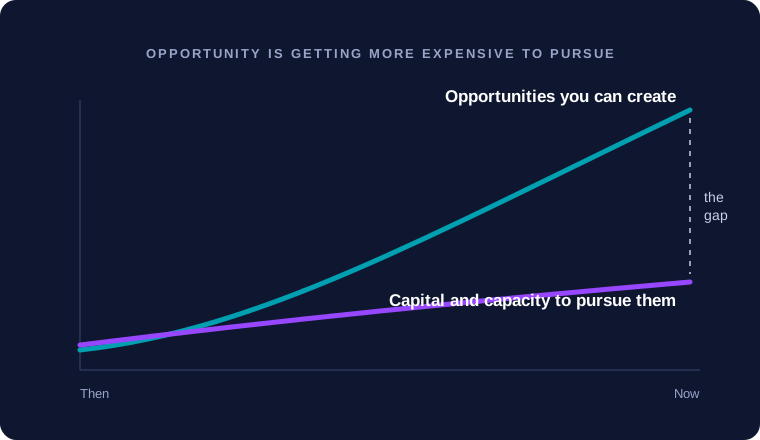
The gut feel: opportunity is getting more expensive to pursue
There’s an interesting contradiction in this week’s headlines.
Technology continues to make new opportunities possible at extraordinary speed. Yet many of the organizations pursuing those opportunities face increasingly difficult questions about financing, implementation, customer adoption, and sustainable economics.
AI infrastructure providers are confronting the capital intensity of their expansion. Professional communities are reconsidering how they fund their missions. Industrial companies are exploring what it will take to put AI into physical operations.
These are different challenges, but they share a common characteristic: the resources and capabilities required to realize an opportunity are becoming as strategically important as the opportunity itself.
A related example came from McDonald’s recent earnings discussion, in which the company acknowledged that an overloaded promotional calendar contributed to operational difficulties. Multiple individually attractive growth initiatives created demands that restaurant teams struggled to absorb.
The point extends well beyond restaurants. Organizations can identify more opportunities than they have the capacity to execute well.
For leaders, this suggests a growing need to evaluate commercial opportunities through a wider lens. Market attractiveness remains important, but so do capital requirements, customer readiness, organizational capacity, and the dependencies that determine how quickly value can be realized.
The ability to develop an idea, launch a product, or enter a new market is only one part of the commercial equation.
On Eudai this week
Our latest articles explore several dimensions of this challenge:
- Why Good Technology Struggles to Become a Market: The conditions required to turn technological capability into customer adoption and sustainable revenue.
- Market Creation Starts Before Demand Generation: Why developing demand in emerging markets requires more than generating awareness and leads.
- When More Marketing Creates Less Growth: What McDonald’s experience reveals about organizational capacity and the cumulative cost of commercial initiatives.
- Expand Your Creative Surface: How broader experiences, perspectives, and connections improve the quality of the ideas and opportunities we recognize.
One thing worth thinking about
We’re entering a period when the ability to create new possibilities may be growing faster than the resources available to pursue them.
That makes judgment, prioritization, and commercial capability increasingly important.
The question for organizations is how to identify the opportunities they can turn into meaningful and sustainable value.